

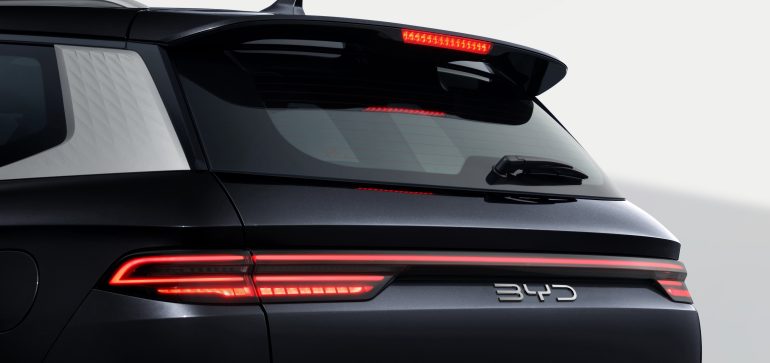
Electric cars have become symbols of progress, but in South Africa, progress still needs a plug and a backup plan. The BYD Sea Lion 5, arriving this November, is built for that reality — a plug-in hybrid that doesn’t see compromise as a flaw, but as a feature of intelligent design. It’s a glimpse of how technology can adapt to context rather than demand that context change first.
For BYD, the world’s leading new-energy company, the Sea Lion 5 represents far more than a model launch. It’s the next move in a deliberate strategy to link mobility with energy, to show how cars, batteries, and solar infrastructure can work as part of a single ecosystem. “We’re not just a car manufacturer,” says Nomonde Kweyi, marketing director at BYD Auto South Africa. “We’re a technology company focused on creating a cleaner, smarter future.”
Hybrid thinking
Built on BYD’s DMI (Dual-Mode Intelligent) platform, the Sea Lion 5 merges electric and combustion power in ways that make sense for South African roads — and households. It can run purely electric for shorter urban commutes, then shift seamlessly to petrol when longer range is needed. It’s a subtle but important proposition: a car that understands the local infrastructure rather than waiting for it to catch up.
In that sense, the Sea Lion 5 might be less about transition and more about translation — translating advanced EV tech into a format that aligns with how South Africans actually drive.
A system, not just a car
What sets BYD apart isn’t just its growing lineup — which now includes the Dolphin Surf, Seal, and Shark 6 — but its view of the car as a node in a much larger network. With more than 120,000 R&D engineers and around 50 patents filed daily, BYD operates like an energy company disguised as an automaker. Its technologies span solar generation, battery storage, and electric mobility, designed to function together in what the brand calls a “new-energy ecosystem.”
Steve Chang, BYD South Africa’s managing director, calls the Sea Lion 5 “a pivotal moment” for that vision. “We’re moving from fleet operations to family driveways,” he says. “The goal is to create technology that connects mobility with solar and storage — giving South Africans a real sense of energy independence.”
That concept — independence — has particular resonance here. The Sea Lion 5 fits into a broader shift toward distributed energy, where households generate and manage their own power. For BYD, selling a hybrid SUV is simply one layer of a far more ambitious equation.
Designed for the everyday
Beyond its systems and acronyms, the Sea Lion 5 is also an object of thoughtful design. Its proportions are confident without being aggressive, its surfaces taut and aerodynamic. Inside, the cabin balances warmth and tech: a panoramic sunroof, keyless entry, wireless charging, an intuitive voice assistant, and a large infotainment screen that feels more integrated than imposed.
This isn’t luxury in the traditional sense — it’s functional intelligence. Every feature appears to exist because it solves something, not because it could. It’s a philosophy that aligns with BYD’s Blade Battery, a benchmark in safety and durability, and the quiet foundation of the company’s new “Super Hybrid” generation.
Beyond the grid
South Africa’s energy conversation has become defined by what doesn’t work. BYD’s counterpoint is a system that can. As the cost of imported fuel rises and solar adoption accelerates, vehicles like the Sea Lion 5 could become connectors — bridging the once-separate worlds of energy, transport, and technology.
The company’s long-term commitment, underscored by recent visits from BYD executive vice president Stella Li, includes investment in local partnerships, charging infrastructure, and skills development. In other words, this isn’t a symbolic launch. It’s a sign that the world’s biggest new-energy player is taking South Africa seriously.
A different kind of optimism
The BYD Sea Lion 5 isn’t trying to be a saviour — it’s trying to be sensible. In a market where full electrification still feels aspirational, this plug-in hybrid offers something more grounded: a new kind of optimism, powered by technology that meets reality halfway.
When it arrives in November, the Sea Lion 5 won’t just be a car to test-drive. It’ll be a quiet test of how ready South Africans are to plug into a smarter, cleaner energy future.