The post Africa’s Developer Growth Has a Retention Problem Nobody Wants to Name appeared first on Reframed.
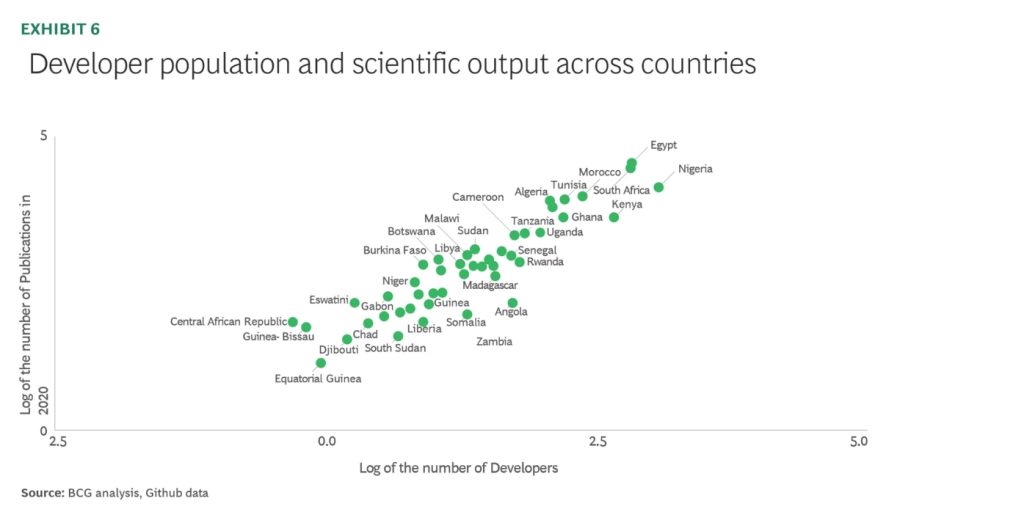
]]>Boston Consulting Group’s latest report, released this week, lands with a headline figure that deserves attention: Africa’s developer community expanded at 21% annually between 2019 and 2024, faster than any other continent. With 4.7 million developers on the continent today, compared to Asia’s 73.9 million and Europe’s 27.5 million, the gap is enormous. But the direction of travel is real. BCG’s analysis points to structural shifts, not just a cyclical blip: a young population, expanding urban tech hubs, rising digital access, and deliberate national policy investment converging in countries like Tunisia, Kenya, Morocco, and Rwanda.
Those are good numbers and an honest characterisation of momentum. The problem isn’t that the report is wrong. It’s that the report is carefully, strategically incomplete.
A familiar genre with a new data set
The “Africa Rising” consulting report has been a category since at least 2010. McKinsey, the World Economic Forum, Brookings, and now BCG in Casablanca have all produced versions of the same essential document: confident optimism about African potential, structured around youth demographics, growth rates, and a policy prescription for governments willing to invest. The BCG report fits the template precisely. It celebrates speed, flags the gender gap as the critical differentiator, and closes with a quote about long-term national competitiveness. What it doesn’t do is interrogate the structural obstacles that these same analysts observe elsewhere on the continent.
Durable tech ecosystems require aligned capital, mentorship, policy support, and talent pipelines working in combination, not just one at a time, as the Africa Bridge Fund’s approach to ecosystem building shows. The BCG report identifies the same ingredients. It just doesn’t spend much time on what happens when they’re absent.
What the numbers don’t tell you
South Africa is listed as one of Africa’s three largest developer hubs by absolute numbers, alongside Nigeria and Egypt. That positioning is accurate. What it obscures is that South Africa is simultaneously haemorrhaging the very talent that makes it a hub.
Xpatweb’s Critical Skills Survey found that 22% of South African companies couldn’t fill ICT specialist roles in 2025, up sharply from 14% the year before. Software developers, data scientists, and AI engineers are among the most in-demand and most emigration-prone profiles in the country. The developers BCG counts in the 4.7 million figure are increasingly working for international clients, building products that are designed, owned, and monetised offshore. The growth rate is real. Whether the economic value of that growth stays on the continent is a different question, and it’s one the report doesn’t ask.
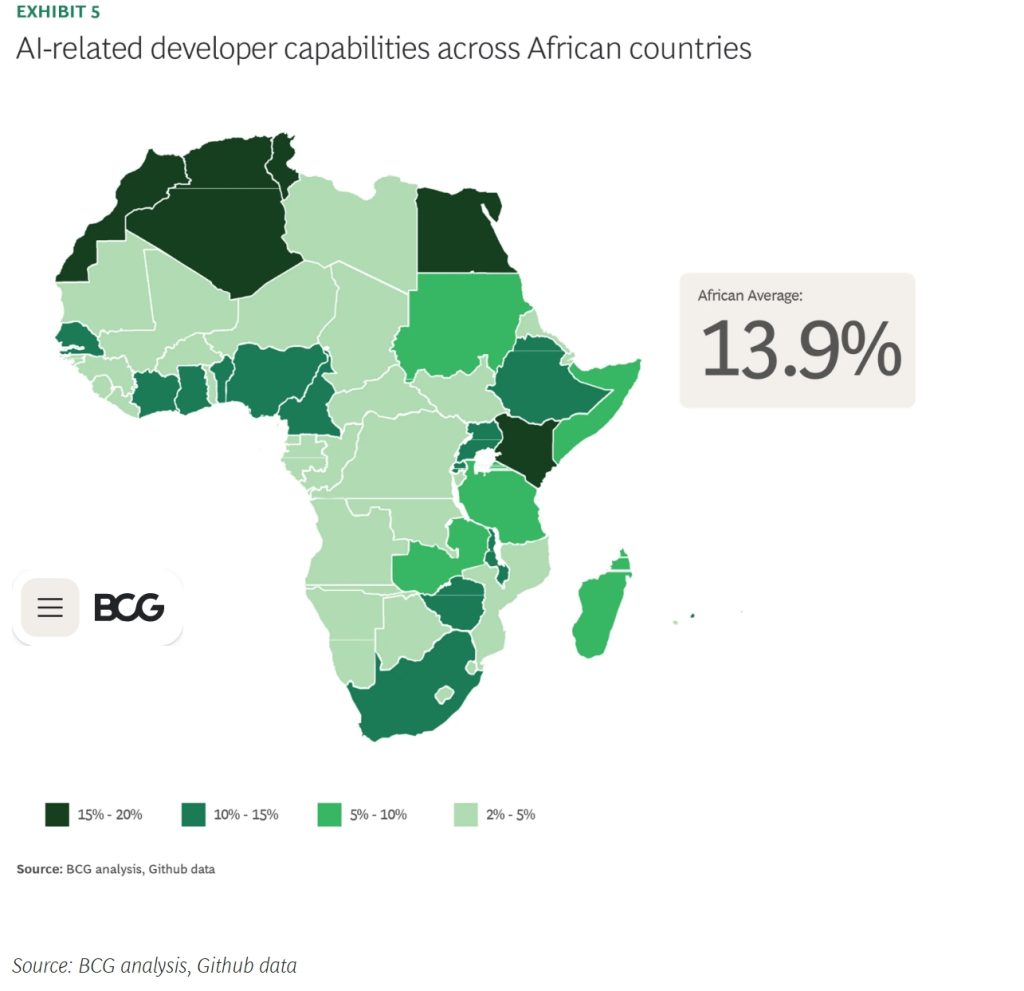
OfferZen’s 2025 State of the Software Developer Nation report noted that the share of South African developers identifying as women rose from 18% to 22% in the past year. That’s modest progress on the gender front. It also tells you that South Africa’s data doesn’t match the continental average BCG uses when citing the gender gap as Africa’s single most powerful untapped lever. Tunisia, which leads Africa at 24% women developers, achieved that through a decade of sustained policy effort. The comparison matters because it suggests the gap is closeable, but it doesn’t tell you how long that takes or what it costs in a country where 57% of young people aren’t in employment, education, or training.
The AI disruption nobody wants to mention
BCG’s report drops in the middle of an accelerating global conversation about AI and developer jobs. Tools like GitHub Copilot, Cursor, and others are already reshaping what junior developers are expected to do, and compressing the time it takes experienced developers to do it. The global demand for entry-level development work is contracting in mature markets even as Africa’s entry-level developer supply is expanding.
This isn’t an argument that Africa’s growth is futile. It’s an argument that the window for that growth to translate into structural economic advantage may be shorter than a consulting report calibrated for government audiences would suggest. A continent that builds its developer base over the next decade into a role that AI is actively automating isn’t automatically better positioned. It depends entirely on what kind of development work those developers are doing, what infrastructure they’re working on, and whether local companies exist to employ them.
The BCG report mentions AI once, in the conclusion, as a growth opportunity. That’s not the only way to characterise what AI represents for a continent whose developer growth story is largely built around volume.
The gender gap is real. The framing is safe.
The report’s most detailed and data-rich section covers gender inclusion, and it’s not wrong to focus there. Tunisia’s progress to 24% women developers is evidence that intentional policy works. Morocco’s lag below 14% despite a larger and faster-growing ecosystem is a genuine strategic failure worth naming. Rwanda and Kenya outperforming far larger markets on gender inclusion reinforces that scale isn’t destiny.
But gender inclusion is also the framing choice that carries the least risk for a consulting firm whose clients are governments and multinationals. It’s progressive enough to signal values, structural enough to justify programme spending, and far enough from the harder political economy questions (brain drain, currency disadvantage, data costs, energy instability) to avoid creating friction in any boardroom. The BCG report is technically right that closing the gender gap is one of Africa’s highest-leverage moves. It’s also choosing to talk about that lever because the conversation around it is palatable.
What the report is really doing
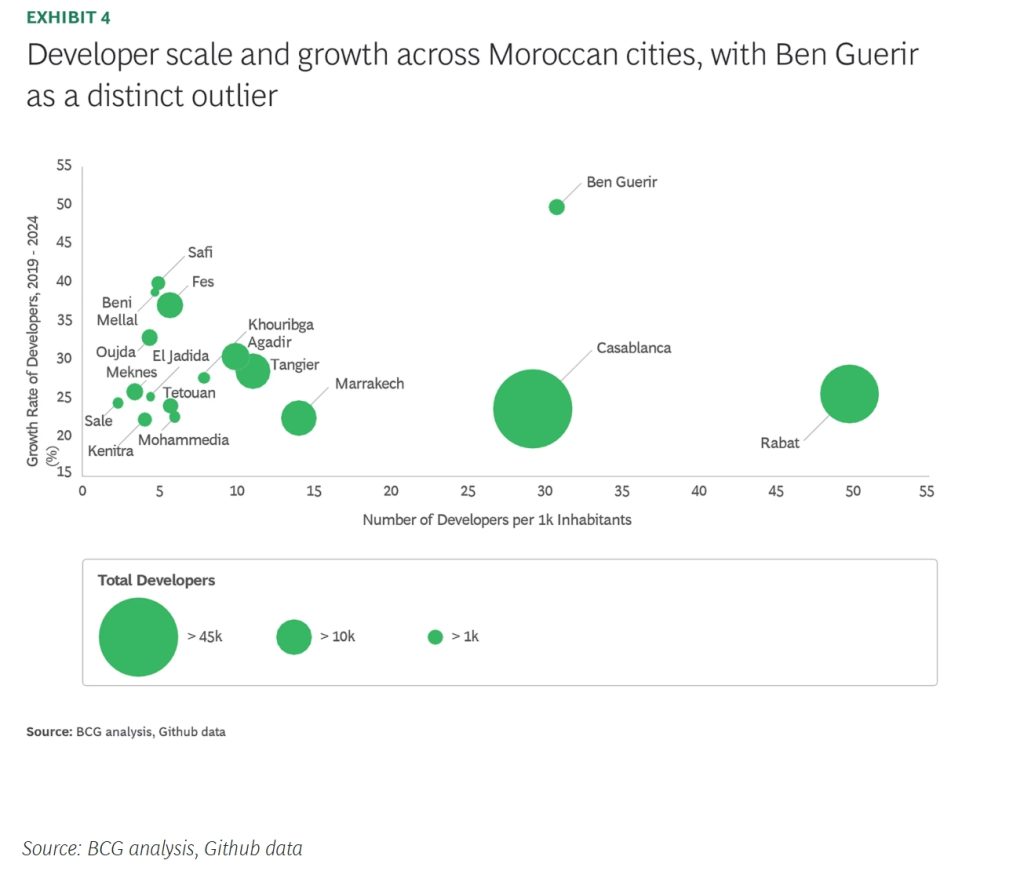
BCG’s Casablanca office, home to the team behind this report, is well-positioned commercially. Morocco features prominently in the analysis, with Ben Guerir cited as expanding its developer community fiftyfold in a decade. That’s a genuine story. It’s also the story of a country where BCG is actively involved in advisory work. The report isn’t a neutral piece of research. It’s a market-positioning document from a consulting firm establishing authority in a geography it wants to grow. That doesn’t make the data wrong. It does explain the frame.
The consistent emphasis on “intentional policy choices” as the driver of success isn’t incidental. That framing is a direct pitch to the governments, development banks, and multinationals who would hire BCG to design those policies. Africa’s developer growth, in this telling, is an argument for advisory services as much as it is a description of a phenomenon.
South Africa’s specific contradiction
For South Africa specifically, the BCG report lands at a useful moment of tension. Energy stability has improved significantly: only 26 hours of load shedding in 2025, with 230 consecutive days of uninterrupted supply by January 2026. That represents a structural shift from the years that gutted productivity and accelerated emigration. But Eskom’s medium-term outlook still flags a 9.5 gigawatt supply gap by 2029 to 2030, with coal retirements and contract expirations likely to strain the grid again. The improvement is real. The resolution isn’t.
South Africa also sits 61st globally on the 2025 Global Innovation Index, ranking strongly on education expenditure and market capitalisation while collapsing on knowledge and technology outputs. The country spends on education but doesn’t yet convert that spending into research, high-tech exports, or commercial innovation at scale. BCG’s prescription, more policy alignment and ecosystem investment, isn’t wrong. But it describes a transformation that requires sustained political will and institutional consistency that South Africa has historically found difficult to maintain.
The real story
Africa’s developer growth is one of the more consequential technology trends of the coming decade. A 21% annual growth rate, sustained across five years and grounded in structural demographic and policy shifts, isn’t a rounding error. Tunisia’s gender inclusion gains prove the gap isn’t fixed. The countries that invest deliberately are genuinely pulling ahead.
But a growth rate isn’t a guarantee. The BCG report is better at celebrating the headline than at reckoning with the conditions that determine whether that growth becomes durable economic value: where developers are actually working, what they’re building, who captures the upside, and what AI compression does to the category they’re being trained to enter. Those are harder questions. They’re also the ones that matter most for the countries that need this moment to count.
Growth without retention is participation in someone else’s economy. Africa’s developer community deserves a more complete account of what it’s building towards.
The post Africa’s Developer Growth Has a Retention Problem Nobody Wants to Name appeared first on Reframed.
]]>The post Who gets left behind in the race for progress? appeared first on Reframed.
]]>It was about his mother’s friend. She needed a new phone. Nothing complicated. She didn’t want to scroll TikTok or video-call five people at once. She only wanted to call, text, and send the occasional WhatsApp message to her family and friends. That was it.
My friend found an old Nokia feature phone running KaiOS — one of the so-called “smart” feature phones that had seemed, briefly, like a bridge between two worlds. Calls, SMS, WhatsApp. Simple. Familiar.
The mobile network helped swap her old micro SIM for a nano SIM. Everything was set up, eventually. But by the time they were ready, they discovered WhatsApp no longer supported her device. An app that had become, for her, a lifeline to family and friends, was now simply inaccessible. The bridge had quietly collapsed.
It’s a small story. Perhaps even an inevitable one. But it reveals something disquieting when you sit with it long enough: a sense that the very people who most need stability — the elderly, the differently abled, the rural and marginalised — are often the first to be abandoned by the forward march of technology.
Who, exactly, is it convenient for?
In theory, we have never had it easier. Services are digitised, automated, optimised. But “ease” is a slippery word. Convenience often isn’t about making life easier for everyone. It’s about making life cheaper, faster, more profitable for those at the top of the chain. And those who fall outside the narrow profile of “the ideal user” — young, urban, digitally fluent, permanently online — are left to scramble for workarounds.
You don’t have to dig far to see this playing out. According to Pew Research, the new “normal” post-2025 is predicted to be “far more tech-driven,” but alongside the promises of better efficiency and broader access, experts warn of widening gaps: between urban and rural, young and old, wealthy and struggling. The McKinsey Technology Council, too, in its top trends in tech, notes the accelerating pace of innovation — but rarely pauses to ask who struggles to keep up.
The gap isn’t just economic. It’s emotional. Psychological. A growing sense, voiced quietly in conversations and forums and call-in shows, that technology isn’t something we adopt but something that happens to us. That if you stop moving — even for a year, a month — you might not find your way back.
Profit or empowerment?
We’re sold a particular mythology of innovation: that every new wave of technology lifts all boats, that disruption is ultimately good, that obsolescence is just the cost of progress. But who decides what progress looks like?
In 2025, despite all the promises, 5G has not revolutionised everyday life in the way it was marketed to. Coverage remains patchy. Speed differences, outside major metros, are marginal for most users. Yet the need to buy 5G-capable devices, to stay “current,” has been baked into the upgrade cycle. The cost, financial and environmental, is quietly passed down to consumers.
It’s a pattern repeating now with AI. The noise is deafening. Every sector — especially creative industries — is being “disrupted”. Jobs are shifting or disappearing. Tools are proliferating faster than anyone can track. AI is pitched as the great equaliser, yet those without access to powerful devices, high-speed connectivity, and specialised digital literacy are once again left behind.
Data from Experian shows that even as digital services expand, around 75 million people globally are still “being left behind” in the tech revolution. In South Africa, the State of the ICT Sector Report (ICASA, 2025) reveals that while smartphone penetration is growing, it remains far from universal. And beneath the surface, issues like digital literacy, affordability, and infrastructural inequality tell a more complicated story.
The myth of choice
Black Mirror’s “Common People” episode imagined a world where life itself was a series of mandatory subscriptions. Watching it, it was hard not to flinch. The fiction wasn’t that distant from reality. The illusion of choice in tech is just that: an illusion.
Yes, you can choose not to use the major monopolistic platforms — in theory. But the alternatives are often clunky, obscure, less reliable. They require more technical skill. They don’t integrate seamlessly into the systems our work and social lives increasingly depend on.
Meanwhile, convenience is marketed as the ultimate luxury. The value proposition isn’t “this will free your time for what matters” — it’s “this will ensure you won’t be left behind.”
When opting out isn’t really an option
Even when alternatives are available, take-up is sparse. We often think, surely there are others like me who want smaller, simpler devices. More ethical platforms. Less intrusive technology. But when the market responds, uptake is often low.
It’s easy to overestimate how representative our circles are. Echo chambers, even offline ones, trick us into thinking there’s a bigger movement than there is. When it comes time to “vote with your wallet,” inertia often wins. Convenience wins. Marketing wins.
Take the iPhone Mini for example, beloved by tech critics and a vocal minority of users, was ultimately a commercial failure. Apple cancelled it after disappointing sales. A stark reminder that big talk about wanting alternatives doesn’t always translate into mass behaviour.
Invisible biases, invisible exclusions
It would be comforting to think this is purely about money. That if enough demand existed, companies would meet it. But there’s a deeper layer: who gets considered in the design process.
For too long, the “average user” has been imagined as young, able-bodied, urban, and Western. Biases in AI models are well-documented — models trained on data that excludes, marginalises, or caricatures whole segments of the human experience.
Hardware design follows the same patterns. Devices are made thinner, smaller, sleeker — and harder to hold for people with motor impairments. Interfaces are optimised for eyes that aren’t ageing. Updates assume a baseline of digital fluency that isn’t universal.
Reports like those from the UNDP and World Economic Forum call for more “inclusive tech,” but the urgency often feels abstract. Meanwhile, those struggling are left to patch together solutions on their own. An extra app to make text bigger. A clunky workaround to keep an old service alive. The mental load quietly rises.
Who is innovation for?
I don’t expect companies to turn into charity organisations. They exist to make profit. That isn’t new. But if we’re going to keep punting innovation as an unequivocal good, we should ask harder questions.
Good for whom?
The small story of my friend’s mother’s friend may seem trivial. In the sweep of things, one woman losing WhatsApp access doesn’t register on corporate earnings calls. But it’s not about the one case. It’s about the pattern it belongs to. The creeping sense that as we digitise more and more of life, those who aren’t “ideal users” are treated as expendable.
And when DEI initiatives — already fragile — are quietly shelved under the rhetoric of “efficiency” or “post-woke” fatigue, it’s hard to see how this will reverse.
Sitting with the discomfort
There’s no neat ending here. No grand call to action. The reality is messier than that.
Most of us, even when uneasy, are complicit. We accept the latest updates. We buy the new models. We adjust to the new normal, then the next one.
But perhaps it’s worth lingering, however briefly, with the stories that don’t make the headlines. With the woman who simply wanted to send a WhatsApp. With the invisible mental load carried by those trying to navigate interfaces not built for them. With the possibility that “progress,” when unexamined, can leave just as many behind as it claims to uplift.
Perhaps it’s enough, for now, to resist the temptation to tie a bow around it. To stay uneasy. To notice who is missing from the future we’re rushing to build, because when people are left behind quietly enough, for long enough, we begin to forget they were ever meant to be included at all.
The post Who gets left behind in the race for progress? appeared first on Reframed.
]]>