
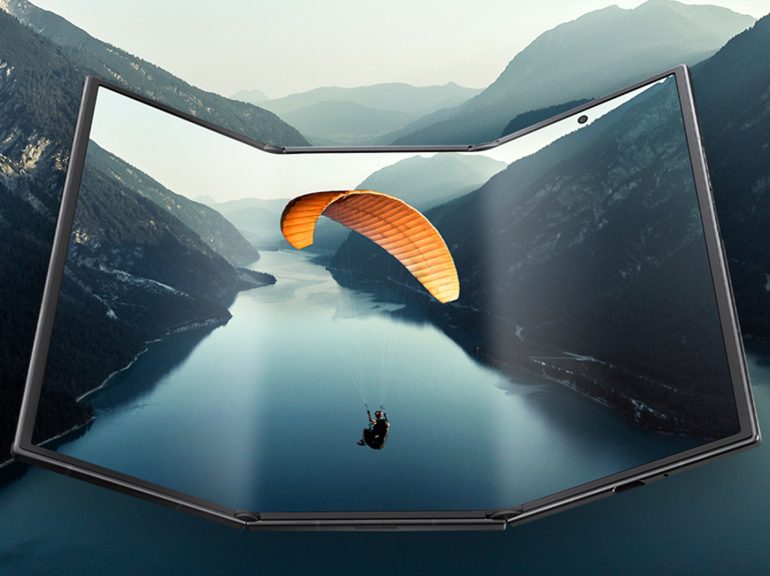
Samsung’s just announced the Galaxy Z TriFold, and the marketing language is precisely what you’d expect: leadership, mastery, boundaries expanded, possibilities shaped. It’s a 10-inch foldable that folds twice, measures 3.9mm at its thinnest point, and runs standalone Samsung DeX for a proper desktop experience. On paper, it’s impressive. In context, it’s late.
Huawei launched the Mate XT, the world’s first commercially available trifold smartphone, in September 2024. It went on sale in China, generated over three million preorders, and then quietly arrived in South Africa in April 2025 for R69,999. The device isn’t perfect, but it exists, it’s shipping, and people are buying it. Samsung’s now entering a category where someone else proved the concept, absorbed the engineering risk, and weathered the pricing critique.
That doesn’t mean the Galaxy Z TriFold isn’t interesting. It’s just not first.
The device folds inward twice, protecting the main screen when closed. Samsung calls this a “multi-folding form factor” with “precisely engineered” hinges and an auto-alarm system that vibrates and alerts you if you’re folding it wrong. The 10-inch display when fully open is the largest Samsung’s ever put on a phone. Folded, it’s a 6.5-inch device with a 21:9 cover screen. The whole package weighs 309 grams and runs on the Snapdragon 8 Elite chipset with 16GB of RAM, a 200MP main camera, and a 5,600mAh battery split across three cells.
It’s also the first Samsung phone with standalone DeX, which means you can run up to four workspaces simultaneously, each with five apps open. Add a second screen via Extended Mode, and you’ve got a dual-display desktop setup that fits in your pocket. It’s a compelling pitch for people who actually want to work on their phones, not just pretend to.
But here’s where the comparison gets uncomfortable. The Huawei Mate XT also unfolds to 10.2 inches, uses a Z-shaped fold pattern, and weighs 298 grams. It launched 15 months before Samsung’s version. It’s available in South Africa through Huawei’s official stores, Vodacom, and other retailers, and there’s even a successor, the Mate XTs, which Huawei released in China earlier this year. More importantly, the Mate XT and XTs offer three usable modes: a standard phone, a dual-screen configuration, and a full tablet. The Galaxy Z TriFold only works as either a single-display phone (looking much like the Fold 7) or as a full 10-inch tablet. There’s no dual-screen middle ground. Samsung isn’t pioneering trifolds. It’s productising them, and leaving out flexibility in the process.
The Galaxy Z TriFold will likely benefit from Samsung’s years of foldable refinement, but it’s worth remembering that Huawei’s been making foldables just as long. The original Mate X launched in 2019 with an outward-folding design that Samsung never attempted. Since then, Huawei’s produced book-style folds, clamshells, trifolds, and even the Pura X — a sideways-opening clamshell with a 16:10 aspect ratio that’s become unexpectedly popular online. Samsung’s largely stuck to iterating the same two form factors. Huawei’s even preparing a global launch for the Mate X7, which suggests it’s not treating foldables as a regional experiment anymore.
What Samsung does have is stronger positioning in markets where Huawei’s been sanctioned or sidelined, and an ecosystem that integrates more seamlessly with Western services. But the narrative that Samsung’s foldables are automatically superior because of “institutional knowledge” doesn’t hold up when Huawei’s been just as aggressive with experimentation and has actually shipped more varied designs.
TM Roh, Samsung’s mobile chief, claims the Galaxy Z TriFold “solves one of the mobile industry’s longest-standing challenges” by balancing portability, performance, and productivity. That’s a generous reading. What it actually does is add another screen size option to the foldable lineup, with all the trade-offs that entails: higher cost, more fragile hardware, and a use case that’s still searching for mainstream appeal.
The device supports multi-window workflows, photo editing with side-by-side comparisons, and Gemini Live with multimodal AI that understands what you’re looking at. There’s a 200MP camera with 3x optical zoom, 45W fast charging, and an IP48 rating that protects against water but not dust or sand. It’s rated for submersion in 1.5 metres of freshwater for 30 minutes, which is better than nothing but hardly reassuring for a device this expensive.
Samsung hasn’t announced pricing yet, but if the Huawei Mate XT costs R70,000 in South Africa, expect the Galaxy Z TriFold to land somewhere in that range or higher. That puts it in the same territory as high-end laptops, and the value proposition becomes harder to justify. Yes, it’s portable. Yes, it runs desktop software. But so does a laptop, and you don’t have to worry about folding it incorrectly.
The trifold category is still experimental, and Samsung’s entry legitimises it in a way Huawei’s couldn’t, at least in markets where brand perception matters. But it also highlights how much of Samsung’s “innovation” narrative is really about execution and timing. The Galaxy Z TriFold isn’t revolutionary. It’s iterative, risk-averse, and arriving after someone else took the leap.
That’s not necessarily a criticism. Samsung did pioneer the modern foldable category, but its strength has always been in refinement and scale rather than constant reinvention. The Galaxy Z Fold series proved that. The question is whether trifolds will follow the same trajectory, or whether they’ll remain a curiosity for people with more money than use cases.
For now, the Galaxy Z TriFold is a statement piece. It shows Samsung can build a trifold, that it can integrate DeX into a foldable, and that it’s still willing to push hardware boundaries when the margins justify it. But it doesn’t solve any problems that weren’t already solved, and it doesn’t make foldables any more necessary than they were when the Z Fold 6, or the Z Fold 7, launched.
It’s just another way to spend money on a phone that folds. Twice.