
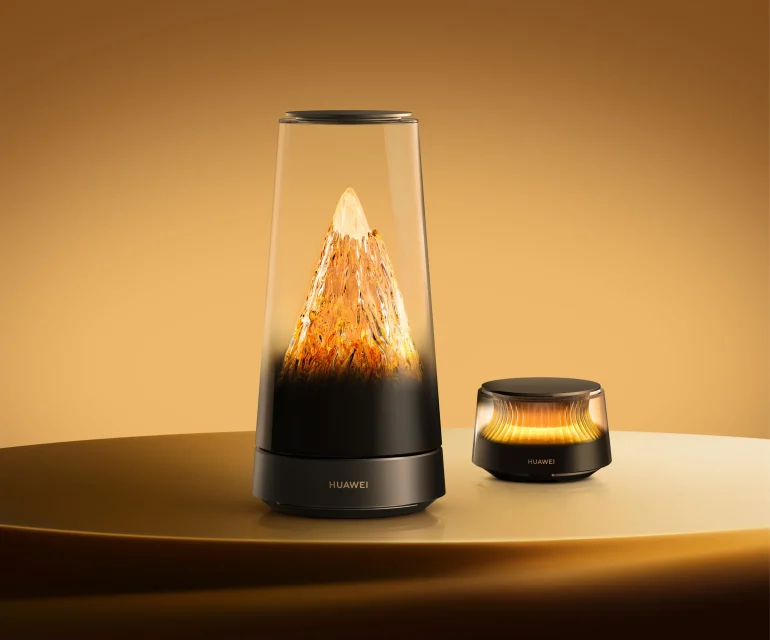
Huawei’s just unveiled the WiFi Mesh X3 Pro in Dubai, and it’s trying very hard to be something more than just another router tucked behind the TV cabinet. The device launched alongside the Mate X7 at Atlantis The Royal, complete with what Huawei’s calling a “Golden Mountain” design that’s meant to evoke snow-capped peaks at sunrise. It glows, it dims, it has colour temperature controls. It’s a router that wants you to know it’s there.
The aesthetic ambition is backed by what’s described as an industry-first transparent antenna system. Instead of the usual black plastic fins jutting out at angles, Huawei’s gone for something that’s supposedly invisible in form whilst still beaming out signal. The design includes adjustable ambient lighting controlled through the HUAWEI AI Life app, where users can set brightness, colour temperature, and timers. It’s meant to blend into different décor styles, though whether anyone’s been asking for a router that doubles as mood lighting is another matter entirely.
Underneath the glow-up, there’s Wi-Fi 7 technology delivering theoretical speeds of 3.6 Gbps across dual bands: 688 Mbps on 2.4 GHz and 2882 Mbps on 5 GHz. The specs show support for MLO (Multi-Link Operation), 4K-QAM, and Multi-RUs, which in practical terms means higher throughput and lower latency when you’re actually using devices that support these standards. The catch, as always, is that real-world performance will depend heavily on your environment, your devices, and how many walls are in the way.
The system’s built around Huawei’s mesh philosophy: one main router and multiple extenders creating a unified network across larger homes. The company promises seamless roaming with sub-50ms latency when moving between access points, plus quad signal amplifiers in each unit. There’s also a Game Turbo feature that claims to reduce gaming latency by 37% by recognising over 90 games and creating a dedicated fast lane, though these figures come from Huawei’s own testing and the feature’s only supported in certain regions.
On the cooling front, Huawei’s included what it’s calling “shark fin fans” with a dual air vent system. Routers don’t typically get much attention for their thermal management, but Wi-Fi 7’s higher power requirements make it relevant. The device also packs HUAWEI HomeSec for network security, including Wi-Fi encryption and anti-brute force protections, along with parental controls that let you set time limits and block specific content categories.
The master router measures 250.9mm tall with a 123.2mm diameter and weighs about 790g, whilst the extenders are smaller at 73.5mm tall and 420g. Both units come with 512MB of RAM and 128MB of internal storage, which is standard for this category. The main router has two network ports that support speeds up to 2.5 Gbps and can adapt between WAN and LAN functions, whilst extenders get a single gigabit port.
What’s less clear is whether any of this is coming to South Africa. Huawei’s been inconsistent with router launches locally, and whilst the company’s expanded its portfolio in the region with devices like the nova 14 series and FreeBuds 6, there’s been no confirmation on the WiFi Mesh X3 Pro’s availability here.
The design approach isn’t as eccentric as it first appears. Huawei’s joining a broader movement where tech companies have realised that devices don’t need to apologise for existing in your living space. Samsung’s been doing it with the Frame TV and Music Frame speaker, IKEA and Sonos have built an entire partnership around the Symfonisk range that disguises speakers as lamps and picture frames, and TCL’s pushing “home artification” with its NXTFRAME TVs. Even Motorola’s putting Swarovski crystals on phones and earbuds now.
The thread connecting all of this: as homes get smaller and open-plan living becomes standard, there’s nowhere left to hide the tech. So manufacturers are leaning into visibility instead, positioning routers, TVs, and speakers as intentional design choices rather than necessary evils. For decades, the industry convinced us that the best tech should be invisible. Now it’s betting that we’d rather it be beautiful.
Whether South African consumers will get the chance to decide if they want a glowing mountain on their side table remains to be seen. Huawei’s router availability here has been patchy, and there’s been no confirmation yet on local plans for the WiFi Mesh X3 Pro. But if this design-first approach gains traction globally, expect more networking gear that’s as concerned with ambient lighting as it is with antenna gain.