
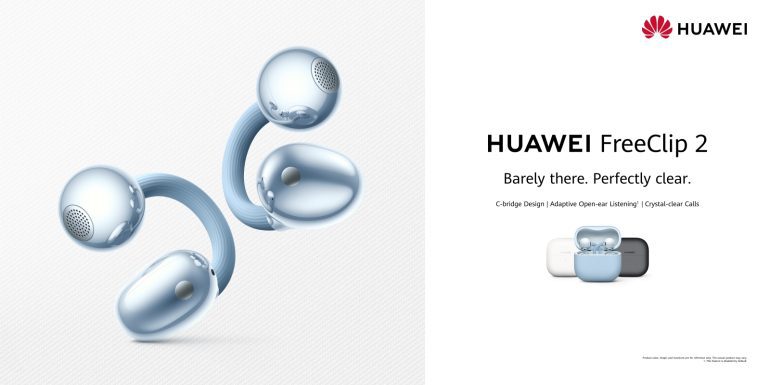
Huawei’s just-announced FreeClip 2 arrives roughly a year after the original FreeClip made its peculiar C-bridge design a thing people might actually wear in public. The new model landed in Dubai earlier today at an event that also showcased the Mate X7 and other devices, and it’s expected to reach South African shelves sometime in 2026.
At first glance, the FreeClip 2 looks like a mild refresh. Same unusual clip-on form factor, same open-ear philosophy, same promise that you’ll stay aware of your surroundings whilst listening to music or podcasts. But the changes, whilst incremental, add up to something more substantial than a spec bump.
The most obvious improvement is weight. Each FreeClip 2 earbud now weighs 5.1g, down from 5.6g in the original FreeClip. That’s about a 9% reduction, which sounds negligible until you remember these things clip onto your ear rather than sitting inside it. Every fraction of a gram counts when gravity’s working against you all day.
Huawei’s also made the C-bridge 25% softer by switching to liquid silicone mixed with the same shape-memory alloy used in the first model. The original relied solely on Ni-Ti alloy, which was durable but less forgiving. The Comfort Bean (Huawei’s name for the bit that sits in your concha) is now 11% smaller, based on data from over 10,000 ear samples. The charging case has shrunk too: 17% narrower and 14% lighter than before.
Then there’s the processing power. The FreeClip 2 includes what Huawei calls an NPU AI processor, which the company claims delivers 10 times more computing power than the original. That’s a vague metric, but it enables two new features: adaptive volume and adaptive voice enhancement. The first adjusts playback volume based on ambient noise, whilst the second boosts vocal clarity in podcasts and audiobooks depending on your environment. Both are disabled by default and live in the experimental features section of Huawei’s Audio Connect app.
The driver setup remains a 10.8mm unit in both models, but the FreeClip 2 uses a dual-diaphragm configuration that Huawei says produces 100% stronger volume and air displacement. The original had a dual-magnet high-sensitivity driver. It’s a different acoustic approach, though without lab measurements, it’s hard to say how audible the difference actually is.
Water resistance has improved from IP54 on the original FreeClip to IP57 on the FreeClip 2’s earbuds. That’s a meaningful jump: IP54 protects against splashes, whilst IP57 can handle immersion in up to one metre of water for 30 minutes. The charging case gets IP54 on the new model, whilst the original’s case had no rating at all.
Battery life inches up slightly. The FreeClip 2 offers nine hours of playback per charge (up from eight hours) and 38 hours total with the case (versus 36 hours). Voice calling gets six hours on the new model compared to an unspecified duration on the original. Fast charging remains: 10 minutes gives you three hours of listening on both models.
Gesture controls have expanded. The original let you double-tap to play/pause or answer calls, and triple-tap to skip tracks. The FreeClip 2 adds swipe gestures for volume control and introduces head motion controls, where you can nod to accept or shake to reject calls. Both features need to be enabled manually.
Bluetooth gets a version bump from an unspecified standard on the original (likely 5.2 or 5.3) to Bluetooth 6.0 on the FreeClip 2. That matters less for consumer features and more for potential efficiency gains and better multi-device handling. Speaking of which, dual-device connections work the same on both models, letting you pair with two devices simultaneously across iOS, Android, and Windows.
The three-microphone call noise cancellation system carries over from the original, though Huawei’s marketing materials emphasise the FreeClip 2’s multi-channel DNN algorithms more prominently. It’s unclear if the processing has genuinely improved or if it’s just fresher copy.
Colour options shift between generations. The original FreeClip came in Purple, Black, Rose Gold, and Beige. The FreeClip 2 drops the warmer tones for Blue, White, and Black. The new Blue and White cases feature a denim texture created through high-precision infrared scanning of actual denim fabric, replicated at a microscopic level. It’s a nice tactile detail that makes the case feel less plasticky.
One notable addition: the FreeClip 2 includes sensors the original lacked, specifically a gyroscope and accelerometer integrated unit alongside the bone acoustic sensor. These enable the head motion controls and likely feed data to the adaptive audio features.
The original FreeClip launched at a time when open-ear designs were still trying to prove they weren’t just a gimmick for runners who needed to hear traffic. A year later, that format’s become more accepted, and the FreeClip 2 refines the concept rather than reinventing it.