

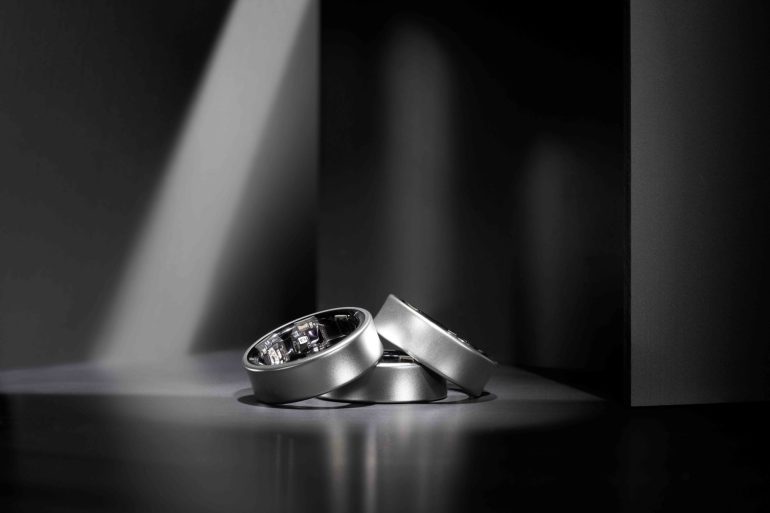
There’s something peculiar about a companion device that costs as much as the thing it’s meant to complement while doing considerably less. Samsung’s Galaxy Ring costs R7,999 in South Africa, and it’s been sitting on my finger since September 2025. The titanium silver version, specifically. It’s an elegant little thing, but elegance doesn’t answer the more obvious question: why wouldn’t you just buy a Galaxy Watch?
The Galaxy Ring is Samsung’s first serious attempt at shrinking health tracking down to jewellery size. It’s a titanium band with three sensors inside, a battery that lasts nearly a week, and absolutely zero buttons. No screen. No notifications. Just quiet data collection feeding into Samsung Health. If you’ve been following the wearables space, you’ll know Samsung isn’t the first to do this, but they’re the first to do it at scale in South Africa.
What you’re actually getting
The Ring itself is well-made in that obvious, Samsung-does-premium-hardware way. At 2.6mm thick and weighing between 2.3g and 3.3g (depending on size), it’s chunkier than a regular ring but not obnoxiously so. IP68 rating, 10ATM water resistance. It’ll survive showers, swimming pools, and the occasional drop into soapy dishwater. I had to visit a Samsung store to try on the sizing kit before committing, which was smart on their part. Ring sizing isn’t like watch sizing. Get it wrong and you’ve got an expensive desk ornament.
Inside that titanium shell: an accelerometer, an optical heart rate sensor, and a skin temperature sensor. Battery life sits at around six days for my size 11 model. Charging takes about 90 minutes via a translucent case that glows when you open it. It’s either charmingly futuristic or unnecessarily showy, depending on how much you enjoy tech theatre.
The case itself is more thoughtfully designed than you’d expect. It’s compact enough to slip into a pocket, and the transparent lid means you can see the Ring sitting in place around the central charging button. Press that button and a circular light indicator shows you the battery level. Hold it down for three seconds and it enters pairing mode. The case charges wirelessly too, which means you can drop it on any Qi charging pad without fiddling with cables. It’s a small detail, but it matters when you’re travelling.
The Ring tracks steps, heart rate, blood oxygen, skin temperature, and sleep metrics. It auto-detects walking and running. Everything else needs manual logging via the Samsung Health app. That’s a noticeable drop-off from a Galaxy Watch, which picks up a dozen different activities without you thinking about it.
Where it works
Sleep tracking is where the Galaxy Ring actually earns its keep. Wearing a smartwatch to bed feels intrusive. The Ring doesn’t. It sits there, collects data, and doesn’t announce itself at 3am with a notification buzz. Samsung’s sleep analysis is properly comprehensive: sleep stages, heart rate variability, blood oxygen levels, skin temperature fluctuations. After a few weeks of data, the patterns become genuinely illuminating. You start to see how that late coffee actually affects your deep sleep, or why you felt groggy despite sleeping eight hours.
The Energy Score feature distils everything into a single number to tell you how recovered you are. It sounds reductive, and it is, but it’s also proved surprisingly accurate. Low score in the morning? It’s probably not the day to attempt a personal best at the gym. High score? You’ve got the capacity to push harder. Over time, this becomes less about the number itself and more about understanding your body’s rhythms. That’s where the Ring shifts from novelty to genuinely useful tool.
Heart rate monitoring is reliable for casual use. Stress tracking is less convincing. It’s based on heart rate variability, which sounds scientific but in practice feels more like informed guesswork than definitive insight.
The gesture controls exist, and they’re actually useful for remote photography. Double-pinch your thumb and ring finger together to trigger the camera. It’s clever when you remember it exists. The problem is that you forget it exists. Then you use it once, think “that’s neat,” and promptly forget about it for another fortnight.
One thing the Ring does well: spotting patterns you’re too stubborn to notice yourself. During a particularly rough week, I kept insisting I was fine (as one does) while the Ring quietly logged my resting heart rate climbing and my deep sleep tanking. Eventually the data became impossible to ignore. Sometimes you need a device to tell you what you already know but refuse to admit.
Where it doesn’t
This isn’t a standalone device. It’s a companion piece, and a fussy one at that. Without a Samsung phone, you’ll lose features. Without an Android phone at all, you’re locked out entirely. No iOS support, no plans for it, no apologetic press releases explaining why. For something that costs as much as a smartwatch, that’s a narrow target audience.
The tracking variety is limited. Auto-detection only works for walking and running. Swimming, cycling, gym sessions? Manual start required. That’s irritating if you’re used to a smartwatch that just figures it out.
There’s also no onboard storage, no music control, no notification mirroring. The Ring is purely a health tracker. Fine if you know what you’re signing up for, but worth stating clearly: this isn’t a smartwatch replacement. It’s a supplement.
The pricing problem
R7,999 is steep. A Galaxy Watch8 offers more features, a screen, notifications, music control, and broader compatibility for roughly the same money. The Oura Ring 4, which pioneered this category, can be fully funded through Discovery Vitality (up to R9,997 value including a 24-month membership) by hitting sleep goals, or purchased at up to 25% discount (around R8,598 including 12 months of membership). Oura charges a monthly subscription for advanced metrics after the initial period. Samsung doesn’t, which counts in its favour, but you’re still paying premium money for a device that does objectively less than a wrist-based tracker.
The counterargument: the Ring is discreet, comfortable, and doesn’t scream “wearable tech.” Fair enough. It’s also beautiful. Samsung’s industrial design is excellent here. The concave inner surface, the matte finish, the case that lights up like a prop from a sci-fi film. All very well executed.
But aesthetics don’t justify eight grand on their own. You’re paying for the novelty of finger-based tracking, for the battery life, and for the form factor. If those things genuinely matter to you, the Ring makes sense. If they don’t, a smartwatch remains the better buy.
Four months later
I’m still wearing it, which probably tells you more than any verdict paragraph could. It’s part of my routine now. I check the sleep data most mornings. The battery life means I’m not constantly thinking about charging it, and the build quality means I’ve stopped worrying about scratches.
Would I recommend it to everyone? Absolutely not. This is a device for a specific kind of person: someone who already owns a Samsung phone, someone who values sleep tracking above all else, someone who finds smartwatches too bulky, and someone willing to pay a premium for discretion. If all of that applies to you, the Galaxy Ring is genuinely excellent. If even one of those criteria doesn’t fit, you’re better off with a Galaxy Watch8.
Samsung’s made impressive hardware here. The execution is excellent, the sensors are reliable, the battery life is class-leading. The problem is that it’s solving a problem most people don’t actually have. Smart rings are cool. They’re just not eight-thousand-rand cool. Not yet.