
The technology industry has an odd habit of making profound changes feel almost invisible. Nobody announced the death of the CD collection, even though shelves that once defined living rooms gradually emptied. Nobody declared that software would stop being something people owned outright, yet boxed copies gave way to subscriptions with remarkably little resistance. By the time most people noticed what had changed, they had already stopped buying albums, installing software from discs or thinking twice about paying monthly for products that had once been purchased only once.
That transition reshaped far more than the way technology is paid for. It changed the relationship between companies and the people who buy from them. Selling someone a product creates a moment of revenue. Charging them every month creates an ongoing relationship, one that’s easier to predict, easier to grow and considerably more attractive to investors. Spotify didn’t just replace music collections with playlists. Adobe didn’t simply ask designers to pay differently for Photoshop. Both companies replaced occasional transactions with continuous ones, and in doing so fundamentally changed the economics of their businesses.
Consumers embraced those changes because the trade-offs often felt worthwhile. Streaming meant never wondering where a favourite album had been stored. Cloud services meant documents followed people from one device to another without USB drives or external hard disks. Software updates became automatic rather than something that arrived every few years with a new version number and another invoice. Convenience rarely arrives carrying a manifesto. It solves enough small frustrations that older habits begin to look unnecessarily complicated.
The smartphone never fit neatly into that pattern. Music could become a service because songs were already intangible. Software could move into the cloud because few people cared whether Microsoft Office lived on a disc or a server. Smartphones were different because they remained stubbornly physical. They travelled in pockets, accumulated scratches, survived drops onto kitchen tiles and quietly became the object people reached for hundreds of times each day. They weren’t simply portals to digital services. They were possessions.
That difference shaped the modern smartphone industry in ways that went well beyond engineering. Manufacturers certainly competed on processors, cameras and battery life, but they also competed on materials, craftsmanship and design because they understood something that wasn’t captured on a specification sheet. People don’t develop emotional attachments to cloud storage plans. They do develop attachments to objects they carry every day. The move from plastic to aluminium, the obsession with thinner bezels and the meticulous attention paid to packaging all reflected the same ambition: to make technology feel valuable before it was ever switched on.
Apple understood that instinct better than anyone else. Plenty of companies made smartphones. Apple built products that people queued overnight to buy, wrapped in cases almost immediately afterwards and continued using long after newer models had appeared. That loyalty had as much to do with perception as technology. The iPhone wasn’t marketed as another handset with a faster processor. It was presented as an object that deserved a place in someone’s life, and millions of people responded exactly as Apple hoped they would.
Success, however, has a way of creating its own constraints. The more capable smartphones became, the harder they were to replace. A flagship device released three or four years ago still feels remarkably modern. Its camera remains excellent, its processor handles everyday tasks with ease and software support now extends far longer than it did a decade ago. New phones continue to improve, but they’re improving on foundations that were already extraordinarily strong. Consumers aren’t delaying upgrades because smartphones have stopped getting better. They’re delaying upgrades because the phones they already own remain more than good enough.
That presents manufacturers with a problem that engineering alone can’t solve. Building a better smartphone has become a necessary part of staying competitive, but it no longer guarantees that someone will replace the device already sitting in their pocket. Once a product reaches that level of maturity, the challenge shifts. Companies still need customers to keep moving, yet the hardware itself no longer provides enough momentum to make that movement feel inevitable.
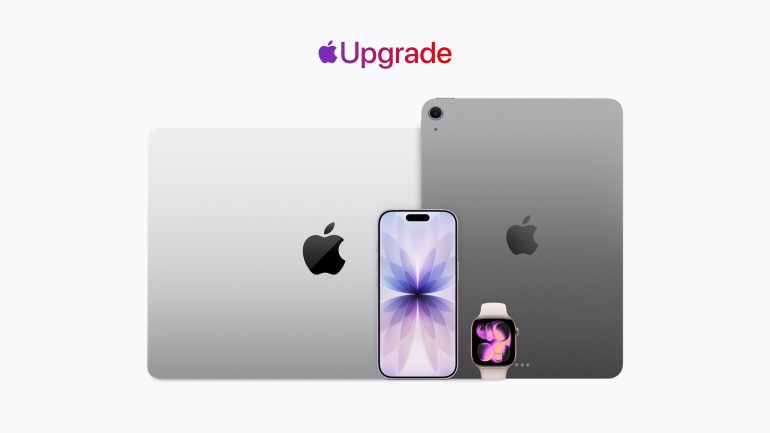
Apple’s latest announcement only makes sense when viewed against that backdrop. On paper, Apple Upgrade is a straightforward leasing programme. Customers in the United States can lease an iPhone, iPad, Mac or Apple Watch through Klarna, make monthly payments, trade in an existing device to reduce those payments and decide at the end of the lease whether to upgrade, buy the device they’ve been using or return it. None of those individual elements is especially surprising. Financing expensive technology has existed for years.
What’s unusual isn’t the financing. It’s the problem the financing is trying to solve.
For most of the smartphone era, manufacturers relied on the hardware to create demand. A noticeably better camera, a larger display or a dramatic improvement in battery life gave consumers a reason to look again. Annual launches worked because each generation delivered improvements that felt obvious in everyday use. Replacing a two-year-old phone often changed the experience of using it in ways that were immediately apparent.
That cycle has become much harder to sustain. Smartphone cameras have reached a point where they produce remarkable photographs in almost any situation most people encounter. Processors have become powerful enough that everyday performance stopped being a meaningful concern years ago. Displays continue to improve, batteries continue to last longer and software continues to become more capable, but those advances are building on products that were already exceptionally refined. The question facing manufacturers is no longer whether they can build a better phone. They can. The question is whether that improvement is enough to persuade someone to spend another thousand dollars.
I’ve written before about how the smartphone is evolving from a communications device into an AI computer, a shift that’s making hardware feel increasingly mature while software and intelligence become the real points of differentiation. Apple’s latest move suggests the commercial model is evolving just as quickly.
Apple doesn’t answer that question directly. Instead, it changes the decision consumers are being asked to make. Buying a new iPhone requires weighing a substantial once-off purchase against a device that’s probably still serving its owner perfectly well. Continuing a monthly payment feels different. The conversation shifts away from replacing something that still works and towards maintaining an arrangement that’s already part of everyday life. The hardware remains at the centre of the experience, but the purchase becomes less of a single event and more of an ongoing relationship.
That shift reflects something Apple has understood for years. The company has never competed on specifications alone, despite the attention every keynote gives to processors, cameras and displays. Apple’s real advantage has always been its ability to make separate products feel like parts of a much larger whole. The iPhone works with the Apple Watch. AirPods move effortlessly between devices. Messages, photographs and passwords follow users from one screen to another with remarkably little effort. Customers don’t simply buy an iPhone. They gradually assemble an ecosystem in which each additional product makes the others more useful.
Apple Upgrade extends that logic beyond the products themselves. The relationship no longer pauses when somebody decides whether to replace a phone. It continues, with the next upgrade becoming one more step inside the same ecosystem rather than the beginning of an entirely new purchase. That continuity has value for customers who prefer predictable monthly costs, but it has even greater value for Apple because it reduces the uncertainty that comes with persuading millions of people to make a fresh buying decision every few years.
The programme also reflects the changing economics of premium hardware. An iPhone doesn’t lose its usefulness because its first owner decides to replace it. Older models remain highly desirable, receive software updates for years and continue circulating through trade-ins, refurbishment programmes and second-hand markets around the world. Apple has spent years building the infrastructure that supports that second life because it understands that the commercial value of an iPhone doesn’t end at its first sale. Apple Upgrade gives the company greater influence over where those devices go next and how they re-enter the market.
That evolution feels entirely consistent with the direction the broader technology industry has been travelling. Software companies discovered that long-term customer relationships were more valuable than occasional purchases. Streaming services built businesses around continuous access rather than permanent ownership. Apple is now applying much the same logic to the category that seemed least likely to embrace it. The iPhone remains a physical object that sits in a pocket and travels through everyday life with its owner. The commercial model surrounding it is beginning to look much less like a traditional purchase and much more like an ongoing service.
For South Africans, Apple Upgrade won’t change how the next iPhone is bought, at least not yet. The programme is available only in the United States and depends on financing arrangements that don’t exist in the local market. On the surface, that makes it easy to dismiss as another example of a business model designed for American consumers rather than a signal of where the wider industry is heading.
History suggests that’s rarely how these shifts unfold. Streaming services didn’t become a global habit overnight, nor did subscription software or cloud computing. New commercial models usually appear in one market, prove themselves and gradually spread elsewhere, often arriving after consumers have already become comfortable with the underlying idea. By the time those models reach the rest of the world, they no longer feel experimental. They feel inevitable.
South Africa has already taken part in part of that transition. For years, mobile contracts have accustomed consumers to paying for expensive smartphones over time rather than upfront. The monthly payment became familiar enough that many people stopped thinking about the total cost of the device altogether. Yet those contracts still worked towards a clear ending. Once the payments stopped, the phone belonged to the customer. Ownership wasn’t immediate, but it remained the destination.
Apple Upgrade points in a slightly different direction. Ownership is still possible, but it no longer sits at the centre of the experience. The programme encourages customers to keep moving from one device to the next instead of reaching the point where the relationship naturally concludes. That approach makes sense in a market where smartphones have become durable enough to remain useful long after the excitement of a launch event has faded. If replacing a phone every few years no longer feels essential, keeping customers engaged becomes more important than persuading them to make another once-off purchase.
That change reaches beyond Apple. For years, technology companies competed by building products people wanted to own. Increasingly, they’re competing to build ecosystems people don’t want to leave. Those ambitions aren’t identical. Cameras will continue improving, processors will become faster and batteries will continue lasting longer, but those advances are no longer the only forces shaping customer behaviour. Services, subscriptions, cloud storage, app purchases, accessories and the countless small conveniences that accumulate over time create their own kind of loyalty. Leaving an ecosystem eventually means untangling years of habits rather than simply replacing a device.
It’s difficult to imagine that becoming less important over the next decade. Artificial intelligence will almost certainly make smartphones more capable, but AI alone won’t persuade millions of people to replace hardware that’s already serving them well. The companies that thrive are more likely to be the ones that reduce the friction around upgrading than the ones that rely solely on another breakthrough feature. Apple Upgrade belongs in that context. It doesn’t promise a radically different smartphone. It removes one more obstacle from the decision to keep buying into Apple’s ecosystem.
That may prove to be the more consequential story. Technology companies spent years teaching consumers to value ownership because ownership was the most effective way to sell products. Today, the economics favour something different. A long-term relationship generates steadier revenue than a series of isolated transactions, while mature products reward continuity more than constant reinvention. Apple’s latest announcement doesn’t mark the end of ownership, and it certainly doesn’t make buying an iPhone obsolete. It does suggest that ownership is gradually becoming less important to the business than ensuring customers never find a compelling reason to leave.
If that turns out to be the direction the industry follows, Apple Upgrade will be remembered less as a financing programme than as an acknowledgement of a much broader shift. The smartphone isn’t disappearing, nor is the desire to own beautifully designed products. What’s changing is the business built around them. For decades, the industry’s biggest challenge was persuading people to buy the next device. The next decade may be defined by something quieter: persuading them that buying it was never the most important part of the relationship.