
South African women entrepreneurs don’t need another lecture about resilience. They already start and run businesses in an environment where access to finance, infrastructure and meaningful business support remains difficult. What can be easier to underestimate is how much access to other people matters too.
That makes the changing role of coworking spaces more interesting than the familiar argument about flexible leases and hot desks. For women building businesses, returning to work or trying to grow beyond a small existing network, a workspace can also become somewhere to find clients, collaborators, advice and the kind of informal introductions that rarely appear on a list of business expenses.
Those connections aren’t a substitute for capital or good policy. They can, however, become part of the infrastructure around a business.
The latest Global Entrepreneurship Monitor data for South Africa gives some sense of the environment in which this is happening. South Africa ranks 47th out of 53 economies in GEM’s latest assessment of its entrepreneurial environment, with persistent weaknesses around infrastructure, government support and access to the resources needed to build a business. Women are still less likely than men to be starting a new business, although GEM says the gender gap has become small.
The gender-specific picture remains less comfortable. GEM’s 2023/2024 Special Report on Women’s Entrepreneurship in South Africa found that women continue to encounter significant barriers to entrepreneurship, while its research also points to a higher fear of failure among South African women entrepreneurs than the GEM average.
The gap isn’t explained by a shortage of ambition. It sits within a much messier collection of problems around money, networks, caregiving, opportunity and the ability to turn an early business into an established one.
This is where the conversation around flexible workspaces becomes more useful.
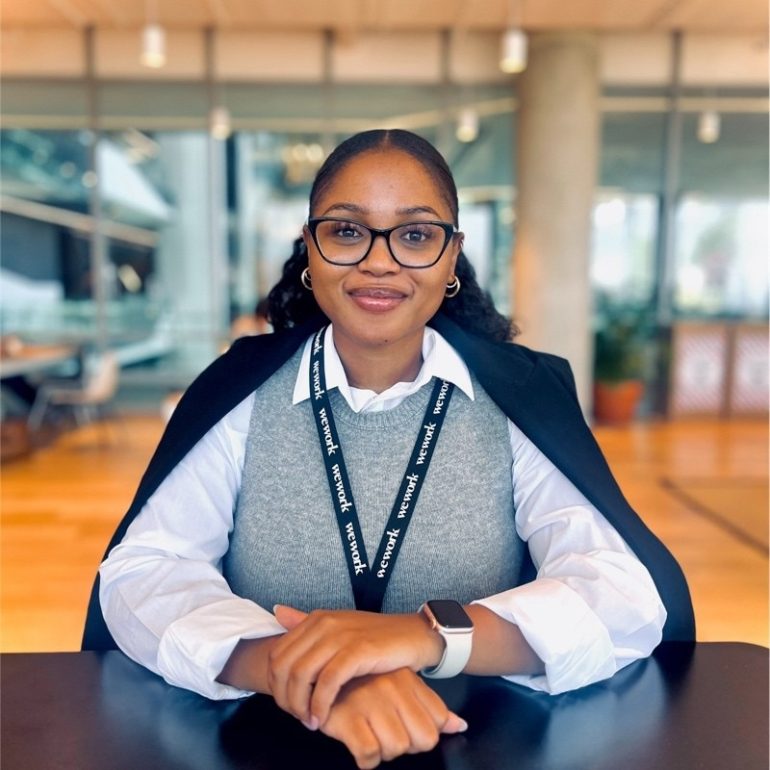
Olona Tywabi, communications manager at the Trevor Noah Foundation and a WeWork South Africa All Access member, argues that proximity itself has value. WeWork’s All Access product is built around the idea that members can move between shared workspaces, meeting rooms and private offices rather than committing to a conventional permanent office.
“Inclusion starts with our willingness to meet people where they are,” Tywabi says. “As women, specifically, we don’t want our ideas to live in isolation which is why we need proximity to other women that inspire us; we need a place to go where we can connect, actualise opportunity, reach mentors, initiate clients and specifically support each other.”
There is a commercial reality hidden inside the language of community. A useful professional network can shorten the distance between having an idea and finding someone who knows how to make it work. It can introduce a founder to a potential client without a formal sales process, provide a recommendation for an accountant or supplier, or make an experienced business owner available for the kind of five-minute conversation that prevents somebody else from making an expensive mistake.
Those benefits are difficult to measure neatly, which is partly why the desk has traditionally been easier to sell than the community surrounding it.
WeWork South Africa CEO Stefano Migliore argues that women still encounter barriers including access to funding, professional networks, resources and infrastructure, alongside the demands of balancing work with caregiving. His company obviously has an interest in arguing that the workplace can help solve some of those problems. The more useful question is how far that argument holds once you strip away the property marketing.
There is reason to think part of it does.
Professional networks have always been a form of economic advantage, although they haven’t always been distributed evenly. A founder who already knows investors, lawyers, executives and other founders starts with a different set of possibilities from someone who has to build every relationship from scratch.
Standard Bank’s support for women entrepreneurs combined cash with mentorship, hardware and business resources rather than treating capital as the only thing standing between a female founder and growth. That programme was small relative to the scale of the problem, but its structure acknowledged something important: access often needs to mean more than access to money.
Coworking fits into that idea from another direction. The product being sold may technically be office space, but some of its value comes from reducing professional isolation.
That distinction becomes particularly relevant as flexible work matures. Working from home removed the daily commute for many people and gave workers more control over their time, but flexibility can come with a different cost when somebody is also responsible for finding clients, solving operational problems and making every major business decision alone. The romantic image of the founder building a company from a kitchen table leaves out how lonely that table can become.
WeWork says women and women-led businesses now make up a large percentage of its South African community and points to facilities such as dedicated New Mother’s Rooms as part of its attempt to make workspaces accommodate lives that don’t neatly separate work from caregiving. At its Strand Street location in Cape Town, for example, its listed facilities include a mother’s room and parent’s room alongside the more conventional meeting and office infrastructure.
Amenities like that are useful, but they also expose the limits of what any workspace provider can claim. A private room for a breastfeeding mother makes a working day easier. It doesn’t fix the structural reasons women continue to carry a disproportionate amount of caregiving or find it harder to access capital.
Coworking shouldn’t be allowed to inherit the same exaggerated promises once attached to remote work, where changing where somebody sat was sometimes presented as changing work itself.
The more credible argument is smaller and probably more valuable because of it. A good workspace can remove friction. It can create proximity. It can make professional relationships easier to form and give people access to opportunities they may not encounter working alone.
Tywabi describes women sharing a workplace as exchanging more than business cards, including confidence and lived experience that can lead to opportunities. That can sound soft until you consider how much business is still built through referrals, introductions and trust.
South Africa’s entrepreneurial problem certainly won’t be solved by better coworking spaces. GEM’s latest assessment makes that impossible to argue credibly when 12 of the country’s 13 entrepreneurial framework conditions are still rated below what it regards as sufficient. Government support, regulation, infrastructure and the broader commercial environment remain part of a much larger problem.
But infrastructure isn’t only electricity, fibre, finance and office space. Sometimes it is knowing the right person to call, having somebody nearby who has already solved the problem you’re facing, or being in a room where an opportunity can find you.
For women building businesses in an economy that already asks a lot of entrepreneurs, that kind of access deserves to be treated as more than a pleasant side effect of having somewhere to work.