
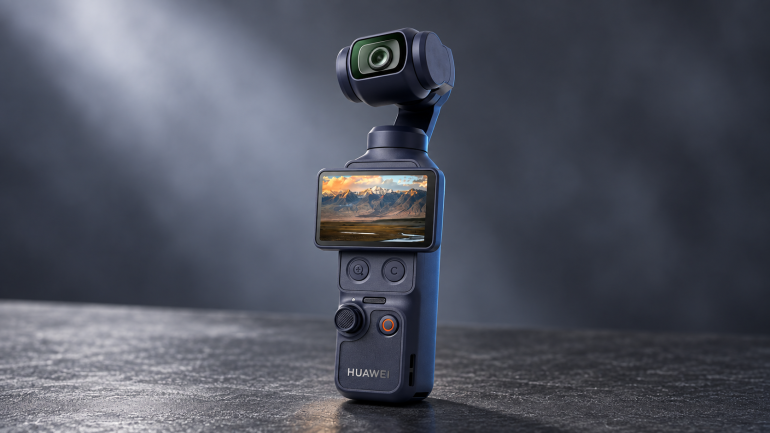
Huawei has a DJI camera with its name on it now. The HUAWEI × DJI Osmo Pocket 4 comes in what the Chinese tech giant calls deep-sea blue and promises to make getting footage onto a Huawei phone less fiddly. It starts at RMB 2,999 and appears to be limited to China for now: Huawei lists it on its Chinese site, and I couldn’t find an announced global or South African release.
You’re getting familiar camera hardware underneath the new finish. Huawei and DJI list the same main specifications for their versions: a 1-inch CMOS sensor, an f/2.0 lens and a three-axis mechanical gimbal, with 4K slow motion at up to 240fps. The standard Pocket 4 also has 107GB of built-in storage, 10-bit D-Log recording and a claimed maximum dynamic range of 14 stops. There’s no announced sensor or recording upgrade attached to the Huawei branding.
Huawei is selling the idea that you can shoot on the Pocket and have the files arrive on your phone without making the transfer a separate task. It says photos can be sent after capture, while videos transfer when you fold the camera’s screen closed. It also advertises Huawei Cloud uploads, switching camera views during phone livestreams and connecting the bundle’s microphone directly to compatible Huawei phones without an adaptor.
That would be handy when you want to edit a clip and post it while you’re still out. A separate camera can give you footage you prefer, but the phone is usually where you need it next. Removing a few steps between the two would make the Pocket easier to reach for when filming on your phone is the quicker option.
Some of this connection already exists, though. DJI’s manual for the ordinary Pocket 4 describes sending files directly to Huawei phones and tablets running HarmonyOS 6.1 or later. You select the sharing option from the camera’s playback screen and connect to the receiving device. The standard camera also supports cloud uploads, including Google Drive and OneDrive, subject to region and device support. Buying the blue one isn’t necessary just to get Huawei sharing.
The automatic transfers Huawei describes go further than manually choosing footage to send. But the companies’ available documentation doesn’t tell us whether all the advertised connections will stay exclusive to this edition. So the confirmed differences are the finish and branding, alongside Huawei’s advertised software integration; better image quality isn’t among them.
DJI has teamed up with other tech companies before. Its 2018 Microsoft partnership involved Windows development tools and enterprise drone applications, while its 2015 Hasselblad partnership included taking a minority stake in the camera maker. Huawei isn’t DJI’s first technology-brand collaboration.
It’s still an intriguing pairing, especially with the HONOR Robot Phone already putting a moving camera inside a handset. HONOR’s 200MP main camera sits on a three-axis mechanical gimbal, and the company has worked with ARRI on its imaging technology. It gives us an example of a phone maker going beyond fixed camera modules and software stabilisation.
That doesn’t make Huawei’s Pocket a Robot Phone competitor. Huawei is selling a separate DJI camera, and neither company has announced a jointly developed handset. DJI could contribute tracking or stabilisation technology to a future Huawei phone, but that’s speculation, and it wouldn’t necessarily involve a camera arm unfolding from the back. They could also keep working on external cameras, making them easier to control through phone apps or use during video calls.
The automatic transfers still depend on updates that Huawei expects to roll out in mid-October. They require a specified HarmonyOS 7 build, an updated DJI Mimo app and new camera firmware. The China-focused software requirements also mean we can’t assume a Huawei phone bought here will support the same features.