A citrus farm with 22 separate Eskom electricity connections is planning to replace them all with a private solar mini-grid. The farmer won’t have to buy the solar panels, batteries or kilometres of power lines needed to make it work.
The project involves a 3 MWp solar plant, 6.6 MWh of battery storage and around 22 kilometres of overhead power lines. It’s being developed by Rhino Energy Solutions (RES), with funding from Nav.Energy, an alternative energy platform associated with First National Bank (FNB).
Instead of paying for the installation upfront, the farmer will buy the electricity it generates under a long-term power purchase agreement (PPA). RES says the electricity will cost less than what the farm currently pays Eskom.
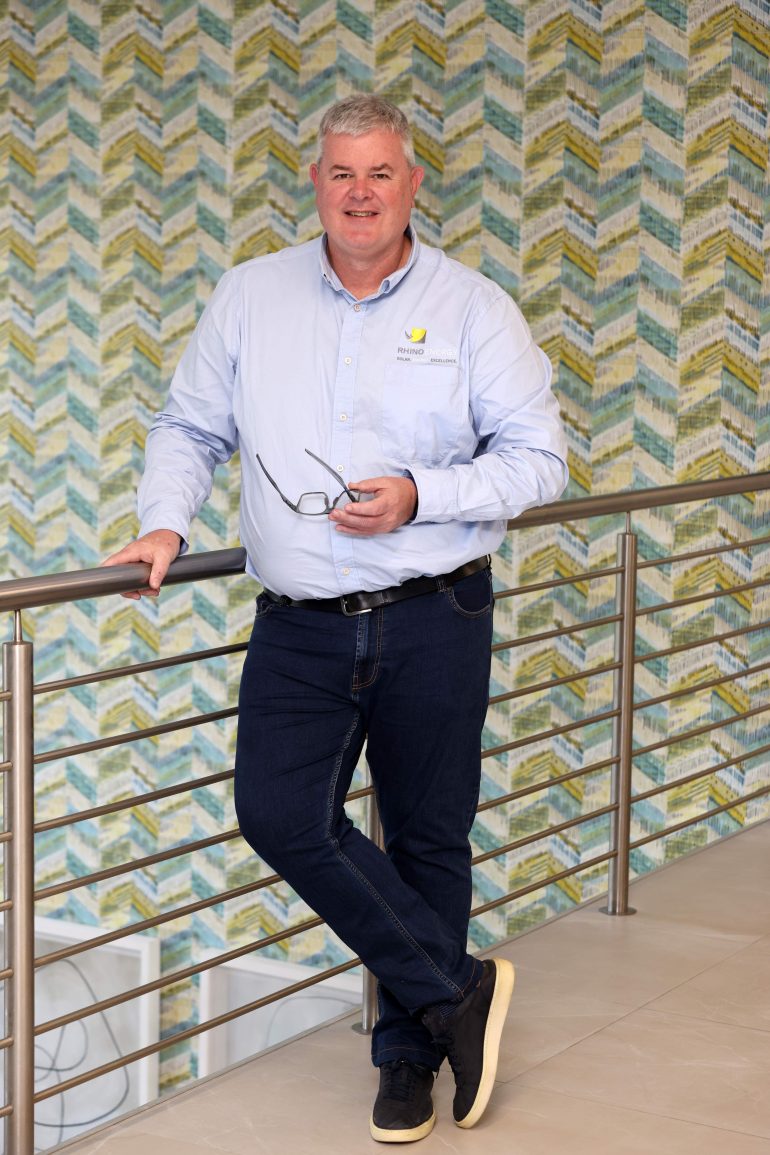
Rogan Davies, group CEO of Rhino Energy Solutions, discussed the project at Solar & Storage Live Cape Town on 21 October. He believes too many businesses approach solar by finding an installer, choosing a system and then looking for someone to finance it. By the time the bank gets involved, there’s often little room to reconsider whether the proposed installation is actually what the business needs.
“By the time the bank sees the deal, the most important decisions have already been made, often by whoever got to the customer first,” Davies says. “The farmer is left to stitch together the advice, the engineering, the contract and the funding, and carry the risk of the gaps between them.”
This particular farmer hadn’t approached RES asking for solar panels. They wanted more predictable electricity costs and a reliable supply for irrigation and refrigeration, without taking money away from agricultural production.
One farm, 22 electricity accounts
The farm’s Eskom connections serve its irrigation pumps, boreholes, packhouse, cold storage facilities and staff accommodation. Each connection comes with fixed and network charges, regardless of how much electricity is being consumed.
Demand changes throughout the day and across the seasons. Irrigation pumps can run overnight during summer, the packhouse and cold rooms are particularly busy during harvesting, and staff accommodation generally uses more electricity in the evenings.
RES examined electricity bills and consumption data from all 22 connections before drawing up a design. Its engineers found that the farm’s requirements could be managed across one network rather than treating each connection as a separate installation.
Putting solar panels on the packhouse roof would have been relatively straightforward, but it would also have left the other 21 electricity accounts largely untouched.
RES instead designed a mini-grid connecting the farm’s facilities through approximately 22 kilometres of overhead lines. Solar panels will generate electricity during the day, with batteries storing energy for evening and overnight use, including irrigation.
The first phase is intended to allow the farmer to cancel 20 Eskom supply points. The remaining two will be removed once the new system has established a reliable operating record.
RES hasn’t disclosed where the farm is located, when construction will be completed or whether the first phase is already operational. It also hasn’t explained what backup arrangements will be available once the farm no longer has its Eskom connections.
That’s worth asking, considering how much the farm depends on refrigeration and irrigation. Battery storage helps, but the 6.6 MWh capacity figure alone doesn’t tell us how long the system can support essential operations during extended periods of poor solar generation.
How the financing works
Nav.Energy is funding the project through a PPA, while RES is also an equity investor. RES will build and maintain the installation, with its operations team monitoring performance throughout the agreement.
“In this project the funder and the EPC+M partner are both invested in the same PPA,” Davies says. “When the incentives line up like that, the customer doesn’t have to referee between providers.”
The project follows the launch of Nav.Energy by FNB, WesBank and RMB on 20 October. The platform offers businesses several financing options, including outright purchases, rent-to-own arrangements and PPAs.
RES also offers different funding arrangements, with PPAs typically running for 10 to 20 years. These agreements allow businesses to avoid large upfront investments, although they also come with long-term contractual commitments.
For the farmer, that means keeping capital available for agricultural production rather than tying it up in electricity infrastructure.
But RES hasn’t disclosed the tariff the farmer will pay, how much it will increase annually or how long this particular PPA will run. It also hasn’t provided projected savings or confirmed who will own the infrastructure when the agreement ends.
Those details are important when comparing a PPA with buying a solar installation outright, particularly over a period of 10 or 20 years.
Why businesses are still investing in solar
For years, much of South Africa’s interest in solar was driven by loadshedding. Households bought backup systems, businesses installed generators and batteries, and companies that could afford solar panels tried to reduce their dependence on Eskom.
The national electricity supply has since improved considerably, but businesses are still dealing with rising tariffs, ageing local infrastructure and the need to plan for their future electricity requirements.
Those concerns aren’t confined to agriculture. South Africa’s growing investment in local AI data centres has raised questions about whether the country’s electricity infrastructure can accommodate additional demand, and what operators will need to spend to secure a reliable supply.
A citrus farm has very different energy requirements to a data centre, but both depend on equipment that can’t simply be switched off whenever electricity becomes expensive or unavailable.
For this farm, the problem is compounded by the distance between its various facilities. The distribution network will allow electricity generated at the solar plant to reach buildings and equipment that currently rely on separate Eskom connections.
Davies wants financial institutions involved much earlier in projects like this, rather than financing whatever an installer has already proposed.
“The best projects we build are the ones where the funder, the engineer and the client are in the room before anyone has chosen a product,” he says.
There’s a commercial benefit for RES in that approach. It gets to influence the design from the beginning and, as an equity investor, earn a return over the life of the agreement rather than simply being paid to construct the installation.
The citrus farm could eventually get rid of all 22 Eskom connections without having to pay for the new infrastructure upfront. RES says it’ll be cheaper, but hasn’t disclosed how much the farmer currently pays for electricity, what the new tariff will be or how much the project is expected to save.