

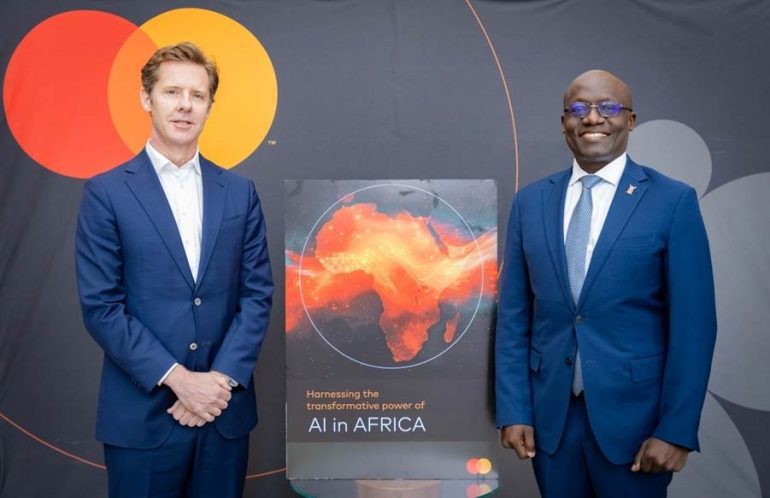
Another week, another ambitious tech forecast. This time it’s from Mastercard, which says the AI market in Africa is set to balloon to $16.5 billion by 2030. The company’s new whitepaper, Harnessing the Transformative Power of AI in Africa, ticks all the right boxes. It highlights AI’s potential to drive financial inclusion, spark job creation and unlock new models of innovation across healthcare, agriculture and education.
All of this sounds good. It also sounds familiar.
The idea that AI can leapfrog Africa into the digital age has been repeated for years. What’s different now is the scale of investment. South Africa attracted over $600 million in AI-focused venture capital in 2023. Kenya is deploying AI-powered maternal health bots that speak local languages. Nigeria and Morocco are crafting national strategies that treat AI not as a buzzword but as core infrastructure.
But the Mastercard report makes one thing clear, even if it doesn’t say it outright. None of this will matter without control. Control over data. Control over platforms. Control over how AI is trained, who gets to use it, and who it serves.
The paper rightly notes that Africa is mobile-first and young. It sees the continent’s demographic reality as an advantage. But it largely ignores the risk of replicating digital colonialism in a new form. Global companies with deep pockets are racing to stake their claim in AI on the continent. Many are packaging these moves as partnerships, though critics might call it asset extraction.
There is a danger here. AI systems trained on biased, Western-centric datasets could entrench inequality instead of solving it. Mastercard’s paper mentions the need for responsible and inclusive AI. It gestures toward local language processing, regulatory clarity and talent development. But it stops short of confronting the deeper tension: Africa needs not just access to AI but ownership of it.
South Africa may be the current leader in terms of infrastructure and readiness, but even here, questions remain. Who sets the standards for AI research? Who funds the startups? Who governs the ethics? The country wants to produce 300 AI startups and 5,000 professionals by 2030, yet the pipeline for that talent is fragile.
Kenya’s momentum is driven by necessity and innovation. It has a real-time, localised approach that feels more grounded. Tools like UlizaLlama show how AI can serve hyperlocal needs. Nigeria’s ecosystem is large, chaotic and buzzing. Morocco is building with a North African lens. But none of these countries are immune to global market forces.
This is where Mastercard’s credibility as a player and commentator becomes blurred. The company is positioning itself as an enabler of inclusive AI. But it is also a payments giant with strategic interests across the continent. Can it really call for “inclusive growth” while expanding its own footprint through the same AI systems it champions?
What’s missing from the whitepaper is a sense of urgency around open-source models, public data infrastructure and African-led AI research. Without these, the risk is that AI in Africa becomes another outsourced dream, coded elsewhere and sold back at a premium.
For a timely example of this power shift in action, look at Google’s new cloud region in Johannesburg. As I argued in “Google Cloud expands in Africa with new Johannesburg region”, the move promises lower latency and improved infrastructure — but also raises serious questions about who holds the keys to Africa’s digital future.
AI in Africa should not be a replication of the last tech cycle. If Mastercard and others want to support real transformation, the priority has to be local control, not just local deployment. Otherwise, $16.5 billion will just be another number.