

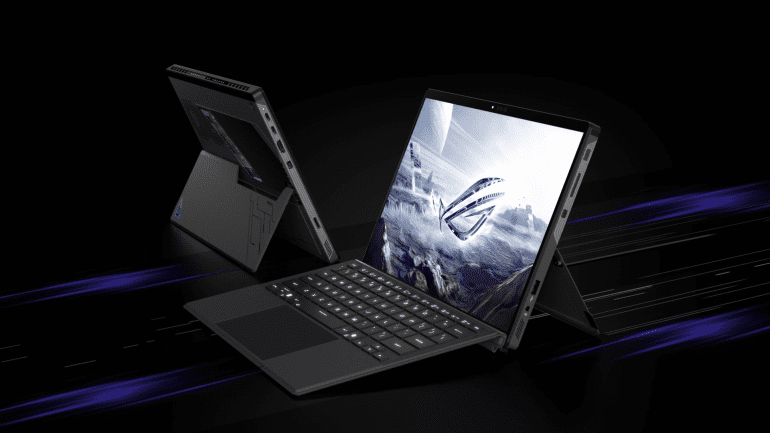
ASUS is no stranger to rethinking gaming hardware, and the 2025 ROG Flow Z13 is the latest example. A gaming tablet that aims to be as powerful as a laptop, the new Z13 is built around AMD’s Ryzen AI Max+ 395 processor, Radeon 8060S graphics, and a redesigned cooling system. With a 2.5K Nebula Display and up to 128GB of unified LPDDR5X RAM, ASUS wants this to be more than just a secondary gaming device — but can it live up to that promise?
Performance and AI integration
The Flow Z13 runs on AMD’s new Ryzen AI Max+ 395 processor, packing 16 Zen 5 cores alongside Radeon 8060S graphics built on RDNA 3.5. This marks a shift toward more integrated gaming performance, with AI acceleration playing a role in optimisations and power efficiency. The processor’s 50 TOPS of NPU performance also allows it to function as a Copilot+ PC, handling AI-assisted workloads beyond just gaming.
Unlike traditional gaming laptops, which separate CPU and GPU memory, the Flow Z13 unifies its RAM into a single pool. This means up to 128GB of LPDDR5X memory can be dynamically allocated between the CPU and GPU, reducing bottlenecks and improving multitasking performance. This approach also allows the Z13 to run large AI models locally, a feature that could appeal to developers and creators.
Cooling and portability
Packing this much power into a 13-inch tablet comes with challenges, and ASUS has focused heavily on cooling. The new stainless steel and copper vapor chamber covers 54% more of the motherboard than before, with dual 2nd Gen Arc Flow Fans pushing 70% more airflow through the system. The standing design of the tablet helps with ventilation, and ASUS has even routed a portion of the airflow behind the touchscreen to keep surface temperatures down.
Despite its compact form, the Flow Z13 maintains a reasonable weight, making it one of the most portable gaming devices with this level of performance. However, users expecting all-day battery life may need to temper expectations — gaming laptops, even ultra-efficient ones, still demand power-hungry components.
Display and connectivity
The Flow Z13 sports a 13-inch ROG Nebula Display with a 2.5K resolution, 180Hz refresh rate, and 500 nits of peak brightness. It also offers 100% DCI-P3 colour coverage, making it a solid choice for both gaming and creative tasks. Corning Gorilla Glass 5 protects the touchscreen, which remains a unique feature in the gaming space.
Connectivity is another strong point. ASUS has equipped the Z13 with dual USB-C ports (both USB4-compatible), a full-sized HDMI 2.1 port, USB Type-A, a microSD card reader, and a 3.5mm combo jack. This removes the need for multiple adapters, something many gaming tablets struggle with.
Price and availability
The ASUS ROG Flow Z13 (2025) starts at R42,999 in South Africa. This places it in direct competition with some high-end gaming laptops, meaning potential buyers will need to consider whether the tablet form factor is worth the trade-offs. The device will be available from retailers including Computer Mania, Evetech, the ASUS eShop, and Takealot.
Is the Flow Z13 worth it?
The Flow Z13 sits in an interesting space. It’s more powerful than most gaming tablets and brings AI-driven enhancements that make it more than just a portable console. However, at its price point, it competes with full-fledged gaming laptops that might offer better sustained performance for the same investment.
For those who want a gaming device that can also function as an AI workstation, the Flow Z13 is a compelling choice. But for gamers purely focused on raw power, traditional gaming laptops may still hold the edge.