

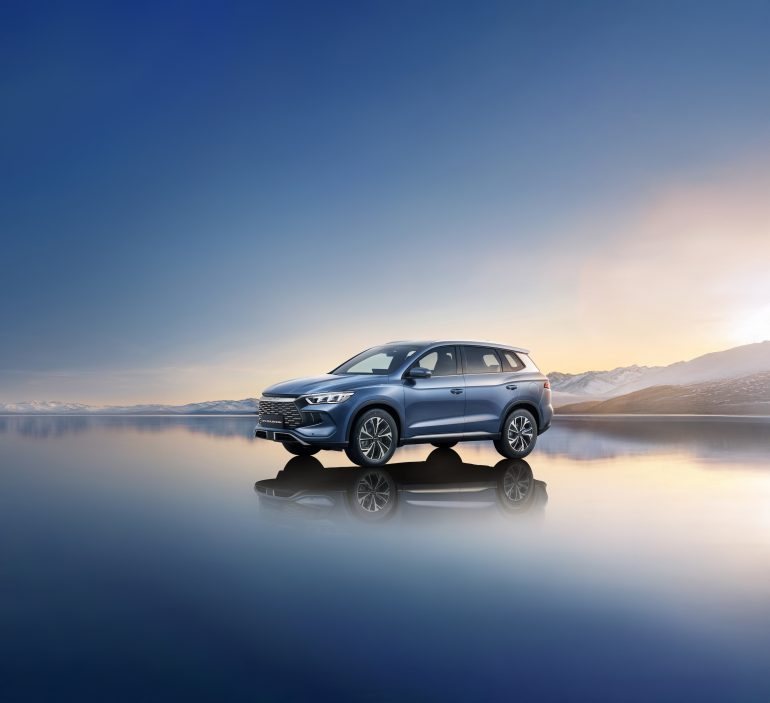
In Johannesburg this week, BYD is staging what it calls a “Mega Electric Day” at dealerships across South Africa. The showcase — scheduled for Saturday 8 November 2025 — gives local consumers an early glimpse of the forthcoming Sealion 5, a plug‑in hybrid SUV that’s set to join BYD’s Ocean range alongside the Dolphin and Seal. On paper the event looks like a feel‑good, family‑friendly brand celebration: test drives, discounts up to R30 000, prize draws, entertainment.
Still, if you peel back the gloss there are questions worth asking. Why emphasise plug‑in hybrid rather than full electric at this point? What does this say about South Africa’s readiness for EVs? And how credible is the claim that BYD is delivering “world‑leading electric vehicle technology” in this market?
Let’s unpack it.
One of the star features of the Sealion 5: a plug‑in hybrid configuration, described by BYD as “long‑range plug‑in‑hybrid capability with family‑focused practicality”. There’s a panoramic sunroof, wireless phone charging, intelligent voice control and a large infotainment display. To be clear: the full specifications and local pricing will only be revealed later this month. Until then, this “sneak peek” still serves as a marketing exercise.
Choosing a plug‑in hybrid (PHEV) rather than a fully electric vehicle (EV) signals pragmatism — or a concession. South Africa’s fast‑charging infrastructure remains patchy, electricity reliability remains a concern and the second‑hand market for EVs is still thin. A PHEV bridges those gaps: you get an electric‑enabled drive when you can, a petrol fallback when you must. But the term “world‑leading electric vehicle technology” now rings a little tinny when the vehicle isn’t fully electric.
Nevertheless, positioning the Sealion 5 as a “volume driver” in BYD’s local line‑up makes sense. The Dolphin and Seal have steadily built brand awareness in South Africa. This next step into a premise of family SUV broadens the addressable audience beyond early adopters and tech enthusiasts to more mainstream buyers. If BYD can bring the R30 000 discount into meaningful value rather than window‑dressing, the brand may well gain traction.
The Mega Electric Day also targets experience. BYD doesn’t just want to sell cars; it wants to sell “mobility” and the lifestyle around it. Test drives, family‑oriented activities, an event feel — these are cues that BYD is aiming beyond the vehicle itself and into branding territory: “we are the future of transport”. It’s a familiar script in the auto industry, yet in the South African context it takes on different shading. Here the contrast between aspiration and infrastructure is sharper.
Consumers will rightly ask: what will the real‑world electric range be in plug‑in mode? How easily will I find public charging stations? What is the cost of running and maintaining the PHEV compared to a conventional SUV? And while the press release emphasises “accessible and functional” technology — that claim merits scrutiny when the real cost and performance numbers are still under wraps.
For South Africa’s automotive industry the significance is two‑fold. First, it shows that international EV/plug‑in players view this market as a growth opportunity. That alone can nudge local infrastructure, policy and consumer sentiment. Second, it highlights that the transition is not linear: outright BEVs (battery‑electric vehicles) may not always be the immediate proposition. PHEVs can act as transitional tech. But stakeholders must not confuse transitional tech with end state. The risk is framing plug‑in hybrids as “good enough forever” rather than stepping stones.
It’s worth linking back to a recent piece on this site, such as our coverage of fintech infrastructure in rural South Africa, which argued that change often requires more than product launches — it needs ecosystems. Standard Bank’s expansion of its Instant Money network was less flashy than a big launch event but arguably more structural. In the EV world, the vehicle is only one node. The chargers, the service network, the grid and the aftermarket are all part of the system. BYD may be selling cars now, but the ecosystem question remains.
From a brand‑strategy lens, BYD is playing smart. Host a big event. Create a sense of exclusivity (“sneak peek”). Attach consumer incentives (discounts, prizes). Align with family‑friendly practicality and technology gravitas. Then launch the headline product (Sealion 5) later this month with full specs and pricing. It’s a classic build‑moment strategy. But the risk is that when the “later this month” details arrive, they don’t live up to the build‑up. If the gap between expectation and reality widens, the brand credibility suffers.
In the South African context, this matters. The auto market here is fragmented, price‑sensitive and heavily reliant on imported brands. Incentives like the R30 000 need to move the needle. Consumers will compare running costs, resale values and service ecosystems not just against other EVs but against familiar ICE (internal combustion engine) rivals. If BYD can credibly argue that its plug‑in hybrid offers lower cost of ownership, meaningful electric‑only drive and a service network that holds up, then this could mark a genuine step. If not, the launch could end up as another flash in the pan, symptomatic of big promises that struggle to match local realities.
So, will the Mega Electric Day setting for BYD prove to be the start of something substantial in South Africa? Possibly. But success will depend on what comes after the spectacle. Real‑world performance. Real ownership experience. The infrastructure wrap. And, crucially, whether BYD can credibly position the Sealion 5 not just as a novelty but as a practical choice for South African families.
For now, the event is a smart move — one that flags ambition and signals a brand taking local market seriously. But ambition alone does not equal transformation. The proof will be in the driving.