

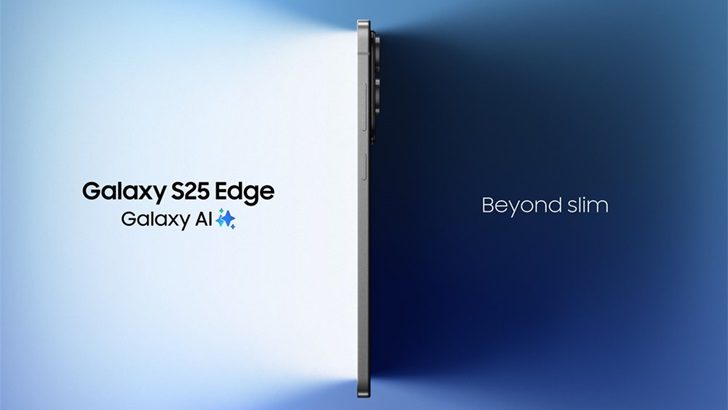
Internationally launched in March 2025, the Galaxy S25 Edge is Samsung’s attempt to make thin phones matter again. At just 5.8 mm thick and weighing only 163 g, the S25 Edge is Samsung’s slimmest Galaxy flagship yet. It’s not thinner than the Galaxy Z Fold 7’s unfolded 4.2 mm profile — but that number is misleading, since no one actually uses the Fold fully flat in their pocket. Fold it shut and the device balloons to 8.9 mm, which makes the Edge feel like a completely different design philosophy: one phone bends physics with a hinge, the other pushes the slab to its absolute limits. For a broader reference point, Apple’s iPhone 16 Pro comes in at 7.8 mm, making Samsung’s latest look almost impossibly thin by conventional flagship standards.
But there’s another player looming over this launch: Apple. The iPhone 17 lineup is set to be unveiled on 9 September, with the much-rumoured iPhone 17 Air expected to be Apple’s own take on an ultra-slim flagship. In a sense, the S25 Edge feels like Samsung racing to plant its flag first — a reminder that it delivered a super-slim flagship before Apple, even though the Air was rumoured months before Samsung’s Edge was revealed. That timing says a lot about how the smartphone industry works: perception matters just as much as engineering.
The question is whether slimness is really the feature people are waiting for. The 3,900 mAh battery is modest for a device in this price bracket, even with Samsung’s fast-charge promises. Durability is also a concern in a market where many users stretch devices for three years or more. The titanium frame and Gorilla Glass Ceramic 2 suggest resilience, but thin phones have a chequered history.
Performance should be familiar. The S25 Edge runs the same Snapdragon 8 Elite Mobile Platform for Galaxy that powers the rest of the S25 series. Samsung also redesigned the vapor chamber to prevent thermal throttling in the thinner chassis, though it’s a problem only real-world stress tests will confirm.
The camera story is more convincing. A 200 MP main shooter, backed by Galaxy AI editing tools like Audio Eraser and Drawing Assist, brings pro-level flexibility in a jeans-pocket form factor. Low-light improvements and macro-capable autofocus on the 12 MP ultra-wide lens make the Edge less of a gimmick and more of a creative tool.
Still, the pitch is narrow. At nearly R25,000, buyers could opt for the Galaxy S25 Ultra or even a foldable like the Z Fold 7, which offer bigger screens and larger batteries. Samsung is effectively betting that portability is the premium. Whether South Africans agree will decide if the Edge is remembered as an engineering marvel or a niche experiment.
What makes the S25 Edge interesting, though, is how it fits into Samsung’s broader playbook. Galaxy AI is the real differentiator, with tools like Gemini Live and Now Bar edging closer to a persistent AI companion. If you’ve been tracking Samsung’s moves into wearables — like the Galaxy Ring’s South African launch — the S25 Edge shows the same DNA: slim design plus AI as a lifestyle pitch.
The slimmest Galaxy flagship yet may not outsell Samsung’s mainstream devices, but it signals that Samsung still wants to surprise. And with Apple’s iPhone 17 Air around the corner, the timing feels deliberate — a reminder that Samsung isn’t just keeping up, it’s trying to get ahead in a game where being first still matters.