

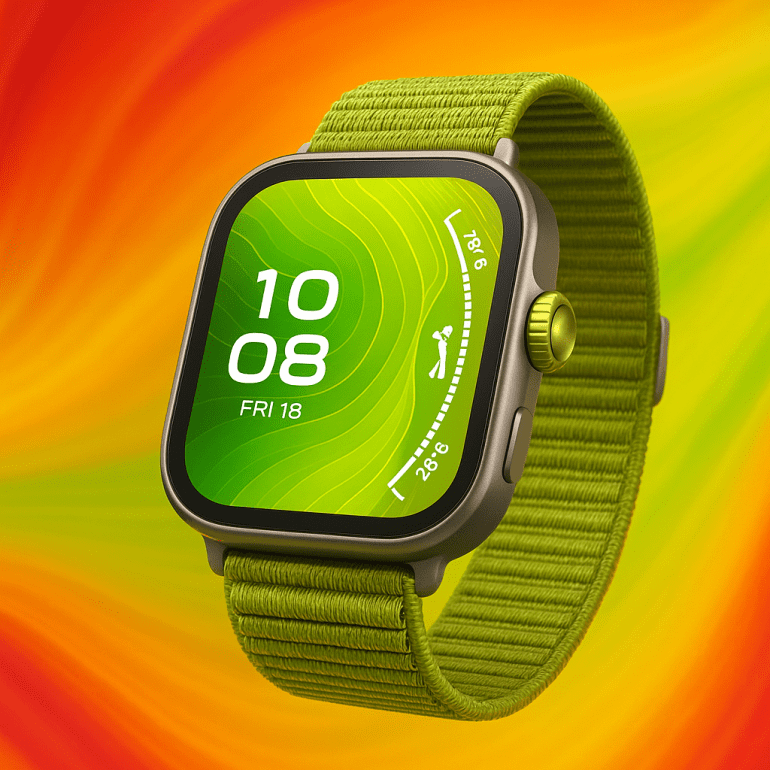
The Huawei Watch Fit series has always been the middle child of the smartwatch world — not quite a full-featured smartwatch, not quite a cheap-and-cheerful tracker, but often just stylish enough to get noticed. Now, Huawei’s back with the Watch Fit 4 and the dressed-up Watch Fit 4 Pro, hoping to lure everyone from gym rookies to fashion-forward techies. But in a market already saturated with square-faced wristwear, the question is: does anyone really need a Watch Fit 4 Pro when the Watch Fit 3 is still pretty great?
Let’s break it down — feature by feature, flex by flex.
The Display: Bigger, Brighter, and… Blingier?
The first thing you’ll notice with the Watch Fit 4 Pro is the “is that a smartwatch or jewellery?” moment. It’s got a titanium bezel and sapphire glass — an unusual combo for a fitness tracker. Huawei wants you to feel like you’re wearing something closer to a Tag Heuer than a Fitbit. And the 1.82-inch AMOLED panel? It punches out 3,000 nits of brightness, making it very readable even if you’re mid-run in Joburg’s afternoon sun.
The regular Watch Fit 4 gets the same size display but dials the brightness down to 2,000 nits and swaps titanium for aluminium. The Watch Fit 3, meanwhile, has a 1.8-inch display that honestly still looks great — it’s only when you put it side-by-side with the newer ones that it feels a little… 2024.
Sensors and Smarts: Who Actually Needs ECG on a Fitness Band?
Here’s where the Watch Fit 4 Pro tries to leapfrog the competition. It adds an ECG sensor, a skin temperature sensor, and a mysterious “depth sensor” that Huawei says enables better biometric readings. If you’re serious about health data — or just want the kind of analytics that used to be locked behind R10k wearables — the Pro has a real edge.
The regular Watch Fit 4 skips the ECG and depth sensor, but still offers GNSS multi-system tracking, continuous SpO2, sleep monitoring, and stress tracking. And that’s still better than what you’ll find on most Fitbits in this price range.
Watch Fit 3 feels a bit more basic here, but not barebones — it still supports 100+ workout modes, heart rate and SpO2 monitoring, and built-in GPS. You won’t miss much unless you’re the kind of person who needs to know their heart variability stats every single morning.
Battery Life: 10 Days, No Complaints
All three watches boast 10-day battery life under “typical” use — a bold but mostly accurate claim. What’s impressive is that the 4 Pro manages this despite the brighter display and extra sensors. It even supports wireless charging, something that still weirdly feels like a luxury on a wearable.
The Fit 4 and Fit 3 charge with Huawei’s magnetic cable. Fast enough, but not magical.
Style & Comfort: One for the Gym, One for the Gram
Here’s where personal taste kicks in. The Watch Fit 3 is featherlight, matte, and looks more like a no-fuss tracker. The Watch Fit 4 adds polish — think softer curves and a more modern vibe. But the Watch Fit 4 Pro is a full-on style play. If you want your fitness watch to double as your date-night accessory, it’s the only pick.
Bonus points to the Pro and Fit 4 for having a speaker and mic — meaning you can take calls straight from your wrist. No, it’s not going to replace your phone, but for those “my phone’s buried in my gym bag” moments, it’s a win.
The Verdict: Do You Go Pro, or Stick With the Classic?
- Get the Watch Fit 4 Pro if you want the full Huawei wearable experience — ECG, bling, and bright display all included. It’s premium without going full Huawei Watch GT or Apple Watch Ultra.
- Grab the Watch Fit 4 if you want most of the features that matter, but don’t care for ECG or titanium.
- Stick with the Watch Fit 3 if you just want a good-looking, no-fuss fitness tracker that still punches above its weight in terms of value.
In other words: the Pro is for show-offs, the 4 is for everyone, and the 3 is for budget-savvy minimalists. You pick your wrist weapon.