

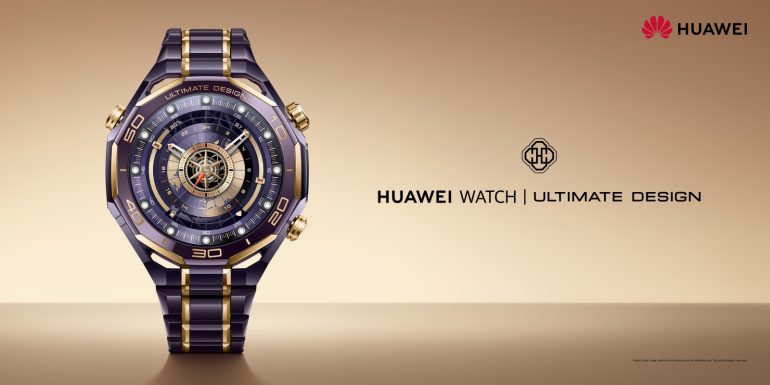
Huawei unveiled the WATCH ULTIMATE DESIGN Royal Gold Edition last night at a Dubai event that also showcased the Mate X7, and the price tag is genuinely startling: €3,299. That’s roughly R66,000 at current exchange rates, for a device that’ll be outdated before you’ve finished paying it off.
There’s no word yet on whether it’ll launch in South Africa, but even if it does, the more interesting question isn’t about availability. It’s about who this is actually for.
Purple ceramic and 18K gold on a ticking clock
The Royal Gold Edition isn’t just expensive, it’s properly luxurious in terms of materials. The twelve-sided bezel is made from rare-earth purple ceramic forged at 1,400°C, with hand-set 18K gold inlays and 24K gold characters. The case is zirconium-based liquid metal with four 18K gold accents. The crown gets the 18K gold-clad treatment. Even the titanium strap has purple ion plating and 24K gold finishing.
Huawei’s put genuine craftsmanship into this thing. The precision cutting, the ceramic work, the gold application, none of it’s cheap or easy. But here’s the uncomfortable bit: all that craft is wrapped around the same tech you’ll find in the [WATCH ULTIMATE 2](https://consumer.huawei.com/za/wearables/watch-ultimate-2/), which costs around R18,999 locally.
What actually changed from the Ultimate 2
Not much. The Royal Gold has the same 1.5-inch LTPO AMOLED display with 3,500-nit peak brightness. Same 150-metre diving capability with sonar-based underwater communication that lets you send texts and emojis to diving buddies up to 30 metres away. Same X-TAP health monitoring that tracks everything from blood oxygen to emotional states. Same battery life: 4.5 days for typical Android use, dropping to 3 days with always-on display.
The differences are almost entirely aesthetic. You get exclusive watch faces designed around the purple and gold theme (Dawn light, Beams, Celestial Path). The dimensions shift slightly, 48.3mm versus the Ultimate 2’s 48.5mm in black or 47.8mm in blue. The bezel swaps from nano-tech ceramic to the fancy purple version. Weight drops marginally from 80.5g to 80.9g, which you’d never notice.
The Royal Gold does include the wireless SuperCharger (2nd generation) in the box, which is sold separately for the Ultimate 2. But that’s hardly justification for the nearly R50,000 price difference.
Feature-wise, it’s identical. Same dual-frequency five-system GNSS positioning. Same Golf Course mode with 17,000+ zoomable course maps. Same Expedition mode with route import and offline maps. Same AI noise cancellation for calls. Same Health Glance that spits out 10+ health metrics in 60 seconds.
The luxury watch problem nobody wants to talk about
At €3,299, the Royal Gold Edition sits firmly in proper watch territory. That’s Omega money. That’s entry-level Rolex money. That’s the price point where people start thinking about heirlooms and whether their kids will want it someday.
But smartwatches don’t play by those rules. They’re computers. They run software that needs updates. And updates, eventually, stop coming. You might get three years of solid support, maybe five if you’re lucky. After that, you’ve got a very expensive bracelet with increasingly dodgy functionality.
A mechanical luxury watch holds value or appreciates. A smartwatch depreciates the moment you unbox it. That €3,299 becomes maybe €1,500 in two years, then €500, then basically nothing. You can’t service it for decades. You can’t pass it down. It just becomes obsolete.
So who’s this for? Someone who wants the flex without committing to traditional luxury? Someone with enough money that planned obsolescence doesn’t register as a concern? Someone who genuinely adores the aesthetic and doesn’t care about resale?
Or maybe it’s not really a product at all. Maybe it’s a statement piece, a flex on Huawei’s design and manufacturing capabilities rather than something they expect to sell in meaningful volume.
TruSense is still the clever bit
The Royal Gold does carry forward Huawei’s TruSense health monitoring system, which remains one of the more thoughtful approaches to wearable health tracking. The X-TAP technology extends monitoring from your wrist to your fingertips, which actually makes practical sense. You can get comprehensive health reports in 60 seconds. There’s ECG analysis, pulse wave arrhythmia detection, emotional wellbeing tracking across 12 states, blood oxygen monitoring.
It’s genuinely useful tech. But you get all of it in the WATCH ULTIMATE 2. Or in Huawei’s other premium wearables. The health features aren’t exclusive to the Royal Gold, they’re just more expensive here.
The South African calculation
If this launches locally (still a big “if”), expect pricing around R65,000 or higher. That’s a serious commitment in a market where most consumers are price-sensitive and even premium buyers tend to think carefully about value.
Huawei’s done well with more accessible wearables here. The Watch Fit series resonates because it offers solid functionality without absurd pricing. The Royal Gold aims at a completely different buyer, someone who wants a statement piece that happens to track heart rate, not someone who wants a capable fitness tracker.
Huawei’s been decent about bringing global launches to South Africa, sometimes surprisingly fast. But a €3,299 smartwatch needs a very specific buyer, and whether there are enough of them locally to justify the logistics is genuinely unclear.
Luxury tech never quite works
Huawei isn’t the first to try this. Apple’s had various Edition models. TAG Heuer’s Connected line plays in similar territory. But they all run into the same fundamental problem: luxury buyers want longevity, and tech products have expiry dates baked in.
The Royal Gold Edition is genuinely beautiful. The craftsmanship is real. But applying that level of craft to something with a three-to-five-year useful life creates cognitive dissonance. You’re not buying a watch. You’re renting one until the software support ends and the battery degrades past usefulness.
There might be a market for that. There are certainly people who don’t think about longevity and just want the most extravagant thing available. But it’s hard to ignore the uncomfortable truth: that €3,299 would buy you something that’ll still work properly in 2035. This won’t.
Huawei’s made something objectively gorgeous. Whether that’s enough to justify the price, the planned obsolescence, and the fact that it’s fundamentally the same as a much cheaper watch underneath is something only buyers with very specific priorities can answer. The rest of us will just admire it from a distance and wonder who it’s actually for.