
When you think about LG and artificial intelligence, chances are you’re thinking about a washing machine that can work out what sort of laundry you’ve put inside it, or a refrigerator that can help you keep track of your groceries. But after spending time in South Korea and seeing some of the technology LG is developing, I’m just as interested in what the company is doing behind the scenes.
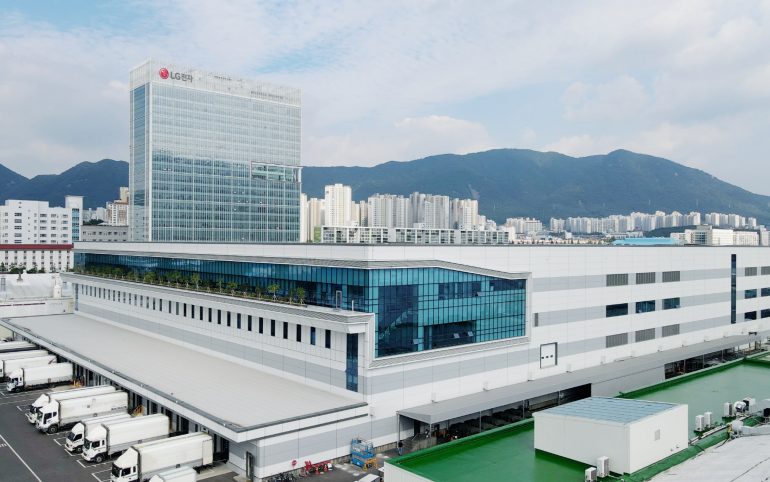
Take LG Smart Park in Changwon, for example. This is one of LG’s major appliance manufacturing facilities, where the company’s spent years introducing AI, robotics and automation into the production process. And while robots assembling refrigerators might not sound all that unusual these days, the way LG has connected everything inside this factory is actually quite impressive.
We’re talking about a facility where AI can predict potential production problems before they happen, robots lift and attach refrigerator doors, and autonomous vehicles carry components weighing hundreds of kilograms around the building. The factory can also manufacture 58 different fridge models on a single production line, which is really impressive when you consider how much the components, sizes and designs can differ between appliances.
What’s also interesting is that LG is now using its manufacturing facilities to develop the next generation of robots, including the CLOiD robot that it introduced earlier this year.
The factory has a digital version of itself
One of the interesting things about LG Smart Park is that the company has created a virtual version of the factory, known as a digital twin.
It’s essentially a digital recreation of the manufacturing operation, with information coming in from machinery, production lines and logistics systems throughout the building. This allows LG to monitor what’s happening inside the factory, but it can also use that information to work out what might happen next.
Every 30 seconds, the system analyses production data to identify potential problems that could affect manufacturing within the following 10 minutes.
So, for example, if a particular component isn’t going to arrive at an assembly station in time, or a piece of machinery starts behaving unusually, the system can flag the problem before it brings part of the production line to a halt.
Now, imagine trying to manage that when you’re producing dozens of different refrigerator models on the same line. Each appliance needs its own combination of components, and everything has to arrive at the correct place at the correct time.
It’s easy to see how even a relatively small problem could affect production.
The digital twin gives LG a better chance of spotting these problems early, while its predictive maintenance systems monitor equipment for signs of potential failures.
According to LG CNS, the company’s IT services division, the technology helped reduce production stoppages caused by unexpected equipment failures by 96%.
That’s a huge improvement, but it doesn’t mean the factory is immune to breakdowns. It means that LG has become better at identifying problems before they become serious enough to interrupt production.
Robots are doing a lot of the heavy lifting
There’s also quite a lot happening when it comes to getting components from one part of the factory to another.
Instead of relying entirely on forklifts or workers transporting materials between assembly stations, LG has developed an automated logistics system that makes use of both the factory floor and the space above it.
Overhead conveyors transport smaller components, including circuit boards, refrigerator door hinges and water filters. These systems can carry loads of up to 30kg and move materials between different levels of the building.
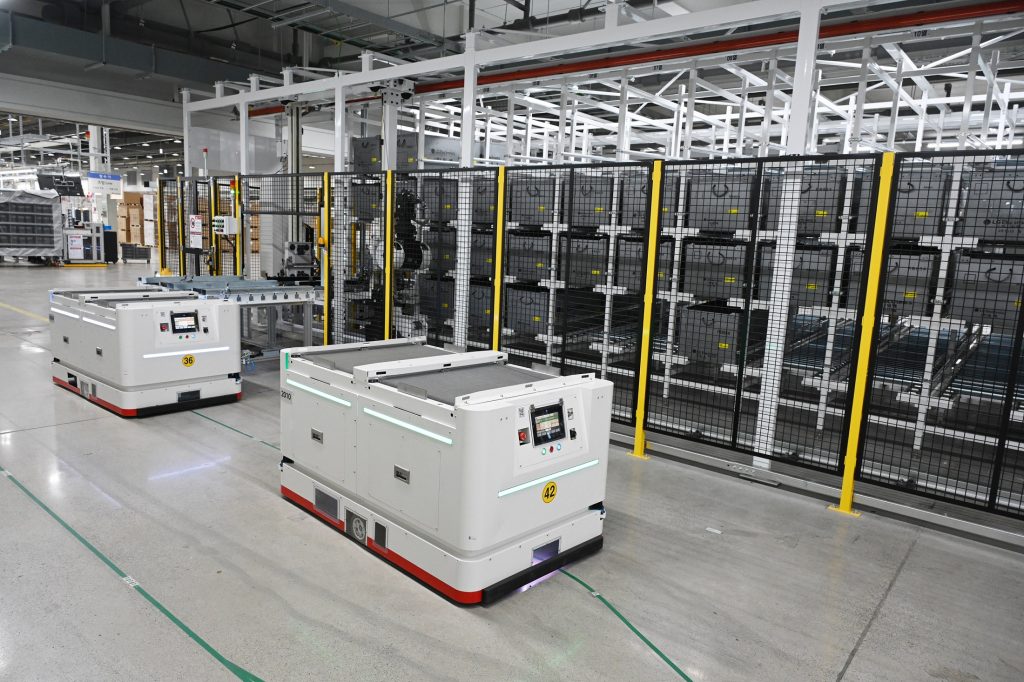
On the factory floor, automated guided vehicles, or AGVs, handle some of the heavier work.
These vehicles can transport loads weighing up to 600kg and use a dedicated 5G network to communicate as they move around the facility.
A June 2025 report by South Korean publication The Asia Business Daily described approximately 50 of these vehicles operating inside the refrigerator manufacturing facility.
What’s clever about the arrangement is that LG doesn’t have to keep moving large quantities of components around manually or leave as much floor space available for storage and transportation.
According to the company, the system has reduced the space required for materials handling by 30%, while the time spent transporting materials each hour has fallen by 25%.
And because the factory is producing so many different refrigerator models, its systems can help make sure the correct components reach the appropriate assembly station without someone having to organise every delivery manually.
Even fitting refrigerator doors is automated
Of course, moving components around the factory is only part of the process. Those components still need to be assembled into finished appliances.
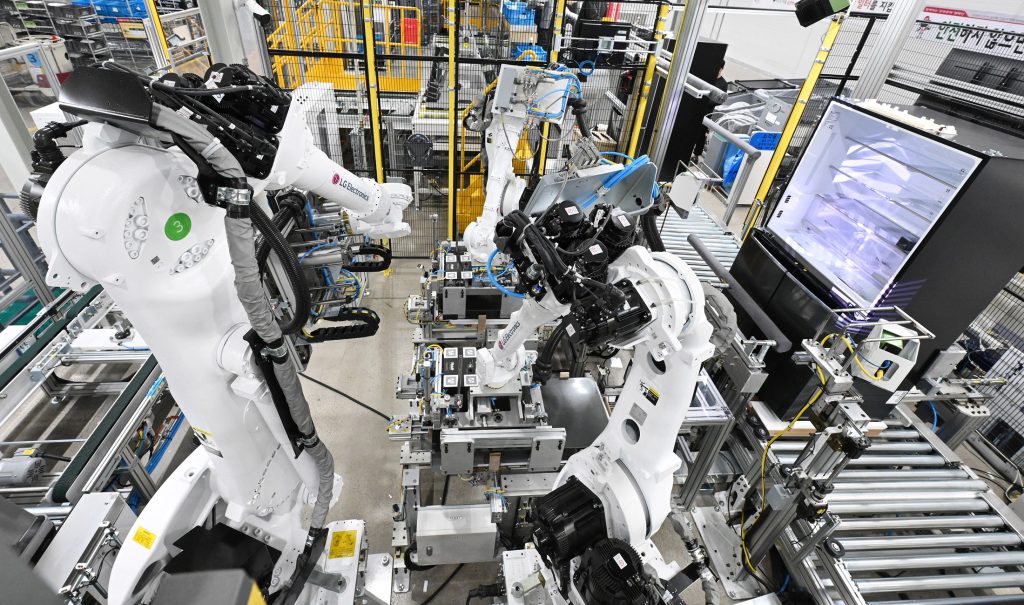
At LG Smart Park, robotic arms carry out some of the more physically demanding work, including lifting refrigerator doors weighing up to 20kg and attaching them to the appliance body.
That might sound fairly straightforward, but think about how precisely a refrigerator door needs to fit. It has to line up with the hinges, sit correctly against the body and close properly. If the positioning is slightly off, it could affect the finished appliance.
LG uses robotic arms equipped with cameras and three-dimensional vision recognition to identify where components are positioned and guide the assembly process.
According to The Asia Business Daily, the refrigerator door assembly system can operate with a margin of error of approximately 0.15mm.
That’s impressive when you consider the weight of the doors and the fact that the robots are repeating these movements throughout the production day.
LG also uses robots for welding operations involving compressors and cooling equipment, with deep learning and camera-based positioning helping the machinery perform the work consistently.
Automated inspection systems then check for problems, including possible refrigerant leaks.
These are also jobs where there’s an obvious advantage to using machines. Repeatedly lifting heavy refrigerator doors is physically demanding, while welding involves heat and other workplace hazards.
But it’s important to understand that LG Smart Park isn’t some completely autonomous factory where people have disappeared from the production process. Employees are still needed to supervise operations, maintain equipment, deal with problems and carry out work that the automated systems can’t handle.
AI is also checking the quality of what LG produces
Another area where LG has introduced AI is quality control.
The company uses machine vision and machine-learning systems to help identify defects during production, rather than waiting until an appliance has been fully assembled before discovering something is wrong.
One of the technologies involved is called PIE, short for Plug-in for Intelligent Equipment, which monitors production machinery and looks for abnormalities that could affect manufacturing.
LG also uses automated visual inspection systems to examine components and finished products for possible defects.
This means that if something goes wrong during an earlier stage of production, there’s a better chance of identifying it before more time and materials are spent completing the appliance.
LG CNS says the improvements introduced through its smart factory programme have helped reduce costs associated with defective product returns by 70%. The company has also reported an improvement of approximately 30% in energy efficiency.
When the World Economic Forum recognised LG Smart Park as part of its Global Lighthouse Network in 2022, it reported a 17% improvement in productivity and a 30% reduction in inventory and energy consumption.
These are figures reported by LG and its technology partners, and they cover different parts of the factory’s transformation. They don’t necessarily tell us how much improvement can be attributed to AI alone.
Still, they’re substantial results for a facility that produces appliances on such a large scale.
LG is now using its factories to teach robots new skills
This is where things get even more interesting, because LG isn’t only using robots to manufacture appliances. It’s starting to use its factories to help develop robots that can perform a wider range of tasks.
You might remember CLOiD, the robot LG introduced at CES 2026 as part of its vision for a home where people spend less time doing household chores.
It’s connected to the company’s broader Zero Labour Home ambitions, which I explored during my visit to LG Sciencepark in Seoul.
LG wants robots that can eventually handle things such as laundry and other household tasks, but developing that kind of technology is considerably more complicated than building a robotic arm that repeats the same movement on an assembly line.
A robot working in someone’s home needs to recognise objects, understand where they’re positioned, pick them up without damaging them and adapt when something changes.
And unlike a factory, where equipment and components are arranged in fairly predictable ways, someone’s home is constantly changing.
So LG has started giving CLOiD practical experience in its manufacturing facilities.
According to an October 2026 report by South Korea’s Dong-A Ilbo, LG began testing CLOiD on an actuator production line in Changwon in September.
An actuator is a component that converts energy into movement, and the robot is being tested in assembly and packaging operations.
LG is also testing CLOiD at its washing machine factory in Tennessee in the United States, where the robot is being evaluated on tasks involving the movement, positioning and loading of components.
These aren’t robots that have already taken over the factory. They’re still being tested, and LG is using the trials to understand what the machines can do reliably and where they need improvement.
What I find interesting is how the company is using an environment it already knows extremely well to develop technology that it eventually wants to put into people’s homes.
The factory provides a way to test robotic movement, object recognition and handling without immediately having to deal with all the unpredictability of a household.
LG reportedly wants to expand these trials and have robots working across dozens of manufacturing processes at its Changwon and Tennessee facilities by the end of 2027.
That’s the company’s ambition, rather than something it has already achieved.
There’s an entire facility dedicated to training robots
LG is also investing in the technology needed to teach these robots how to perform physical tasks.
In September, the company announced an expanded partnership with Nvidia, with the two companies working together on what the industry calls physical AI.
This is AI designed to interact with the physical world, rather than simply processing information or generating text and images.
As part of that work, LG has established a facility called the Data Factory in Yangjae, Seoul, where robots can practise tasks and collect information that can be used to improve their performance.
The facility includes environments designed to recreate manufacturing and household situations, including a simulated production environment based on LG’s Tennessee washing machine factory.
LG is using Nvidia technologies such as Omniverse, Cosmos and Isaac to help create simulations and train its robotic systems.
The company says the facility will eventually accommodate several hundred robots and is targeting approximately 100,000 hours of physical AI training data by the end of 2026, using a combination of real-world recordings and synthetic data.
In simple terms, LG wants its robots to learn from things they do in the physical world, while also allowing them to practise situations in virtual environments.
I can see how that approach could help with something like folding laundry or loading a washing machine, because the objects a robot encounters won’t always be positioned in exactly the same way.
Of course, whether the technology can eventually do these things in someone’s home, safely and without constant assistance, is another question altogether.
LG is also turning its factory technology into a business
There’s another reason LG has invested so heavily in Smart Park.
The company has started selling smart factory technologies and services to other manufacturers, using what it has developed in its own facilities as a foundation.
The business includes digital twins, AI-powered production monitoring, predictive maintenance, automated logistics and robotic manufacturing systems.
LG began expanding these services to external customers in 2024, and the company says it secured approximately 500 billion Korean won in smart factory orders during 2025.
It’s targeting manufacturers in industries such as automotive production, batteries, semiconductors and heavy machinery, where even relatively small improvements to manufacturing efficiency can make a substantial difference.
And there’s a pretty compelling sales argument here. LG isn’t simply demonstrating what these technologies might be capable of doing. It has an actual appliance factory where many of the systems have been running for years.
That doesn’t mean another manufacturer could achieve the same results simply by installing similar technology. LG’s factory transformation has involved extensive changes to its production systems, equipment and infrastructure, as well as considerable investment.
I also think there’s an interesting conversation to be had about what this could mean for manufacturing in South Africa.
Our manufacturers face their own challenges around costs, infrastructure, productivity and skills, and the idea of completely rebuilding a factory around robotics isn’t necessarily realistic for every business.
But technologies such as predictive maintenance and AI-powered quality inspection could be useful without requiring a manufacturer to automate every aspect of its production line.
The bigger question is how businesses would pay for these changes, develop the skills needed to operate the systems and manage the effect that greater automation could have on employment.
The factory is becoming more than a place to make appliances
What I find most impressive about LG Smart Park isn’t necessarily any one robot or AI system. It’s how much of the manufacturing process LG has managed to connect.
The digital twin helps predict problems, the logistics systems make sure components get where they’re needed, robots handle some of the more demanding assembly work, and AI helps identify defects before appliances leave the factory.
All of that is already happening, although LG’s reported improvements are still company figures and don’t provide a complete picture of the costs involved in getting the factory to this point.
But with CLOiD now being tested in Changwon, the facility is taking on another role.
It’s becoming somewhere LG can develop and train the robots it wants to use in the future, both in manufacturing and eventually in people’s homes.
After seeing LG’s vision for the Zero Labour Home in Seoul, I’m interested in how those ambitions will translate into products people can actually use.
And looking at what’s already happening inside Changwon, it’s clear that LG’s been developing some of the technology needed to get there for quite some time.