

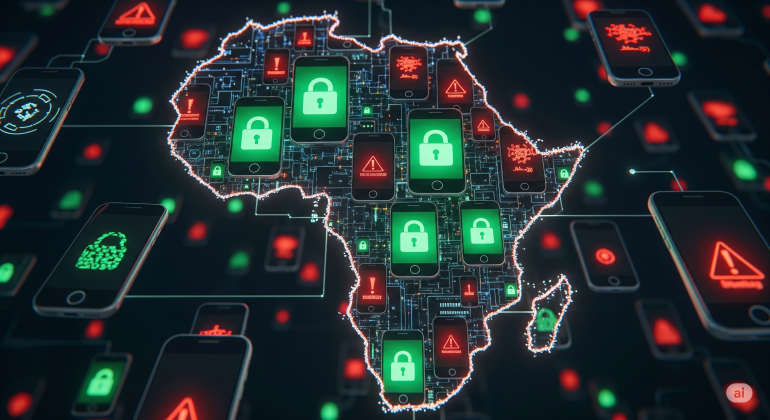
Africa’s cybersecurity awareness has exploded, but the continent just discovered something worse than ignorance: the illusion of knowledge.
Fresh data from KnowBe4’s annual survey of smartphone users across seven African countries reveals a cybersecurity clusterfuck of epic proportions. Concern about cybercrime nearly doubled from 29% to 58% in 2024, which sounds fantastic until you realise that 83% of people think they can spot a security threat whilst 53% couldn’t identify ransomware if it encrypted their grandmother’s WhatsApp photos.
Welcome to the Dunning-Kruger effect, cybersecurity edition. Africa’s digital revolution is accelerating at breakneck speed, but security knowledge is stuck in first gear–and that gap is about to become very expensive.
The Mobile Money Gold Rush Has a Malware Problem
Here’s the thing about Africa’s mobile money miracle: it’s probably the most successful financial inclusion story in human history, and it’s also setting up millions of people for spectacular digital heists.
Mobile financial services usage exploded from 63% to 85% amongst survey respondents, with 95% now using some form of mobile payment or banking. Kenya leads the charge with 28% using mobile payment apps–nearly triple the continental average. South Africa and Morocco aren’t far behind, with over half their users embracing mobile banking.
But whilst users are downloading banking apps faster than they can say “M-Pesa,” their security awareness is stuck somewhere in the feature phone era. According to the Communications Authority of Kenya, mobile application threats surged by 333% in just three months leading up to September 2024. That’s not a typo–333%.
The criminals aren’t sleeping. They’re adapting faster than users can learn, and they’re getting creative. In South Africa, where 189 cellphones are stolen daily, criminals have figured out that stealing an unlocked phone isn’t just grand theft–it’s grand theft plus instant access to someone’s entire financial life.
WhatsApp Became Africa’s Unofficial Office Suite (And Nobody Asked IT)
Plot twist: WhatsApp isn’t just how Africans chat with friends anymore–it’s how they do business. Usage for work jumped from 89% to 93%, making it more popular than email (78%), LinkedIn (45%), or even Zoom (48%) for professional communication.
Think about that for a second. A messaging app designed for sharing memes and family photos is now the backbone of African business communication. IT departments across the continent are probably having stress-induced migraines right about now.
This isn’t just a quirky cultural shift–it’s a security nightmare. WhatsApp conversations blend personal and professional data in ways that would make compliance officers weep. When your grandmother’s birthday photos sit next to sensitive client information on the same device, traditional security boundaries become meaningless.
The Password Problem That Makes You Want to Scream
Ready for the most depressing statistic in cybersecurity? When asked to identify a strong password, 26% of respondents chose “P@$$word!” Seriously. A quarter of African users think slapping an exclamation mark and some dollar signs on “password” qualifies as Fort Knox-level security.
It gets worse. Understanding of strong passwords actually declined from 62% to 58% between surveys. As cyber threats become more sophisticated, user knowledge is moving backwards. It’s like watching someone try to fight a drone with a slingshot.
Multi-factor authentication fares slightly better, with 58% understanding the concept correctly. But 22% think it means “entering my password twice for extra security,” which is roughly equivalent to thinking you can stop a bullet by wearing two T-shirts.
The Oversharing Economy Has Arrived
Here’s where things get properly alarming: the percentage of respondents very unlikely to share personal information nosedived from 29% to 15%. Meanwhile, 14% now feel comfortable sharing personal details, with 8% willing to trade privacy for discounts.
Egypt leads this digital strip-tease, with 11% of users very willing to share personal information, followed by Nigeria at 10%. It’s as if increased digital literacy creates decreased digital wisdom–the more comfortable people get with technology, the more they forget why privacy matters.
This isn’t just about targeted advertising or spam–it’s about creating detailed profiles that criminals can use for sophisticated social engineering attacks. When you’ve voluntarily shared your birth date, mother’s maiden name, and favourite restaurant for a 10% discount, you’ve essentially done half the hacker’s work for them.
AI Makes Everything Worse (Obviously)
As if the cybersecurity landscape wasn’t challenging enough, AI has entered the chat–and it’s not here to help the good guys. While 42% of African users have embraced ChatGPT for research and productivity, cybercriminals are using the same technology to craft personalised phishing campaigns that would fool a security expert.
The survey found that 37% of respondents have fallen for fake news or disinformation campaigns. Now imagine those campaigns supercharged with AI-generated content that can mimic writing styles, create convincing fake images, and personalise attacks based on scraped social media data. The result isn’t just misinformation–it’s weaponised misinformation with surgical precision.
The Phishing Renaissance
Despite all the awareness campaigns and training programmes, phishing victims actually increased from 26% to 32%. Read that again: as general cybersecurity concern doubled, actual victimisation rates went up.
This isn’t because people are getting stupider–it’s because criminals are getting smarter. Modern phishing campaigns don’t look like those obvious Nigerian prince emails anymore. They’re sophisticated, contextual, and designed to exploit specific psychological triggers.
According to SABRIC’s 2024 crime statistics, digital banking and mobile app crime cost South African consumers over R1 billion in 2023. That’s not just numbers on a spreadsheet–that’s people’s life savings disappearing into criminal cryptocurrency wallets.
The Training Mirage
Corporate cybersecurity training is improving–33% of respondents now strongly agree their employers provide adequate training, up from 21% previously. That sounds encouraging until you remember that these are the same people who think “P@$$word!” is secure.
The problem isn’t the quantity of training–it’s the quality. Traditional cybersecurity education focuses on theoretical knowledge rather than practical skills. It’s like teaching someone to drive using only textbooks and then acting surprised when they crash the car.
What Actually Needs to Happen
Africa’s cybersecurity crisis requires solutions as innovative as the continent’s digital transformation. Here’s what needs to change:
Kill the Awareness Industrial Complex: Stop measuring success by how many people attended training sessions and start measuring how many people can actually spot a phishing email in the wild.
Build Mobile-Native Security: Africa is mobile-first, but security education is still desktop-centric. Training programmes need to be designed for thumb-scrolling, app-switching, notification-heavy mobile environments.
Gamify Real Threats: Instead of boring PowerPoint presentations about password security, create interactive simulations that let people experience the consequences of poor security choices in a safe environment.
Address the Trust Problem: Users need to develop what cybersecurity experts call “calibrated trust”–the ability to make nuanced decisions about when digital trust is appropriate rather than defaulting to naive acceptance or paranoid rejection.
The stakes couldn’t be higher. Africa’s digital revolution represents one of the most significant economic opportunities in modern history. Mobile money has already demonstrated how leapfrog technologies can transform entire economies overnight.
But if the cybersecurity foundation crumbles, the whole digital house of cards comes down with it. Africa has built the most innovative mobile-first digital economy on the planet. Now it needs to secure it before the criminals figure out how to steal it all.
The continent’s youngest global population represents both the solution and the challenge. These digital natives possess intuitive technology skills, but they also exhibit the dangerous overconfidence that comes from growing up online. They know how to use technology–they just don’t know how to use it safely.
The window for getting this right is closing fast. As Interpol’s 2024 African Cyberthreat report makes clear, cybercriminals are already adapting their tactics to exploit Africa’s unique digital landscape. The emergence of “fraud-as-a-service” platforms is democratising cybercrime just as mobile technology democratised financial services.
Africa’s cybersecurity awareness doubled in 2024, but awareness without competence is just expensive ignorance with better PR. The continent needs to move beyond feel-good awareness campaigns to building actual digital resilience. The alternative isn’t just more cybercrime–it’s the derailment of the most promising digital transformation story of the 21st century.
The race is on. Will Africa’s security education catch up to its digital ambitions, or will overconfidence kill the mobile money revolution? The answer will determine whether the continent’s digital future is defined by empowerment or exploitation.