

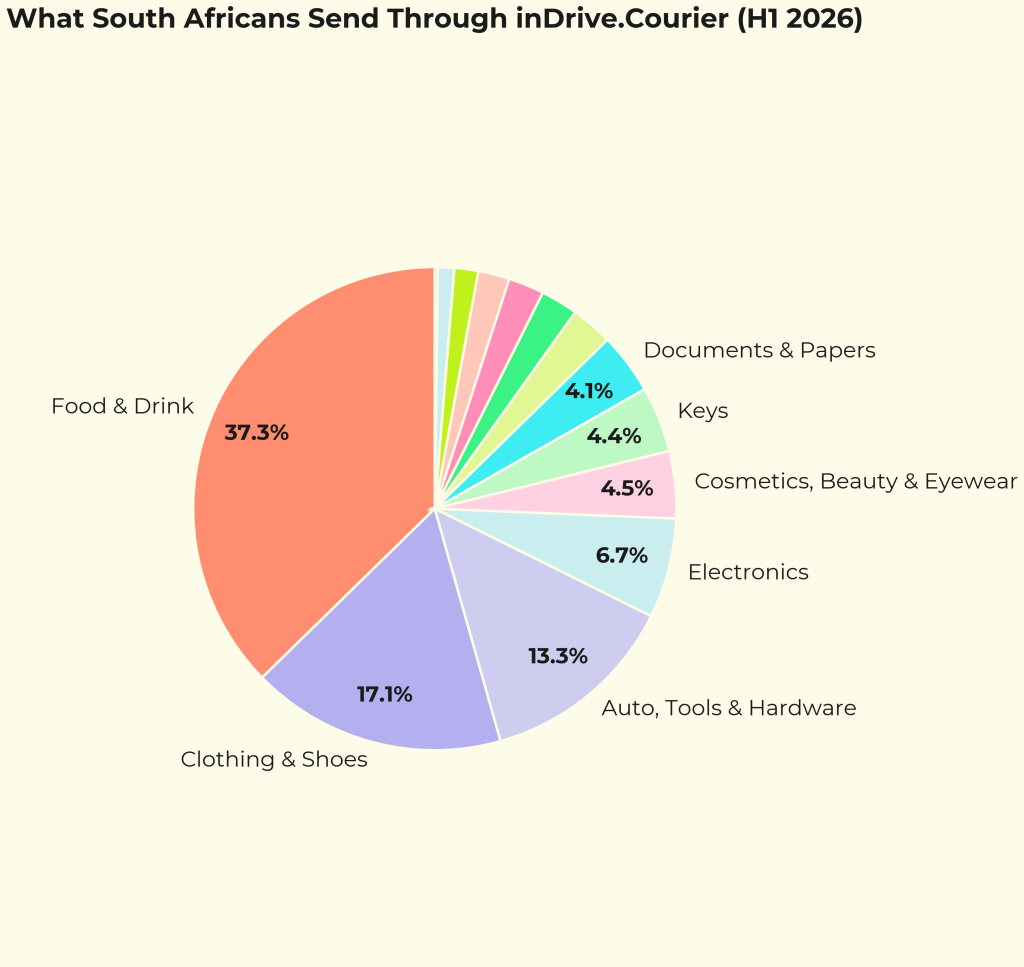
South Africans appear to have found a straightforward use for on-demand couriers: avoiding the small trip across town that eats into the day. An analysis of roughly 5,000 inDrive.Courier orders placed locally during the first half of 2026 found Food & Drink accounted for 37.4% of classified orders, with cake appearing in 9.1% of those deliveries. That was the highest proportion for cake across the nine countries included in inDrive’s analysis.
The cake statistic will probably get the attention because it’s funny, although the categories around it say more about what people are doing with the service. Clothing & Shoes accounted for 17.1% of classified South African orders, followed by Auto, Tools & Hardware at 13.3%. South Africa had the highest share of Auto, Tools & Hardware deliveries in inDrive’s international dataset, while electronics made up just 6.7% of local orders.
That category mix looks peculiar beside ordinary online shopping. DHL’s 2025 survey of South African online shoppers found clothing and electronics were each bought by 70% of respondents, and 86% preferred home delivery when receiving online purchases. A conventional e-commerce order already has a delivery process attached to it, so someone buying a phone or pair of headphones generally has little reason to arrange a second courier themselves.
inDrive’s smaller categories include cosmetics, keys, documents and papers, which puts some of these orders in a different part of the day. The object may already belong to the person sending it, or it may have been bought somewhere that doesn’t offer the delivery they need. Sometimes it has simply ended up in the wrong place.
The delivery fee buys you the trip
A car part is particularly useful for understanding the appeal. The part may be sitting at a supplier while the car is at a workshop elsewhere, leaving somebody to collect it before any repair can happen. Paying a courier can be easier than stopping work, driving across town and then making another trip to the workshop, especially when the item itself is small enough that paying for a dedicated delivery is reasonable.
Keys fit the same behaviour without involving a purchase at all. Leave them at someone’s house, forget them at the office or need to get a spare set to another person and the courier is being paid to solve a location problem. Documents can work much the same way when a physical copy still has to reach somebody.
App-based delivery has been edging towards this broader role for some time. Uber Eats’ expansion deeper into grocery and retail in South Africa has widened the range of things people expect to arrive after opening a delivery app. Grocery and retail delivery still usually begin with something being bought, whereas an on-demand courier can enter the process afterwards, or without a retail transaction ever taking place.
That opens up a rather large collection of minor inconveniences that conventional delivery companies aren’t necessarily designed around. A parcel network is good at moving goods through an established logistics chain. An on-demand courier can be useful when one specific object needs to get from wherever it happens to be now to wherever somebody needs it next.
The numbers shouldn’t be stretched too far. Roughly 5,000 orders from one platform over six months aren’t a proxy for the entire South African courier market, and inDrive has a commercial interest in demonstrating the range of uses for its service. The dataset does show what people choose to move when they can buy an individual trip on demand, and the everyday nature of some of those objects is useful in itself.
Handing over the house keys changes the trust calculation
Using a courier for personal belongings also puts more pressure on the mechanics of the service. DHL’s 2025 South African research found four in five online shoppers wouldn’t buy from an online retailer if they didn’t trust its delivery or returns provider, while 40% already track and redirect deliveries through the delivery provider’s app.
There is an extra degree of intimacy when the courier has something that wasn’t ordered from a shop. inDrive says its couriers undergo identity verification during registration, while customers can view ratings and trip history before choosing one. The service includes live tracking that can be shared with the recipient, as well as an optional one-time password that the recipient must provide before the delivery can be marked complete.
Those features are familiar across modern delivery services, although their value changes with the item in transit. Watching a map because lunch is taking longer than expected is useful. Watching it because your only spare set of house keys is moving through Johannesburg is a considerably less casual use of the same feature.
What inDrive’s data doesn’t tell us is how often the behaviour repeats. We don’t know how many of those 5,000 orders came from repeat customers, how frequently the same person uses a courier for these errands or whether car parts, keys and paperwork are occasional rescue jobs rather than something people have started routinely paying others to move. That would be more useful for judging where this market is going than another ranking of which object South Africans sent most often.