

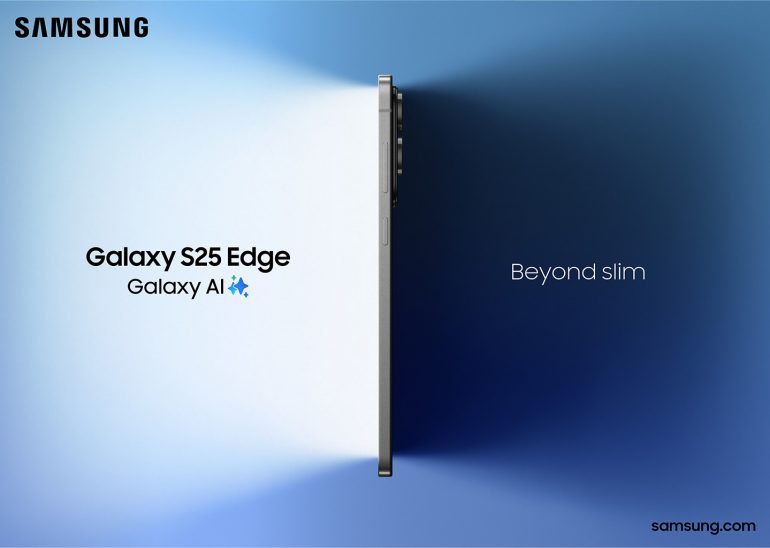
The Galaxy S25 Edge is here — and it might be one of Samsung’s most beautiful, unnecessary phones yet.
Let’s start with the good stuff. This is Samsung’s thinnest flagship phone ever. At just 5.8mm and 145g, it makes an iPhone 15 Pro feel like a brick. It’s a love letter to minimalism, a feat of engineering, and it looks genuinely premium in a way we haven’t seen since the Galaxy S6 Edge — which, ironically, was actually curved.
But then you pick it up and start asking questions.
Where’s the telephoto lens? Why is the battery just 3,900mAh? Why does this have the “Edge” branding when there are… no edges? And more importantly, who is this for?
Form over function — again
This feels like a spiritual sequel to the Galaxy S6 Edge: gorgeous design, slightly impractical specs, and a release that seems more about Samsung showing off what it can build rather than what people need.
Sure, it has the new Snapdragon 8 Elite for Galaxy, a 200MP main camera, and a 6.7-inch flat AMOLED display with 120Hz refresh rate. But beyond that? It starts to feel like a fashion phone. No telephoto. No curved display. No reason it needs to exist other than the design team saying, “Look how thin we made it!”
This is a phone you admire, not one you necessarily buy.
A glimpse at the foldable future?
It’s tempting to think the Galaxy S25 Edge is a preview of what’s to come. A recent leak of the Galaxy Z Fold 7 shows a wider, slimmer design — and this device might be laying the groundwork for that shift. A flat, thin flagship lets Samsung experiment with materials, thermals, and spatial trade-offs before committing to a full-scale foldable redesign.
If the Fold 7 ends up being a fan-fold hybrid with minimal crease and S25 Edge-like proportions, this all starts to make a lot more sense.
But until then, the S25 Edge is in an odd place. It’s not the top-tier S25 Ultra. It’s not as accessible as the base S25. And it’s certainly not a foldable. It’s just… thin.
The price of minimalism
Making a device this thin isn’t free — and we don’t just mean the actual price tag (though it’s likely to sit near R23,000–R25,000 in South Africa).
The thinness means a smaller battery, which Samsung is trying to offset with software efficiency and chip improvements. But as we’ve seen with other ultra-slim phones, battery anxiety creeps in fast. There’s no headphone jack (of course), no microSD slot (Samsung gave up pretending years ago), and while the 200MP main sensor looks good on paper, the absence of a zoom lens is disappointing at this price.
Even the camera bump — which sticks out noticeably — seems at odds with the whole “seamless slab” aesthetic Samsung is going for. It’s a reminder that you can only shrink things so far before physics pushes back.
Who is this for?
That’s the big question. The Galaxy S25 Edge is probably for design-first users: people who want something that feels like the future in their hand, even if they’re giving up a few essentials. It’s not for gamers. Not for power users. Probably not for photographers, either.
Samsung knows this. This phone isn’t trying to be the best all-rounder. It’s trying to be a talking point.
And in that sense, it works.