

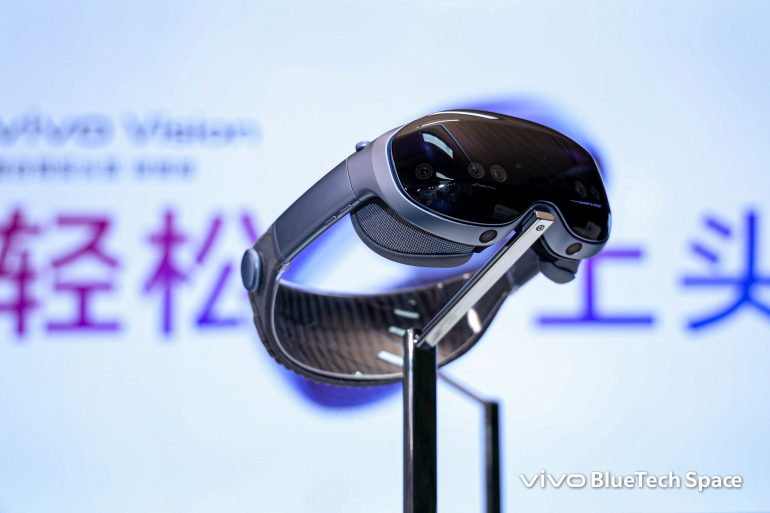
If you were expecting a clunky, headset‑shaped brick, the vivo Vision Discovery Edition might just surprise you. At 398 g, 83 mm tall and 40 mm thick, vivo claims it’s “26 percent smaller than the industry average.” The company has gone all in on ergonomics too: four light‑seal sizes, eight foam options. In other words, they want you to forget you’re wearing it — at least for a while.
vivo’s first mixed reality (MR) headset is also a showcase for their optics chops. Dual Micro‑OLED screens deliver “8K binocular resolution,” 94 percent DCI‑P3 coverage, and DeltaE under 2. If that reads like overkill, consider it the company’s way of saying, “We can do cinema-grade visuals in a headset that isn’t a paperweight.”
Performance is courtesy of Qualcomm’s Snapdragon XR2+ Gen 2. vivo says it’s “up to 2.5× GPU performance and 8× AI performance” over the previous generation. That’s the kind of jump you want for smooth eye-tracking, gesture control, and spatial rendering. Speaking of which, OriginOS Vision handles input with 1.5-degree eye-tracking and 26 degrees of fingertip freedom. For reference: that’s enough precision to make the difference between flailing at menus and actually feeling like a Jedi.
Hu Baishan, vivo’s Executive VP and COO, framed the headset as part of a long-term mission: “Our aim is to let ‘technology illuminate beauty’, and our goal is to reach every user.” It’s a bit dramatic — but then, this is vivo celebrating 30 years. There’s history here, but also ambition.
Imaging remains vivo’s ace. They’ve upgraded their strategy to cover night shots, telephoto macro, cross-device experiences, and even health tools. ZEISS is onboard too: André Kutz called the collaboration “both deep and broad… continuously innovating in the area of smartphone optics.” And yes, there’s a portable slit lamp teased for ophthalmic diagnostics, because why not mix health tech with MR?
vivo is also leaning into culture. Li Ge from the China Photographers Association said, “vivo’s decade-long exploration in imaging shows how technology can make professional-grade photography accessible to all.” It’s the company’s way of saying: we want your MR experiences to be creative, not just cinematic.
Here’s the kicker: the hardware is impressive, but MR isn’t just about gear. Watching a 120-foot virtual screen or multiple sports angles sounds cool, until the content ecosystem is empty. This is where vivo has to prove itself. For a sharper look at why the software, content, and developer ecosystem make or break mixed reality headsets, see our deep dive: Meta’s augmented ambitions: A new era of mixed reality and AI?.
For South African audiences, this headset is a curiosity for now. China gets first access, and the wider rollout depends on whether vivo can pull creators, apps, and partnerships into its orbit. If they succeed, the vivo Vision Discovery Edition could be the MR headset you actually wear. If not, it’ll be a glimpse at what could have been.