
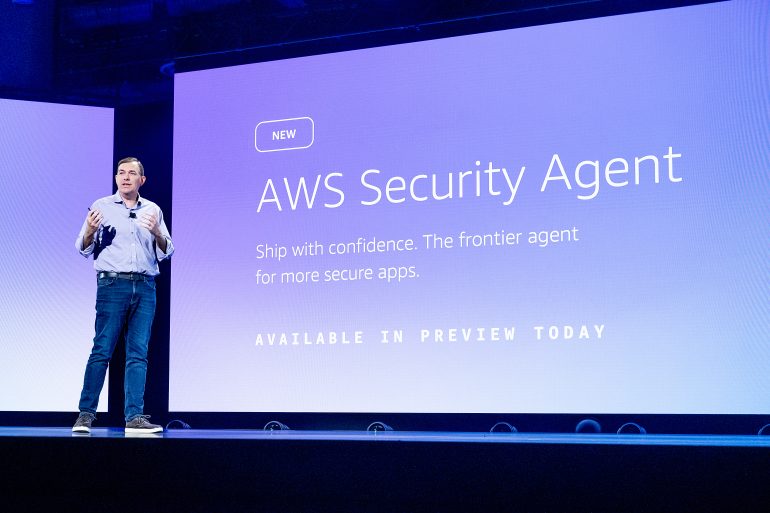
AWS has launched what it’s calling frontier agents, a new class of AI agents designed to work autonomously for hours or days without constant supervision. The first three agents tackle software development, security, and operations: Kiro autonomous agent functions as a virtual developer, AWS Security Agent acts as a security engineer, and AWS DevOps Agent handles operational issues. They’re positioned as extensions of development teams rather than assistants, capable of completing complex projects independently.
The defining characteristics of frontier agents are autonomy, scalability, and independence. You give them a goal, they figure out how to achieve it, they can handle multiple tasks simultaneously, and they work without needing intervention for extended periods. It’s a significant shift from current AI coding tools, which mostly assist with individual tasks and require constant human direction.
Kiro autonomous agent maintains persistent context across sessions and learns from pull requests and feedback. It can handle tasks ranging from triaging bugs to improving code coverage, with single changes spanning multiple repositories. You can assign tasks directly from GitHub, and the agent works independently, sharing changes as proposed edits and pull requests. For teams, Kiro builds collective understanding of codebases, products, and standards by connecting to repos, pipelines, and tools like Jira, GitHub, and Slack.
Kiro addresses the context-switching problem that drags down developer productivity. Developers spend significant time juggling background tasks, rebuilding context, coordinating cross-repository changes, and stitching together information scattered across tickets and chat threads. Kiro handles that friction so developers can focus on high-priority work. Whether it actually delivers on that promise depends on how well it understands your specific codebase and standards, which only becomes clear after extended use.
AWS Security Agent embeds security expertise throughout the development lifecycle, proactively reviewing design documents and scanning pull requests against organisational security requirements and common vulnerabilities. You define security standards once, and the agent automatically validates them across applications. It also transforms penetration testing from a slow manual process into an on-demand capability, returning validated findings with remediation code. If you have multiple apps deploying simultaneously, you can scale the number of Security Agents to meet demand.
SmugMug, a photo hosting platform, used Security Agent to catch a business logic bug that exposed information improperly. According to staff software engineer Andres Ruiz, existing tools wouldn’t have caught it because it required contextualising information and parsing API responses to find unexpected data. That’s the kind of vulnerability only human testers typically spot, and if Security Agent can consistently identify these issues, it represents a genuine leap in automated security testing.
AWS DevOps Agent delivers always-on incident triage, guided resolution, and recommendations for improving application reliability and performance. When incidents happen, the agent instantly responds, using knowledge of your application and component relationships to find root causes. It learns your resources and their relationships across observability tools like CloudWatch, Dynatrace, Datadog, New Relic, and Splunk, plus runbooks, code repositories, and CI/CD pipelines. It maps application resources and correlates telemetry, code, and deployment data to pinpoint root causes and reduce mean time to resolution.
Commonwealth Bank of Australia tested DevOps Agent on a complex network and identity management issue that typically takes seasoned engineers hours to identify. The agent found the root cause in under 15 minutes. If that performance is consistent, it could significantly reduce downtime and operational burden, particularly for organisations running large distributed systems.
AWS is explicitly positioning frontier agents as team members rather than tools. They’re not assistants that help with tasks; they’re autonomous systems that complete projects independently. That’s a significant conceptual shift, and it’s unclear whether organisations are ready for it. Trusting an AI agent to work unsupervised for hours requires confidence in its reliability and understanding of your specific context, and that trust takes time to build.
For South African organisations managing software development, security, and operations at scale, frontier agents are worth watching but probably not adopting immediately. The technology is new, and it’s not clear how well it performs across diverse environments and use cases. Customers like Clariant, Commonwealth Bank of Australia, SmugMug, Western Governors University, and Presidio are already using these agents, but they’re large organisations with resources to manage experimental technology.
AWS’s aim here is to push AI agents from task automation to autonomous operation, and if frontier agents deliver on their promises, they could genuinely transform how software is built and maintained. The challenge is whether organisations trust AI enough to let it work independently and whether the technology is reliable enough to justify that trust.