
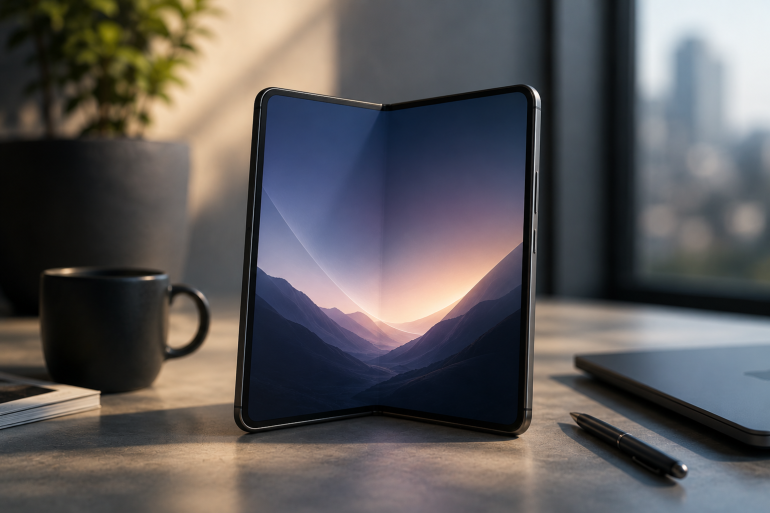
We still call it a phone. That habit is probably the strangest thing left in how we talk about the device in our pockets, because making a phone call is now one of the least interesting things it does. It unlocks our front door, holds our banking app, replaces our passport at an airport gate, edits a client deck on the train, and increasingly does all of this while quietly consulting something that isn’t quite an app and isn’t quite a person either. The word “phone” survives out of habit, not accuracy. Nobody has come up with a better one yet.
Getting to Samsung means starting somewhere else first, because Samsung isn’t really the story here. Its rumoured wider Galaxy Z Fold 8 is the reason this piece exists, but treating it as a foldable-phone story would miss what’s actually interesting about it. A near-complete leak of the Fold 8’s specifications did the rounds last week, courtesy of a detailed report from Android Central, which described a device measuring a strikingly slim 4.5mm when unfolded and adopting a 4:3 aspect ratio closer to a small tablet than a conventional smartphone. TechRadar corroborated much of that leak independently, adding that Samsung appears to be splitting its foldable line in two: a wider “Fold 8” aimed squarely at the format Apple is rumoured to be chasing, and a “Fold 8 Ultra” that inherits the narrower, taller shape long-time Fold owners already know. The Verge has run its own leaked renders of the wider model, and PhoneArena has covered the colourways expected across both. Samsung has not confirmed a second Galaxy Unpacked event this year. It has not announced a Fold 8 of any description. Everything circulating right now sits in the leak economy that surrounds every major phone launch, repeated and cross-referenced by outlets with a strong track record on Samsung specifically, but unconfirmed all the same.
None of that would be worth an essay if it were only about screen width. A separate, less remarked-upon leak changes that, also detailed by PhoneArena, suggesting the S Pen is coming back to a Fold for the first time since Samsung stripped it out of the line to shave down thickness. That’s a company adding stylus support back into a device it had just spent two generations making thinner without one. It only makes sense if Samsung is betting that people will spend more time creating, annotating and working inside these things than it assumed a year ago. A stylus is a tool for a computer, not an accessory for a phone.
Foldables, as a category, were built on a slightly different assumption to the one now driving that S Pen decision. The industry pitch since 2019 has been that people wanted a tablet that fits in a pocket. It’s an appealing idea and it has never quite landed, for the same reason tablets themselves never fully replaced laptops: a bigger screen doesn’t automatically make a device better at getting things done. Tablets remained brilliant for consuming and middling for producing, because the software running on them was still built around single-purpose apps that needed a keyboard, a mouse, or a stylus bolted on as an afterthought to feel complete. Foldables inherited that same ceiling. They gave you more screen, not more capability. A wider Fold 8 doesn’t automatically escape that trap either, unless something about how people use the device has actually changed.
Something has. For most of the smartphone era, using a device meant opening the right app for the right job. Plan a trip and you’d open a browser to compare flights, a maps app to check the drive from the airport, a calendar to see which week actually works, a banking app to see what you can afford, and WhatsApp to loop in whoever you’re travelling with. Every one of those steps required you to know which tool did which job and to move between them yourself. Agentic AI removes that requirement almost entirely. You say “plan my trip to Durban in September” and the coordination happens without you having to know, or care, which app is doing what underneath. Samsung has already built a version of this into its current flagships. The Galaxy S26 launched earlier this year with what the company calls a multi-agent system, letting Bixby, Gemini and Perplexity work alongside each other rather than forcing a single assistant to handle everything, a shift we covered in detail when Samsung’s Galaxy S26 and Galaxy Buds 4 brought multi-agent AI to South Africa. The task has become the interface. The app hasn’t disappeared, but it’s stopped being the thing you have to think about.
Once the interface changes like that, hardware eventually follows it, and that’s the more useful way to read what’s happening with a wider Fold. A phone organised around apps rewards a screen shaped for scrolling one thing at a time. A phone organised around outcomes rewards a screen wide enough to hold a plan, a document and a conversation next to each other while an agent stitches them together. Samsung’s outer display on the rumoured Fold 8 is reportedly growing to 5.5 inches, nearly as capable on its own as last year’s cover screen was when fully unfolded. Manufacturers seem to be betting that a meaningful share of AI interaction is going to happen without anyone opening the device fully at all, which would make the outer display every bit as important as the inner one, not a smaller companion to it.
Samsung isn’t leading this shift on its own, and it’s worth being honest about that. OPPO got there first with the Find N and Find N2, before OnePlus brought its own book-style foldable to market with the Open. Google has been iterating on the Pixel Fold since 2023. Huawei went furthest of all in April, putting the Pura X Max on sale in China with a genuinely wide, passport-shaped design well ahead of any of its rivals, at a starting price north of R30,000. Apple’s own foldable iPhone remains unreleased, but reporting from MacRumors points to a September 2026 launch alongside the iPhone 18 lineup, arriving with a similarly wide, book-style shape and a price expected to clear $2,000. None of these companies invented the wide foldable independently of each other. What’s more interesting than any single first is that four separate manufacturers, working from different supply chains and design philosophies, have converged on roughly the same proportions inside the same eighteen months. That kind of convergence usually means something in the underlying use case has shifted, not that everyone happened to like the same shape.
It’s also a shift with an uneven starting line, and nowhere is that clearer than here. Most South Africans buying a phone this year are not choosing between a Fold 8 and an iPhone Ultra. They’re stretching a mid-range device across four or five years, replacing a battery rather than the whole handset, and weighing a Galaxy A-series phone against whatever Xiaomi or Honor is offering at a similar price. If the organising principle of computing really is moving from apps to agents, that raises a question with real consequences for a market like this one: does AI capability require flagship hardware to feel meaningful, or can it run acceptably on the phones people can actually afford? Smartphones themselves transformed South Africa precisely because they escaped the premium tier fast enough for ordinary people to carry the internet in their pockets within a decade of the first iPhone. Whether the agentic layer follows the same path, or stays locked to devices costing more than most people’s monthly salary, will decide whether this becomes a second smartphone revolution or another feature reserved for people who can already afford flagship hardware.
Samsung has spent the past two years building the software case for that shift before the hardware caught up with it. Galaxy AI first arrived with the S24 in 2024 as a set of on-device features bolted onto an otherwise conventional phone. By the S26, it had grown into that multi-agent system letting three different assistants share the load depending on what’s actually being asked. A wider Fold with the S Pen restored and an outer display treated as a genuine workspace looks less like Samsung discovering a new gimmick and more like the hardware finally being asked to catch up with decisions the software side made a generation earlier.
None of this makes the word “phone” wrong exactly. It just makes it a word describing where the device came from rather than what it has actually become, in the same way “car” still carries the etymological ghost of a horse-drawn carriage decades after the horse left the picture entirely. We’re going to keep calling it a phone for a while yet, mostly because language changes slower than hardware does. The more useful question, watching Samsung, Huawei and Apple all quietly build towards the same wide, agent-shaped device from three different directions, isn’t what to call it. It’s what we’re actually going to ask it to do once we stop needing to open it to find out.