
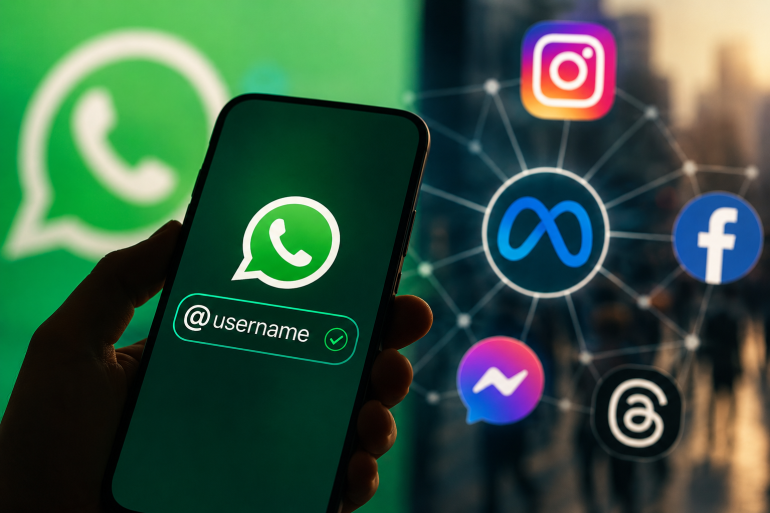
The internet has never struggled to identify people. It’s struggled to recognise them.
Over the past two decades we’ve accumulated a collection of digital identities that rarely speak to one another. An email address unlocks work. Instagram revolves around a username. LinkedIn expects your real name. Banking apps rely on your phone number. WhatsApp has always treated that same number as both your address and your identity, assuming the people who wanted to contact you already knew how to reach you.
Meta’s decision to introduce WhatsApp usernames will inevitably be described as a long-overdue privacy feature. Giving people the option to start conversations without revealing their phone number is an obvious improvement on a platform used by billions. The more consequential change sits beneath the feature itself. WhatsApp is beginning to separate identity from the information used to authenticate it, moving away from a model where a SIM card defines who you are towards one where that identity can move more freely across Meta’s products.
When WhatsApp launched in 2009, it wasn’t trying to help people discover one another. It replaced SMS with something faster and richer, assuming the people in your contacts were already part of your life because you already had their phone numbers. In that environment, a phone number wasn’t simply a way of routing messages. It represented an existing relationship, making it perfectly reasonable for identity and contact details to become the same thing.
The way people use WhatsApp today reflects a very different internet. In South Africa, the app has become the country’s default communications platform for everything from school notices and neighbourhood watch groups to doctor’s appointments, customer support and second-hand sales. Around the world, it’s just as common to message a business, an estate agent, a landlord or someone selling a bicycle as it is to message a family member. The app has evolved from a digital address book into communications infrastructure, yet every new interaction has continued to begin with the exchange of a permanent personal identifier.
Usernames acknowledge that shift by allowing the relationship to begin before the phone number is revealed, if it’s ever revealed at all. The number still sits behind the account because it’s useful for verification, security and recovery. It no longer needs to become the first piece of information another person learns about you.
Meta presents that as a privacy improvement, although privacy is only part of the story. Someone who has spent years using the same handle on Instagram, Threads and X will probably choose it again on WhatsApp. The phone number disappears from public view, but the identity itself may become easier to predict. A familiar username can connect multiple parts of someone’s online life in a way a phone number rarely could, replacing one identifier with another that behaves very differently.
That trade-off becomes even more interesting for businesses. Brands have spent years encouraging customers to move from public social media posts into private WhatsApp conversations. The journey has always involved unnecessary friction. A customer sees an advert, copies a phone number, saves it as a contact, opens WhatsApp and only then starts the conversation. Every additional step creates another opportunity to abandon it.
A username shortens that journey because it behaves like every other modern digital identity. A television advert can end with @BrandName instead of an international phone number. Product packaging, websites and billboards can direct customers towards the same identity they already recognise on Instagram or Facebook. The improvement isn’t simply that usernames are easier to remember. They’re consistent with the way people already navigate the internet.
Consistency has become one of Meta’s biggest strategic advantages. Meta has spent years making its products feel less like separate destinations and more like parts of the same ecosystem. That ambition extends well beyond messaging, shaping everything from AI to mixed reality, as Meta’s augmented ambitions: A new era of mixed reality and AI? demonstrates. Facebook, Instagram, Threads and WhatsApp continue to serve different purposes, but the experience becomes stronger when moving between them feels natural. Usernames contribute to that goal by making identity less dependent on a phone number and more consistent across the platforms people already use.
Meta has experimented with this idea before, although most people have forgotten it. Back in 2016, Facebook Messenger introduced usernames and Messenger Codes as a way for people and businesses to connect without exchanging phone numbers. The feature never became central to Messenger because it solved a problem Facebook didn’t really have. People already discovered one another through profiles, friend requests and the social graph. Messenger simply became another place where those conversations continued.
WhatsApp started from the opposite premise. It wasn’t built on a social network and never tried to become one. The phone number was the social graph. If someone had your number, there was usually a reason for it, and that assumption shaped almost every part of the product’s design.
The internet gradually changed around it.
A customer messages a plumber after finding them on Google. Someone enquires about a flat advertised on Facebook Marketplace. A traveller contacts a guesthouse through its website. A freelancer responds to a job posting. None of those interactions requires a permanent relationship, yet all of them have traditionally begun by exchanging a permanent identifier. Usernames recognise that the platform people use today no longer resembles the one Meta acquired in 2014.
The comparison with China is tempting because it looks as though Meta is following the same path as WeChat. In reality, the two companies have arrived at very different answers to the same question.
WeChat became indispensable by concentrating digital life inside a single application. Messaging, payments, shopping, transport, government services and thousands of Mini Programs all became part of one ecosystem, allowing a single identity to unlock almost everything a user needed. The application became the destination.
Meta never pursued that model. Instead, it built a collection of products that each developed their own role. Instagram became the home of creators and visual storytelling. Facebook remained centred on communities and groups. Threads emerged as a platform for public conversation, while WhatsApp dominated private messaging. The challenge wasn’t persuading people to use those products. It was making them feel connected without making them identical.
Usernames are one answer to that challenge because they allow recognition to move more freely between Meta’s products while leaving each app to do what it already does well. The strategy isn’t about turning WhatsApp into a super app. It’s about making the journey between Instagram, Facebook, Threads and WhatsApp feel less like switching platforms and more like continuing the same digital life.
That creates opportunities that extend well beyond messaging. A retailer using the same identity across Instagram, Facebook and WhatsApp no longer asks customers to learn a new way of finding them. A sports team can carry the same recognisable presence from match-day updates to ticket enquiries. A publisher can move readers from a public post into a private conversation without introducing another layer of friction. The username becomes part of the brand rather than simply another route to it.
Public figures, creators and businesses will almost certainly embrace that consistency because being recognised is part of their value. Other users may decide WhatsApp deserves a different identity from the one they use elsewhere, creating a deliberate boundary between public social media and private conversations. The arrival of usernames doesn’t dictate either approach. It simply makes both possible.
Meta’s products still occupy different corners of the internet because they’re designed for different kinds of interaction. Instagram rewards visibility. Facebook organises communities. Threads thrives on public conversation. WhatsApp remains the place where conversations become private. Usernames don’t blur those distinctions. They make it easier to carry the same identity between them.
That marks a very different path from the one taken by China’s technology giants. WeChat became indispensable by drawing messaging, payments, commerce and public services into a single application. Meta has left those experiences distributed across multiple products, choosing instead to make the person using them feel more consistent. Rather than building a super app, it’s building a common identity that sits above the apps people already use.
For most of WhatsApp’s existence, a phone number served two purposes. It verified the account and it introduced the person behind it. Usernames separate those roles. Phone numbers remain essential to the platform, but they increasingly disappear into the background while recognition shifts to something that can travel more naturally across Meta’s ecosystem. Most people will experience the change as another privacy feature. Looking back, it may come to represent something much larger: the moment Meta stopped treating identity as something attached to an individual app and started treating it as the thread connecting them all.