A TikTok video can travel a very long way in the time it takes a human moderator to decide whether it should have been posted at all, which explains a lot about the numbers in TikTok’s latest Community Guidelines Enforcement Report. Between January and March 2026, the platform removed 1,192,526 videos in South Africa. It says 99.6% were detected before anyone reported them and 94.9% came down within 24 hours.
Globally, TikTok removed 184,012,576 videos, roughly 0.5% of everything uploaded during the quarter. More than 178 million of those removals were made using automated detection technologies, while 8,838,710 videos were later reinstated after further review. Put those figures next to each other and the scale of the moderation problem becomes much more interesting than the headline removal number alone. TikTok needs systems fast enough to identify enormous amounts of violating material before users do, but those systems are increasingly being asked to make decisions that depend on humour, ownership, age, identity, political context and what happened moments earlier in a livestream.
TikTok’s Q1 2026 Community Guidelines Enforcement Report shows a platform whose moderation infrastructure is dealing with several different kinds of judgement at once. In South Africa alone, TikTok removed more than 346,000 accounts it suspected belonged to children under 13 and interrupted 141,565 LIVE rooms for guideline violations. Globally, another 32,504 videos were removed under TikTok’s rules covering edited media and AI-generated content.
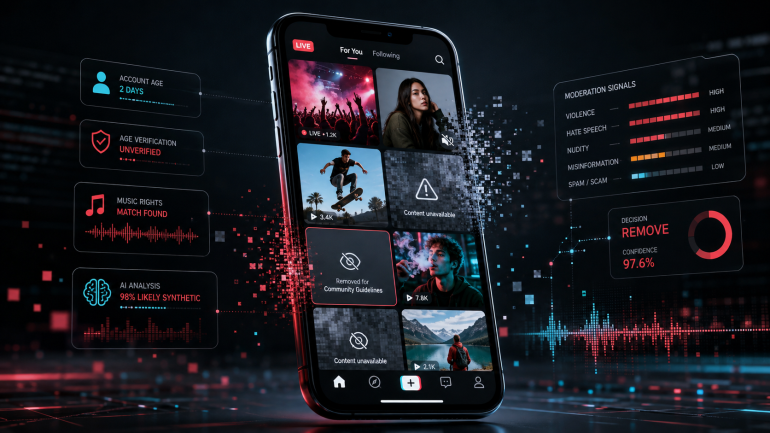
Recognising a prohibited video, estimating whether someone is really 12, stopping a livestream while it is still unfolding and deciding whether synthetic media is misleading are not variations of exactly the same technical task. They rely on different signals and different levels of context, but TikTok has to make all of those decisions at the speed of a platform designed to distribute content almost instantly.
Almost nine million videos came back
TikTok’s 99.6% proactive-removal rate looks impressive, although it answers a narrower question than it might first appear to. It tells us that TikTok found almost all the South African videos it ultimately removed before users reported them. It can’t tell us how much violating material remained on TikTok because the platform never detected it in the first place.
The 8.8 million global reinstatements add something important to that picture because moderation is not always a clean one-way process in which software looks at a video, reaches the correct answer and moves on. Decisions are challenged, reviewed and sometimes reversed. For the person whose video disappears, an error rate that looks negligible across billions of pieces of content can still mean a perfectly ordinary post being removed because it happened to fall on the wrong side of an automated judgement.
There isn’t a credible alternative where people manually inspect every TikTok before the rest of us are allowed to see it. Human moderators can review difficult cases, appeals and material escalated by automated systems, but they can’t plausibly sit ahead of the entire TikTok firehose. We’ve seen the same structural problem emerge elsewhere in AI, where human-in-the-loop oversight starts to strain when automated systems operate faster than people can meaningfully review their decisions.
TikTok has an additional problem because those decisions are being made while the material is already moving through the feed. A moderation system can be highly accurate overall and still make millions of decisions that later need to be undone, while an appeal process that eventually reaches the right answer may still arrive long after a post has lost its audience.
LIVE turns moderation into a race against time
LIVE makes that timing problem much harder to ignore. TikTok says it interrupted 141,565 LIVE rooms in South Africa during Q1 for breaches of its guidelines. Globally, it recorded enforcement actions including warnings and demonetisation against 58,207,389 LIVE sessions and 21,996,667 LIVE creators under its monetisation rules.
Those global figures cover different kinds of enforcement and shouldn’t be mistaken for 58 million dangerous livestreams. A warning about monetisation and the termination of a broadcast are plainly different events, but both have to be dealt with while the content is still unfolding.
A prerecorded video can be reviewed after publication and still be removed before it gathers much of an audience. A LIVE may be over before a human moderator has finished working out what happened. That makes some level of automated detection unavoidable, while also making incorrect automated decisions more consequential. A false positive on an uploaded video can be reversed later. A wrongly terminated livestream can’t be recreated with the same moment, audience and context, just as a harmful LIVE can’t be unseen because TikTok eventually reached the correct conclusion 20 minutes after it happened.
TikTok removed 346,000 South African accounts because it didn’t trust the age attached to them
Video moderation at least begins with a piece of media that can be examined. Age enforcement asks TikTok to make a judgement about the person behind the screen.
The company says more than 346,000 accounts in South Africa were removed during the quarter because they were suspected of belonging to children younger than 13. These were suspected under-13 accounts, not 346,000 independently verified South African children, and one user can create more than one account.
What matters technically is what happens once TikTok decides the birthday attached to an account probably isn’t reliable. From that point, age assurance has to depend on other signals, whether they come from account behaviour, content, additional verification or some combination of them.
That pushes TikTok into a more complicated form of moderation because it isn’t simply classifying what a user posted. It is inferring something about the user themselves. The demand for stronger age assurance also sits awkwardly beside demands for platforms to collect less information and make fewer assumptions about the people using them. Both expectations eventually have to be translated into an actual decision about whether an account stays online.
In South Africa, TikTok says it made that decision hundreds of thousands of times in three months.
AI moderation isn’t really about detecting AI
TikTok removed 32,504 videos globally during Q1 under its policy covering edited media and AI-generated content. The platform also requires realistic AI-generated material to be labelled in specified circumstances, uses automated detection alongside creator-applied labels and supports C2PA Content Credentials, which can preserve information about the origin and modification of compatible media. TikTok says more than three billion videos have now been labelled through its broader transparency efforts.
Detecting that AI was involved in producing an image or video only gets TikTok part of the way towards deciding whether the content is a problem. There are perfectly legitimate reasons to create a synthetic person, alter an image or generate video that never happened. The moderation decision changes when the material is presented in a way that misleads people about reality.
Taylor Swift has already provided an unusually public example of how quickly that becomes a context problem. During the 2024 US presidential election, Donald Trump shared AI-generated imagery falsely suggesting that Swift had endorsed him. Swift later cited the incident when explaining her decision to make her actual political endorsement public.
More recently, Swift’s music has started disappearing from some Trump-affiliated TikTok posts. Entertainment Weekly reported that a Team Trump video using “August” and another Trump-related post featuring “Father Figure” were muted, with TikTok indicating that the copyright owner had made the sounds unavailable. Swift’s representatives haven’t publicly explained precisely what action was taken, and TikTok hasn’t announced a general feature allowing artists to blacklist arbitrary accounts from using their music.
The songs themselves remain available elsewhere on TikTok, which makes the result very different from the platform’s 2024 licensing dispute with Universal Music Group. During that fight, TikTok said it was removing songs written or co-written by songwriters represented by Universal Music Publishing Group across the service.
TikTok’s intellectual-property policy already allows copyright owners to report specific material they believe infringes their rights, while also acknowledging that unauthorised use does not automatically amount to infringement because copyright exceptions can apply.
For TikTok, the important technical shift is towards more granular decisions. A moderation system can no longer assume that because an asset is allowed on the platform, every use of that asset should be treated identically. The song can be legitimate while a particular use becomes the subject of a rights complaint. An AI-generated image can be harmless while another image created with the same technology is deceptive. A person can legitimately use TikTok at 13 and be prohibited from doing so one day earlier.
Context is becoming part of the classification problem
Automated moderation became necessary because platforms needed to classify content at a scale no human workforce could match. That model works best when the relevant signal is relatively clear. Context makes the job far less predictable.
A classifier can identify an image, but determining whether that image is documentary, satirical, deceptive or being used to impersonate someone asks more of the system than recognition alone. Speech can contain identical words while functioning as a threat, a quotation, a joke or condemnation. Music can be licensed to a platform without necessarily being cleared for every commercial or political use.
TikTok has to make versions of those decisions while its recommendation system is doing exactly what it was designed to do: distribute content quickly. That creates an awkward mismatch inside the same platform because distribution benefits from speed, moderation increasingly needs context, and appeals need even more of it.
The almost nine million videos TikTok reinstated during Q1 are one indication of what happens when the first answer doesn’t survive another look. They don’t tell us that TikTok’s systems are bad at moderation, just as the 99.6% proactive-removal rate doesn’t prove they are consistently right. Both numbers describe different parts of the same process.
TikTok’s transparency report can’t tell us how many harmful videos its systems never caught, how many users chose not to appeal incorrect decisions or whether identical content would receive the same result if uploaded again tomorrow. It records enforcement activity rather than independently measuring whether every decision was correct.
What it does show is how far the job has moved beyond recognising obviously prohibited material. TikTok is trying to determine whether users are old enough to be there, whether a livestream needs to be stopped before it finishes, whether synthetic media is deceptively representing a real person and whether an otherwise legitimate piece of music is being used in a way that violates somebody’s rights.
That’s why the 8.8 million reinstatements may be as revealing as TikTok’s much more flattering proactive-removal rate. A moderation system can be accurate overwhelmingly often and still produce millions of decisions that need to be reconsidered once more context becomes available. TikTok’s systems are being asked to make harder calls, while the time available to make them is not getting any longer.