
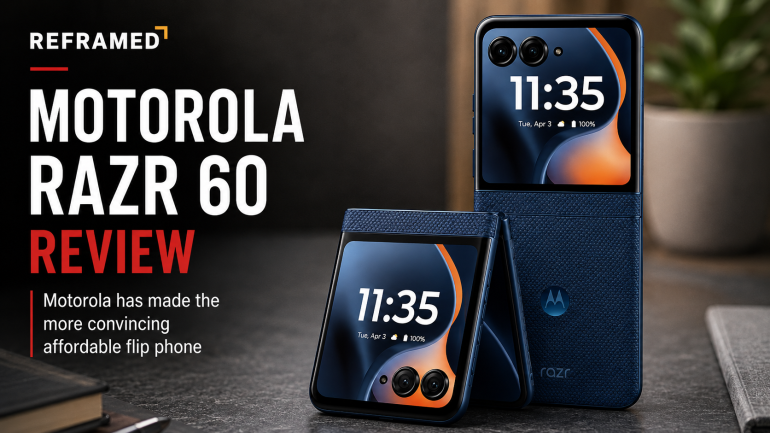
By the time I reviewed the Motorola Razr 60 in May 2026, it had been in South Africa for several months, which was enough time for the initial fascination with another folding phone to have worn off. That helped, because a flip phone can make an unusually strong first impression without necessarily being a particularly good smartphone. The Razr 60 became more convincing once opening and closing it had stopped being the most interesting thing about it.
I liked living with it, and not because Motorola has somehow removed all the compromises that come with a flexible display. The crease is still there, the processor belongs firmly in the mid-range and the long-term software proposition is one of the areas where Samsung remains more reassuring. Motorola has instead made a series of hardware decisions that suit what this phone is meant to be. The internal screen is large, the cover screen is useful rather than decorative, the 4,500mAh battery is generous for the form factor and the cheaper Razr doesn’t feel as though it was designed mainly to persuade you to spend more on another model. Motorola confirms the 6.9-inch main display, 3.6-inch outer screen, Dimensity 7400X and 4,500mAh battery in its official Razr 60 specifications.
That became particularly apparent when I considered it alongside Samsung’s Galaxy Z Flip range. The Galaxy Z Flip7 is the faster phone and has a significantly larger cover display, while Samsung’s software-support advantage is difficult to dismiss. I still prefer the Motorola as a piece of hardware. The Galaxy Z Flip7 FE makes the comparison less flattering for Samsung because more of its compromises are visible in the parts of the phone you interact with every day.
Motorola hasn’t designed the cheaper Razr to feel cheap
There’s still something distinctive about a Razr. Motorola has avoided turning the modern version into a nostalgia prop, but it has also resisted the smartphone industry’s tendency to make every expensive device look as though it belongs in the same boardroom.
The Razr 60 is compact when closed and weighs about 188g. Neither figure explains much until the phone is actually in your pocket. Folding a 6.9-inch smartphone roughly in half changes how easily it disappears into clothing and smaller bags, which remains one of the simplest arguments for this form factor. The phone then opens into something with the screen area of a conventional large Android device rather than asking you to accept a permanently smaller display in return.
Motorola’s choice of finishes helps it feel less anonymous too. There’s texture where many rivals would simply use another sheet of glass, and the phone feels deliberately designed around being handled rather than displayed under retail lighting. None of that affects benchmark scores, but industrial design shouldn’t need to justify itself through benchmark scores.
More importantly, very little about the exterior suggests that this is the less expensive Razr. That isn’t always true of cheaper versions of premium smartphones, where reductions in cost are often communicated to the owner every time they pick the device up. Motorola has made much bigger compromises internally than externally, and after spending time with the phone I think that was the right place to make them.
The hinge opens with enough resistance to feel controlled without requiring any effort, and it holds the phone partially open when needed. I used that more than I expected, particularly for photographs, video and calls when I wanted the phone sitting on a surface rather than leaning against whatever happened to be nearby. A folding mechanism becomes much easier to justify once it starts changing what you can do with the device rather than merely changing how small it becomes.
The crease across the middle of the display hasn’t disappeared. It is visible when the light catches the screen at certain angles and obvious under a finger moving across the centre. My irritation with it declined much faster than the crease itself. During ordinary use, particularly when looking directly at the display, I rarely thought about it after the first few days.
The Razr 60 also carries an IP48 rating, so it has water resistance and limited protection against larger solid objects, although the rating doesn’t make fine dust irrelevant. Motorola’s official specifications list the IP48 certification alongside the rest of the phone’s hardware. I’d still treat a folding phone with more care than a conventional slab around sand or particularly dusty environments, but normal ownership no longer feels like an exercise in protecting a fragile prototype.
The main screen quickly stops feeling unusual
Inside is a 6.9-inch FHD+ pOLED display with a resolution of 2640 x 1080 and refresh rate of up to 120Hz. Motorola uses a tall aspect ratio that makes sense once the display has to fold into the Razr’s compact exterior, and the result works particularly well for the things I spend much of my time doing on a phone: reading, messaging, browsing websites and moving through feeds.
It’s a very good display. Colours have the richness expected from OLED, text is sharp and the 120Hz refresh rate gives Android the fluidity I expect at this price. More expensive phones can offer higher refresh rates, but 120Hz has long since crossed the point where I’m unlikely to feel deprived during ordinary use.
The unusually tall panel can leave more empty space around some video, although that never became a meaningful complaint for me. The benefit is that once the Razr is opened, it behaves like a properly large smartphone. I didn’t find myself accepting a cramped main display simply because the phone could become smaller when closed.
The surface is inevitably softer than conventional smartphone glass and the crease reminds you what kind of display you’re touching. That was far more noticeable to me during the first few hours than it was after several days. Foldables haven’t eliminated their physical peculiarities, but the better ones have reached a point where those peculiarities no longer dictate the experience.
The cover screen earns its place
The 3.6-inch pOLED cover display is smaller than Samsung’s latest approach, but I used it frequently enough that I would be reluctant to move back to a flip phone with a token external panel. Motorola allows considerably more than clocks and notification icons here, and supported apps can run without opening the phone.
Some applications obviously make more sense on 3.6 inches than others. I have no desire to conduct complicated work on a square screen that fits in my palm, but music controls, messages, notifications and quick pieces of information work well. The value lies partly in being able to decide that an interaction doesn’t deserve the full phone.
That changed a small part of my behaviour. Checking one message on a normal smartphone often involves unlocking the device, seeing something else and wandering into another app before remembering why it was in my hand. The Razr 60 didn’t cure me of distraction, and claiming that a folding screen is a digital-wellness intervention would be a stretch, but there were plenty of moments when I read something on the outer display and put the phone away again.
Samsung has gone considerably further with the 4.1-inch FlexWindow on the Galaxy Z Flip7, and I prefer Samsung’s larger external panel when considering the screens in isolation. Samsung also gives it a refresh rate of up to 120Hz. The Razr 60 does not need to win every individual hardware comparison for me to prefer the whole device.
The Galaxy Z Flip7 FE is where Samsung’s approach becomes less convincing. Its smaller cover-screen arrangement and other hardware compromises make the phone feel more clearly like the cheaper member of the family. The Razr 60 has compromises too, but Motorola has concentrated them somewhere else.
The Dimensity 7400X explains the price
Motorola uses MediaTek’s Dimensity 7400X, paired with 8GB of LPDDR4X RAM and 256GB of storage. The 256GB storage is UFS 2.2, which isn’t particularly impressive hardware in 2026. Motorola’s support documentation confirms the processor, memory and storage specification.
This is the part of the Razr 60 that most clearly reveals how Motorola reached its price. The Dimensity 7400X is a mid-range processor, LPDDR4X isn’t new memory technology and UFS 2.2 storage looks dated beside the faster standards used in more expensive phones.
In daily use, however, I found the phone considerably less compromised than that paragraph makes it sound. Messaging, social media, web browsing, photography, navigation and streaming all sit comfortably within the processor’s abilities, and the 120Hz display helps the interface feel responsive. I wasn’t routinely waiting for the Razr to catch up with me.
There’s a difference between saying the performance was good enough for my use and pretending the silicon doesn’t matter. Anyone buying primarily for demanding gaming, sustained workloads or the greatest possible performance headroom over several years can do better for the money. Samsung can do better within the flip-phone category too, with much stronger processors in both of its Flip7 models.
What interested me after using the Razr was where Motorola had chosen not to compromise. I touched the displays, folded the hinge and relied on the battery every day. The processor rarely became the subject of my attention. That won’t make the same trade worthwhile for everybody, but it makes more sense than simply comparing the Dimensity model number with a Samsung chip and declaring the decision settled.
The 4,500mAh battery suits the phone better than a flagship processor might
The 4,500mAh battery is one of the hardware choices I appreciated most. It supports 30W TurboPower wired charging and 15W wireless charging, figures Motorola confirms in its official support documentation.
A 4,500mAh battery is not remarkable in a conventional Android phone, but flip phones have less internal space to work with because the battery has to coexist with a hinge and be distributed through a body split into two sections. Motorola has still managed to make the battery large enough that I wasn’t routinely thinking about the folding form factor as a penalty.
My use generally involved messaging throughout the day, social apps, browsing, photography and the usual mixture of mobile data and Wi-Fi. The Razr was comfortable enough over a normal day that I didn’t develop the habit of looking for a charger halfway through the afternoon.
Thirty-watt wired charging is competent without being exciting. Faster charging would have been welcome, particularly when several Android manufacturers have normalised much higher rates, but I prefer Motorola’s decision to put a substantial battery in the phone rather than rely on very fast charging to compensate for limited capacity. Wireless charging is also present, which matters because cost-cutting becomes more irritating when it removes conveniences I already use.
Battery capacity is another reason the hardware appealed to me. Motorola hasn’t treated poor endurance as an unavoidable cost of buying a flip phone, and that makes the entire form factor easier to recommend.
The cameras make more sense when the phone is folded
Motorola gives the Razr 60 a 50MP main camera, 13MP ultrawide and 32MP internal camera. The camera system is documented alongside the rest of Motorola’s official Razr 60 specifications.
The main camera is capable of producing good photographs, particularly with decent light. I wouldn’t recommend the phone to someone whose first priority is getting the strongest possible camera system for the money, though. Conventional phones in this part of the market don’t have to spend part of their manufacturing budget on a flexible display and hinge, and some can put more of it into imaging hardware. There’s no dedicated telephoto camera here either.
The Razr’s shape gives its cameras advantages that are much harder to explain with megapixels. Closing the phone lets the outer screen act as a viewfinder for the rear cameras, which means I can use the better 50MP main camera for selfies and see exactly what’s in the frame. It also means somebody taking a photograph of me can have me checking their composition in real time, a feature that may save relationships with people whose instinct is to place a subject somewhere around the bottom-left corner of the frame.
Partially opening the Razr turns the lower half into a stand. I could put it on a desk or table for a group photograph, recording or video call without finding something to balance it against. These uses aren’t technically complicated, but they’re more persuasive to me than another page of camera modes because the folding hardware is creating something a normal slab cannot do as neatly.
The camera itself could be better and the absence of optical zoom limits its versatility. The way Motorola uses the rest of the phone around it is much more convincing.
Motorola’s software is at its best when it doesn’t try too hard
The Razr 60 shipped with Android 15, and Motorola’s relatively light approach to Android continues to suit me. The company adds enough to make the hardware its own without turning every interaction into a reminder that there’s another software layer sitting over Google’s operating system.
The familiar Motorola gestures remain genuinely useful. Twisting the phone can launch the camera and the chopping gesture turns on the torch. These features have existed for long enough to sound almost mundane, but they survive because they remove a little friction from tasks people repeat constantly.
Motorola also has several generations of experience designing software for the Razr’s cover display, and it shows. The smaller screen feels integrated into the phone rather than tacked onto the front because a flip device apparently needs one.
Moto AI is less important to my judgement. Motorola markets AI processing and related software heavily, including on the official Razr 60 product material. Some of those features may become useful over time, but they didn’t determine whether I enjoyed the phone. The hardware was already changing my behaviour without needing a generative feature to explain why.
A small outside screen altered how often I opened the phone. The hinge changed how I positioned it for photography. Folding it made a large-screen device easier to carry. These are straightforward benefits, which is perhaps why they were easier to appreciate than another smartphone AI pitch.
Samsung still has a stronger long-term proposition
Motorola’s hardware impressed me more than its long-term software story. Samsung has made extended software support part of the value proposition of its modern premium phones, and that matters when devices cost enough that keeping them for several years should be perfectly normal.
I don’t think the usual argument that many consumers replace their phones before the end of a long support period changes much. Software support also affects resale, hand-me-down use and the ability to keep a device when circumstances or preferences change. A manufacturer keeping the software current gives the owner that choice.
It’s particularly relevant with a foldable because there’s already uncertainty around how mechanical components and flexible screens will age over a very long ownership period. The physical Razr 60 feels mature enough that I’d like the software commitment surrounding it to be equally ambitious.
Samsung remains easier to recommend if this is high on your list. It’s one of the reasons my preference for Motorola’s hardware shouldn’t be mistaken for a claim that the Razr 60 is universally the better purchase.
Samsung’s Flip7 FE makes Motorola’s choices look unusually sensible
The Galaxy Z Flip7 and Galaxy Z Flip7 FE take different approaches to the same category, and the FE is the Samsung phone that made me appreciate Motorola’s choices most.
Reframed previously looked at the Galaxy Z Flip7 FE’s South African pricing, with the 128GB model launching at R18,499. That price matters because the FE is supposed to make Samsung’s folding hardware accessible to more buyers.
Motorola’s Razr 60 was sitting at around R13,000 locally when I reviewed it in May, depending on the retailer and promotion. The difference in approach becomes apparent before looking at processor benchmarks. Motorola gives the Razr 60 a 6.9-inch internal display, 3.6-inch cover display, 256GB of storage and 4,500mAh battery. The FE has stronger processing hardware and Samsung’s superior software commitment, which are good reasons to favour it, but Motorola’s compromises are easier for me to live with because so many of the physical parts of the phone remain intact.
The full Galaxy Z Flip7 is a more difficult comparison and a much stronger rival. Samsung has given it a larger cover display and more powerful hardware, and it remains an impressively thin folding phone. Somebody who prioritises performance and software longevity over my preference for Motorola’s design has an entirely reasonable case for choosing it.
I simply enjoyed the Razr 60 more as an object I carried and handled every day. The textured materials, proportions, hinge and battery made the phone feel considered rather than assembled to meet a particular specification tier. That judgement is subjective, as industrial design inevitably is, but pretending reviews become more rigorous when they ignore how a device feels to use would leave out half the reason to write one.
The fold still needs to be worth something to you
At roughly R13,000 when I reviewed it, the Razr 60 made the financial premium attached to folding hardware much less uncomfortable, but buying a foldable still involves compromises that disappear if you buy a conventional phone.
The flexible inner display requires greater care than conventional hardened glass. The hinge introduces a mechanical component that a slab doesn’t need, and the IP48 rating still leaves fine dust as something to think about. If you work around sand, dust or environments particularly hostile to delicate electronics, the Razr would not be my first recommendation.
There’s also more raw smartphone hardware available for the same money if folding the phone has little value to you. A conventional device can offer a faster processor, more versatile cameras or a larger battery because its engineering budget isn’t being spent on dividing the phone in half.
I found enough value in the fold for that trade to make sense. The phone became smaller when I put it away, the cover display dealt with interactions that didn’t require the main screen and the hinge turned out to be useful for photography rather than simply impressive engineering. Those advantages appeared throughout normal use instead of needing me to invent scenarios in which a foldable might someday be helpful.
That is why the Dimensity 7400X bothered me less at the end of the review than it did at the beginning. Motorola has compromised most aggressively on the part of the phone I noticed least often, although anyone with heavier performance requirements could reasonably reverse that judgement.
Verdict
The Motorola Razr 60 is not the fastest phone around R13,000, nor the best camera phone, and Samsung offers a stronger case if long-term software support sits near the top of your buying criteria. Those weaknesses are substantial enough that I wouldn’t give the Razr a free pass simply because its screen folds.
What earned the Razr 60 its recommendation was how little the cheaper positioning intruded on the parts of the device that make a flip phone worth buying. The hinge feels good, the main display is excellent, the outer screen developed a genuine role in how I used the phone and the 4,500mAh battery means Motorola hasn’t sacrificed everyday endurance simply to make the form factor work. The Dimensity 7400X remains an obvious compromise, but at the price I encountered in South Africa in May, it is one I could understand.
Samsung’s full Galaxy Z Flip7 has advantages I would happily acknowledge, particularly performance and the larger cover display. I still prefer Motorola’s hardware. Against the Flip7 FE, my preference is considerably stronger because Motorola’s cheaper foldable feels less like a device constructed around protecting the appeal of a more expensive sibling.
After several weeks, the Razr 60’s folding screen wasn’t what kept me interested in it. The phone had simply become pleasant to use, and for a category that spent years asking buyers to admire the engineering while tolerating the compromises, that is meaningful progress.