
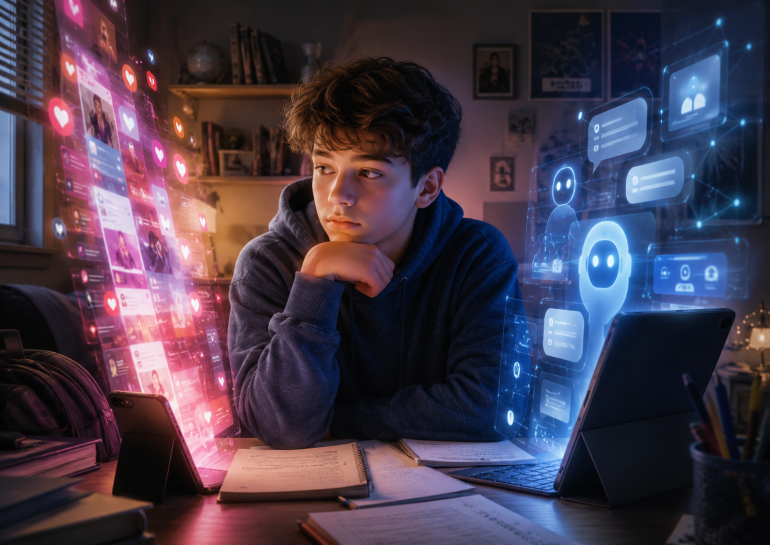
Governments are beginning to decide that some technology is too good at capturing teenagers’ attention to be left entirely to parents, schools and the teenagers themselves. Australia now requires age-restricted social platforms to take reasonable steps to prevent under-16s from creating or keeping accounts, a rule that covers Facebook, Instagram, Snapchat, Threads, TikTok, Twitch, X, YouTube, Reddit and others. The official justification goes beyond children encountering bad content: Australia’s eSafety Commissioner explicitly points to design features that encourage young people to spend too much time on screens and can expose them to material harmful to their health and wellbeing.
OpenAI has arrived at almost the opposite conclusion about generative AI. On 18 August, it announced ChatGPT for Teens, a version of ChatGPT specifically designed for people between 13 and 17, with stronger safeguards around learning, prolonged use and the ways teenagers can relate to the chatbot. Anyone who states that they’re 13 to 17, or whom OpenAI estimates to be under 18, is automatically placed into the teen experience.
The timing deserves more scrutiny than a checklist of whether those safeguards are good enough. We’re starting to tell teenagers they’re too young for some social networks because of the way those products can shape behaviour, demand attention and exploit vulnerabilities associated with growing up. At the same time, one of the most powerful AI companies in the world is making a product specifically for the same age group, even though it has had to design protections against some strikingly similar problems.
ChatGPT isn’t TikTok with a text box, and treating the products as interchangeable wouldn’t help the argument. There’s no public follower count or endless conveyor belt of short videos, and a teenager can use ChatGPT to understand algebra, practise writing, learn to code or ask questions they might not feel comfortable asking in class. Those differences are significant, and they’re part of the reason keeping teenagers away from generative AI entirely would be harder to justify than delaying access to a social media account.
The comparison becomes harder to dismiss once we look at behaviour rather than interface. ChatGPT for Teens includes more frequent break reminders during longer sessions, while OpenAI says its under-18 safeguards are designed to discourage emotional reliance and steer teenagers towards real-world support rather than allowing the chatbot to become a substitute for it. OpenAI has also spent considerable effort defining how the product should behave when a teenager begins treating it less like software and more like a relationship.
Those protections exist because conversation makes this type of software unusually easy to relate to. ChatGPT responds whenever it’s asked, follows a subject wherever the user takes it and can maintain a patient, sympathetic tone long after most people in a teenager’s life have gone to bed. An adolescent doesn’t need to believe literally that a language model is conscious for the interaction to acquire emotional meaning, particularly when the system can feel responsive in ways that ordinary software never has.
OpenAI has researched some of this behaviour itself. A collaboration with the MIT Media Lab analysed nearly 40 million ChatGPT interactions and ran a separate four-week randomised controlled study involving nearly 1,000 people, specifically examining loneliness, emotional dependence and what the researchers called “problematic use of AI”. Emotional engagement was relatively rare across ChatGPT use as a whole, but the research found that outcomes varied according to both how people used the system and their individual circumstances, with heavier use and stronger attachment among the factors researchers were interested in understanding.
That doesn’t establish that ChatGPT is addictive in the same clinical sense sometimes attached to other behaviours, and using “addiction” as shorthand for any technology people struggle to put down can muddy a useful argument. OpenAI’s own product decisions still tell us something important: a service that needs to remind teenagers to stop using it, prevent itself from encouraging emotional dependence and maintain a deliberate boundary between conversation and companionship is clearly capable of producing patterns of use its creator considers risky.
Education presents a different version of the same problem. ChatGPT can explain something a teacher couldn’t make click, give an individual learner effectively unlimited practice and provide access to a kind of personalised assistance that has traditionally depended on whether a family could afford a tutor. In South Africa, where educational resources are distributed brutally unevenly, that potential is substantial, and local AI tutoring platforms such as HelloAida are already trying to use AI to guide learners towards answers rather than simply hand them over. ChatGPT is also capable of doing the work the learner was supposed to learn by doing, which makes the line between assistance and substitution particularly important.
ChatGPT for Teens tries to manage that through features intended to make the product more useful for learning rather than simply completing work on a teenager’s behalf. OpenAI describes the experience as one designed to help teenagers think critically and deepen their understanding, rather than treating access to answers as the measure of whether the product is helping them learn.
There’s something revealing about the engineering required to make that work. OpenAI built a system whose appeal partly comes from its ability to remove intellectual effort, and it now has to decide when removing that effort would defeat the purpose of the task. A teenager writing an essay isn’t simply manufacturing 1,200 words to satisfy a teacher; wrestling with the first draft, trying to connect two ideas and realising that an argument doesn’t quite work are part of what the exercise is meant to develop.
Research into what happens when AI takes over some of that process is still young, and sweeping claims that ChatGPT is making everyone stupid run well ahead of what the evidence can support. The concern about cognitive offloading is nevertheless worth taking seriously, particularly for teenagers, because education deliberately makes learners perform mental work they may later choose to automate. Adults can decide that a machine should take over parts of their workload, but children are still developing the skills that allow them to know what should be delegated in the first place.
We don’t mourn every bit of mental effort technology has removed from our lives. Few people would argue that teenagers should be denied calculators because adults no longer spend much time doing long division by hand, but the calculator analogy only goes so far because generative AI can intervene much earlier in the thinking process. It can suggest the argument, organise it, phrase it and repair it before the learner has had much opportunity to discover why their own version didn’t work.
That makes the political treatment of AI particularly strange. Governments have become much more suspicious of the argument that giving children access to a technology is acceptable as long as the company supplies enough parental controls, age assurance and safety settings, and Australia’s social media rules deliberately put responsibility on the platforms rather than children or their parents. Under-16s aren’t fined for having an account; the companies face the regulatory burden of keeping them off age-restricted services.
Generative AI is still being approached from a different starting point. The assumption is generally that teenagers will need AI because it will be part of school, university and eventually work, so the task becomes finding ways to introduce them to it safely rather than first asking whether some forms of AI use should also be delayed.
OpenAI has made that case directly in its broader discussion of teenagers and AI, arguing that young people need opportunities to learn how to use these systems responsibly. Perhaps, although OpenAI also has an enormous commercial interest in that becoming true.
The company doesn’t say ChatGPT for Teens exists to acquire customers early, and presenting that as an established motive would go beyond the evidence. It would be equally naive to analyse the strategy of an AI company without asking what habitual use is worth to it. A 14-year-old who learns to research with ChatGPT, studies with ChatGPT and eventually arrives at university already accustomed to asking ChatGPT for help isn’t merely acquiring an abstract skill called AI literacy. They’re learning to turn to a particular product.
Technology companies have understood the value of becoming the default for decades. Microsoft benefited when generations learnt computing through Windows, Google became so closely associated with finding something online that its name became a verb, and Apple knows how difficult it is to leave an ecosystem after years of purchases and habits have accumulated around it. Generative AI offers something even more intimate because ChatGPT isn’t only somewhere a person goes to find information. It can become somewhere they go when they’re unsure what to write, what something means, how to approach a problem or, increasingly, what to think about it.
If asking an AI becomes as instinctive as searching the web, establishing that behaviour early could be extraordinarily valuable. OpenAI is competing with Google, Anthropic, Meta and others for a place in a new layer of computing that may eventually sit between people and much of what they do digitally, so younger users can hardly be irrelevant to that contest. The company can sincerely want teenagers to use AI safely while also benefiting enormously if ChatGPT becomes the AI those teenagers continue reaching for as adults.
That combination of benefit and commercial incentive should sound familiar because we’ve already lived through a version of it with social media. Platforms offered genuine connection, creativity, information and community while their businesses benefited from getting people to spend more time using them. Years later, regulators are trying to separate those benefits from design choices that made the products difficult for younger people to put down, and Australia’s restrictions are explicitly aimed at shifting some of that responsibility back onto the companies running the platforms.
The difference with generative AI is that its influence could extend beyond attention. A social feed can shape what teenagers watch, what they compare themselves with and how long they remain online; a conversational AI can also participate in how they reason through a school assignment, formulate an opinion and process something personal. If overreliance develops, the issue isn’t simply that a teenager spent three hours looking at a screen. It’s which parts of their thinking they became accustomed to handing over during those three hours.
None of that makes ChatGPT for Teens an elaborate scheme to addict children, and saying so would make the argument easier to dismiss than it should be. OpenAI has acknowledged real risks and has built protections that are preferable to giving 13-year-olds the standard product and assuming everything else is somebody else’s problem. The question is why the existence of those protections is being used primarily to justify access when, in another part of the technology industry, the need for extensive protections has helped persuade governments that children should sometimes be kept away for longer.
Australia’s law also shows how much depends on the categories regulation chooses to recognise. Many standalone messaging and gaming services, along with services primarily supporting education or health, fall outside its social media restrictions, which makes sense if the problem being regulated is specifically social media. Generative AI doesn’t fit comfortably into the category lawmakers have spent the past decade learning how to regulate, but a different interface doesn’t automatically mean the developmental risks have disappeared.
We allowed social platforms to become embedded in adolescence before society had worked out what persistent engagement-driven technology might do to young people. By the time governments became willing to ask whether children should have accounts at all, those platforms were woven into friendships, entertainment and everyday culture, which made unwinding the relationship far harder than preventing it would have been.
Generative AI is reaching teenagers while that lesson is still fresh, and it comes with capabilities that could be enormously useful to them. That’s precisely why the decision about when and how young people should use it shouldn’t belong primarily to the companies that stand to gain decades of loyalty if asking an AI becomes a habit before those users have finished learning when they should think without one.