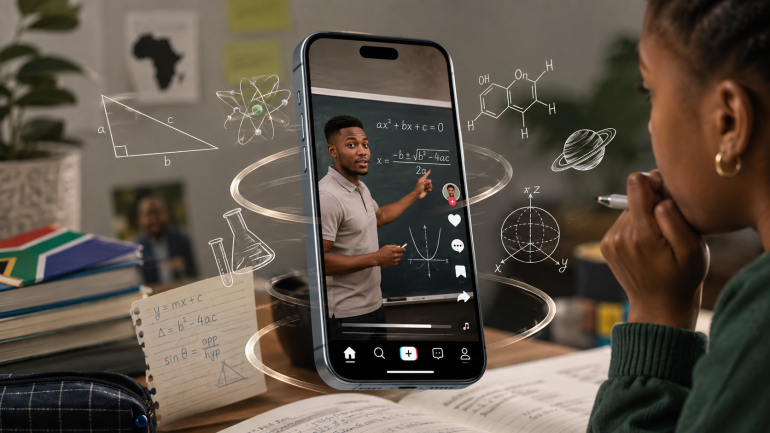
A maths lesson delivered in Sepedi, with song and dance worked into the explanation, probably isn’t what most people picture when they hear “educational technology”. It is, however, what South African creator @whereistheteacher6 is doing on TikTok, alongside @mphokatmakhema, who posts maths lessons covering learners from Grade R through Grade 12.
There’s something quite ordinary about what they’re doing. They’re teaching maths in ways that suit the people watching them. The difference is that the classroom is TikTok, the lesson might last a minute or two, and a learner can come across it while scrolling through everything else the platform serves them.
TikTok changes how someone might arrive at that lesson. A learner doesn’t have to open a textbook or decide to search YouTube for an explanation. They don’t even have to be thinking about maths. The video can simply appear because they watched another one, lingered on something vaguely related or because TikTok’s recommendation system decided to try it.
According to GWI data covering 2025, 42% of South African TikTok users surveyed said they had watched or listened to educational content online. That compares with 39% in Kenya and 30% in Nigeria.
South African TikTok users also show a strong interest in technology. The same research found that 61% were interested in the subject, making them 9% more likely to express an interest in technology than South Africans who don’t use TikTok. In Nigeria the figure was 72%, while Kenya came in at 56%. Science attracted smaller numbers, including 35% of TikTok users surveyed in South Africa.
Those numbers need a little care. The GWI research cited by TikTok covers respondents aged 18 and older, even though TikTok’s material talks repeatedly about learners and young people. The 42% figure also measures whether people consumed educational content online, not whether they consumed it on TikTok.
It would therefore be a stretch to turn the research into a claim that nearly half of South African TikTok users are learning on TikTok, and an even bigger stretch to use it as evidence of what school-age learners are doing. What it does show is that educational material isn’t alien to the online habits of the people surveyed. The teachers already posting maths and science videos give us examples of how that can spill over onto TikTok itself.
TikTok already has the audience
TikTok has also been deliberately making more room for educational material inside the app. In February 2025, it launched a dedicated STEM Feed in more than 20 countries across Sub-Saharan Africa, including South Africa.
The feed sits alongside Following and For You and carries science, technology, engineering and mathematics videos. For users aged between 13 and 18 it is switched on by default, although they can turn it off. TikTok says Common Sense Networks assesses whether videos are appropriate for the STEM Feed, while the Poynter Institute checks the reliability of the information before videos can appear there.
The feed puts educational material inside an app people already open without being asked. That sounds obvious, but it changes one of the usual problems with digital learning products. You can build an excellent learning platform and still need to persuade somebody to visit it. TikTok has already cleared that hurdle because the user came for TikTok.
What happens after that can be very small. Someone might watch a physics explanation because it appeared between unrelated videos. A learner who gets stuck on an equation could find one teacher whose explanation finally makes sense and then stick around for another lesson. None of this requires TikTok to recreate a school timetable inside the For You feed, or the person watching to have opened the app planning to study.
We’ve already seen another version of TikTok’s ability to push education into people’s view in South Africa. NOVAR, the free e-learning platform created by Mikhongelo Marvel Shibambu and Malunghelo Mathonsi, became widely known after a video showing the founders, the computer they had assembled from salvaged parts and the learning platform they had built went viral. I wrote about how NOVAR’s later IBM backing highlighted some of South Africa’s technology gaps. NOVAR wasn’t teaching through TikTok in that instance, but the platform helped millions of people discover that NOVAR existed. That is a fairly different role from being an education platform, although it is still part of how learning resources now find their audiences.
Then comes the harder part
TikTok can tell us how many people watched a video and how long they stayed with it. Working out whether somebody understood algebra better afterwards is considerably harder.
The research TikTok supplied doesn’t measure that. The 42% figure for South Africa tells us that educational material is already part of people’s online media consumption. It doesn’t tell us what they understood from it or whether it changed anything after they put the phone down.
That doesn’t make the videos themselves trivial. A short maths video doesn’t have to carry an entire curriculum to be useful to the person watching it. @whereistheteacher6 using Sepedi, music and movement to explain a concept may reach a learner who has heard the same material explained differently several times before. @mphokatmakhema can work through an equation in front of a class and then have that explanation continue circulating long after the lesson ends.
There is also something slightly strange about still treating this as separate from “real” education. South African learners already move between classrooms, WhatsApp groups, YouTube videos and whatever else helps them make sense of the work in front of them. TikTok is another place in that mix, except its algorithm can put the explanation in front of someone before they have decided to ask for it.
South Africa’s formal education system is trying to work out its own relationship with digital learning at the same time. The Department of Basic Education is developing a new Digital Education Strategy and has acknowledged that the country’s 2004 White Paper on e-Education belongs to a very different technological era.
TikTok is arriving in that discussion from the other direction. It wasn’t designed around schools and it didn’t need an education strategy before teachers started using it. Learners were already on the platform, educators started making material for them, and TikTok eventually began formalising some of that activity through things such as the STEM Feed.
There are obvious problems packed into that arrangement too. The same system showing someone a useful explanation is built to keep them scrolling. An excellent maths teacher is competing with everything else TikTok knows the viewer might enjoy more at that particular second. Educational content being available is not the same thing as somebody giving it their attention, and attention still isn’t the same thing as learning.
TikTok’s numbers can tell us that the audience for educational material exists. The creators themselves tell us a little more, because we can see teachers taking the way they already teach and adapting it to wherever their learners happen to be spending time.
What happens after that is much less tidy. Maybe @whereistheteacher6 helped someone finally understand the equation. Maybe they watched for five seconds and swiped away. TikTok knows which of those videos stayed on the screen. It doesn’t know whether the maths stayed with the person watching it.