
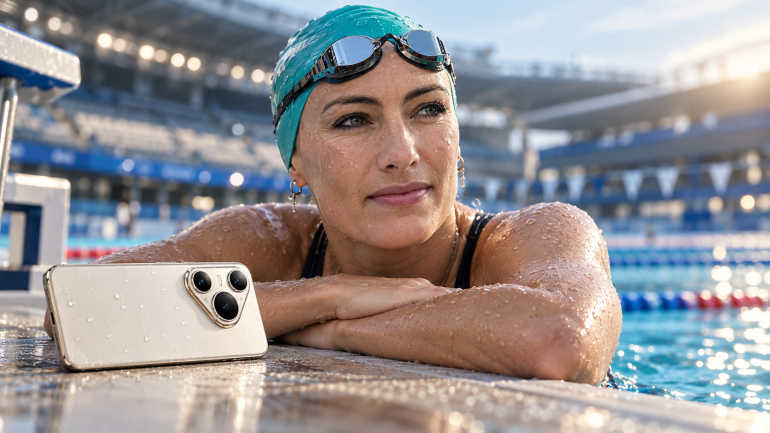
When Tatjana Smith retired from competitive swimming in 2024, she believed she was done. There was no planned return waiting somewhere down the line, and after a career that had already made her South Africa’s most decorated Olympian, there wasn’t exactly much left for her to prove. Two years later, Smith has changed her mind and will return to competitive swimming at the South African Short Course Championships in Pietermaritzburg from 24 to 27 September 2026.
The athlete coming back to the pool isn’t approaching the sport in quite the same way as the one who stepped away from it. Smith will return with a new coach, a new training group, a new city and a new event, while putting considerably more emphasis on having a life that exists beyond swimming.
“When I announced my retirement from swimming, I genuinely believed that chapter of my life was over,” says Smith. “With some distance, I realised that stepping away had been the right decision for me at that time. I had always believed that swimming was something I did, not who I was. Stepping away proved that to me.”
Time away from competition gave Smith the opportunity to find out what life without the constant demands of elite sport actually looked like. It also eventually reminded her which parts of swimming she missed. Racing, competition and the challenge of the sport were still there once the pressure surrounding them had been removed, but the decision to go back would now be hers rather than something she felt obliged to continue doing.
“This time, the decision is mine,” she says. “The time away gave me perspective, but it also gave me power. Now I get to bring both of those things back into the pool.”
Coming back differently
Smith’s career before retirement hardly needed another chapter to validate it. Across the Tokyo 2020 and Paris 2024 Olympic Games, she won four individual medals in the 100m and 200m breaststroke, including two gold and two silver. She also set the 200m breaststroke world record at Tokyo 2020 and is tied with Japan’s Kosuke Kitajima for the most individual Olympic breaststroke medals in history.
Her return therefore seems less about picking up an unfinished career and more about finding out what competing looks like when swimming no longer has to occupy quite so much of her identity. Smith says balance will form a much bigger part of this phase, including the recognition that being an elite athlete and having a full life outside sport don’t have to be mutually exclusive.
“I am not coming back as the same athlete, or the same person,” she says. “It’s a new chapter, a new challenge, a new event, a new training group, a new city and a new coach. Most importantly, it’s a new balance. I have learned that I don’t have to choose between being an athlete and having a full life outside of sport. I can have both.”
That approach also extends beyond Smith’s own training. She has spoken about the environment athletes are expected to perform in and believes sporting excellence needs to exist alongside proper support for the people being asked to deliver it.
“Athletes deserve to love their sport. They deserve to feel safe, supported and respected within it. And they deserve the opportunity to pursue excellence without having to compromise who they are.”
Huawei has its own comeback story
There’s a Huawei connection to Smith’s return as well, and it builds on a relationship that has developed over several years. Smith has been a longstanding friend of the brand, with Huawei’s wearables forming part of her approach to activity, training and recovery. Her return to competition now happens at the same time that Huawei is marking a significant return of its own, with 5G back in its flagship smartphone range in South Africa.
The “max speed is back” connection is an obvious one, but it works because both stories involve returning differently rather than simply recreating what came before. Smith is heading back to competitive swimming with a different relationship with the sport, while the HUAWEI Pura 90s Series brings 5G back to Huawei’s premium South African smartphone range.
The Pura 90s Series is already familiar territory. As I mentioned in my review of the Pura 90s Series, Huawei has continued to push particularly hard on mobile photography, but the return of 5G makes this generation more significant than another annual camera upgrade. It removes one of the biggest compromises attached to buying a recent Huawei flagship in South Africa and gives the company a considerably stronger argument at the premium end of the market.
5G is expected at this end of the market, particularly on phones built around high-resolution photography, video, navigation, streaming and increasingly capable AI features. Huawei has spent several generations improving its cameras, batteries, charging and broader ecosystem while that connectivity gap remained. With the Pura 90s Series, it finally doesn’t.
Smith’s existing relationship with Huawei also gives the partnership more grounding than simply putting an athlete next to a smartphone because both can be described as fast. Wearables have been part of that relationship around activity, recovery and performance, areas that become particularly relevant as she moves back into structured training and competition.
There’s also a good fit with the way Smith is talking about her comeback. Technology can provide more information about training, movement and recovery, but her approach this time puts the athlete back at the centre of those decisions. The data can help inform what happens next without becoming the thing that defines it.
The first race comes next
The South African Short Course Championships will be the first indication of what this version of Tatjana Smith looks like in competition. Two years away from racing is still two years away, regardless of the medals and records that came before it, and Smith isn’t presenting her return as an attempt to rewind the clock.
She’s going back with a different set of priorities, a different environment around her and considerably more clarity about why she wants to be there. Huawei finds itself in a similar position with the Pura 90s Series, bringing an important capability back to its flagship smartphones while continuing to build on the photography, wearables and broader technology ecosystem it has developed in the years around it.
For Smith, we’ll begin finding out what that next chapter looks like when she gets back onto the starting block in Pietermaritzburg later this week.