
Enterprise AI has spent the past few years fixated on foundational models, but Huawei Cloud’s latest announcements appear to imply that the real battle has shifted lower down the stack. Once an AI system is expected to do serious work inside an organisation, the questions become less glamorous and far more complicated: where it runs, how it remembers, what happens during system failures, and how much of the underlying stack a business is willing to hand over to a single vendor. The bigger industry conversation around AI inference technology reflects this reality, proving that the real friction begins long after the model finishes training.
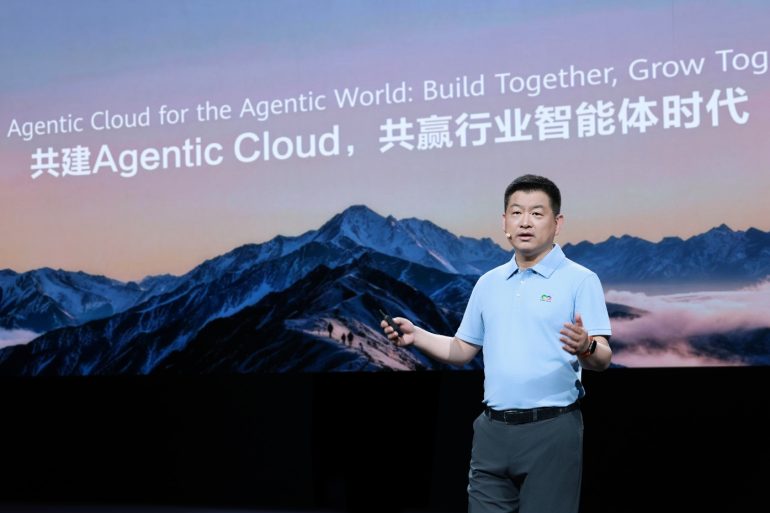
At HUAWEI CONNECT 2026 in Shanghai, Huawei Cloud laid out what it terms an “open agentic cloud”. The initiative takes its AI Cluster Service (AICS) global, scales out its model-as-a-service offering, rolls out AgentArts internationally, and expands its Industry AI Foundry to turn implementation insights into reusable sector tools. Taken together, the updates look less like an assortment of point products and more like a deliberate play to capture the foundational enterprise AI infrastructure on which autonomous workloads operate.
The model is only one part of the problem
Huawei labels this foundation “Agentic Infra”, acknowledging that raw compute capacity is no longer sufficient on its own. According to the company, modern infrastructure must optimise token throughput, coordinate traditional and AI workloads, support ongoing model learning, and run agents securely within live production environments. The vendor reports that over 3 500 enterprise clients currently run on variants of Agentic Infra.
The refreshed AICS illustrates these priorities, featuring full-chain observability and a five-tier fault-recovery system capable of sustaining cloud training runs exceeding 40 days while rebounding from interruptions within 10 minutes. Huawei also claims a 20% increase in token throughput over its previous-generation architecture, with AICS entering commercial availability in China on 30 September, followed by international markets on 30 November.
Because these figures stem directly from the vendor, they should be treated with customary scrutiny rather than as independent benchmarks. Even so, the engineering focus reveals the broader shift: whilst standalone chatbots rely primarily on model quality, enterprise agents tasked with enduring operations require deep context retention, reliable fault tolerance, and tight integration with core business software.
Huawei’s Context Memory Storage targets precisely this friction, claiming petabyte-level memory, high-speed terabyte-scale retrieval, twice the storage density of unnamed market rivals, and a 50% performance uplift. More significantly, it treats dedicated memory architectures as critical infrastructure in their own right, demonstrating that model weights alone no longer account for the bulk of enterprise AI complexity.
Treating models as interchangeable components
Positioned above the hardware foundation is Agentic MaaS, Huawei Cloud’s model-as-a-service environment designed to decouple deployment from underlying infrastructure and host third-party models, demonstrated at HUAWEI CONNECT via MiniMax’s multimodal offering. Rather than compelling enterprises to standardise on proprietary Huawei models, the company is positioning its surrounding cloud fabric as the indispensable layer regardless of the engine selected. If base models become commoditised, cloud providers must capture value through memory layers, orchestration, access governance, monitoring, and data connectivity.
The AgentArts platform reinforces this aim alongside the open-source openJiuwen framework, offering over 5 000 general and 1 000 sector-specific Model Context Protocol (MCP) assets for agent development. Huawei reports adoption across more than 100 client implementations, including Kingsoft Office, the Shenzhen Longgang District Government, and China Southern Power Grid, ahead of its scheduled commercial release outside China on 30 December. These target deployments emphasise enterprise environments where regulatory compliance, system uptime, and existing system integrations outweigh raw model novelties.
Scrutinising the ‘open’ narrative
Huawei repeatedly emphasises openness across its stack, supported by tangible engineering efforts: AgentArts features an open-source counterpart, integrates native MCP standards, and Agentic MaaS supports heterogeneous model frameworks. However, offering compute, memory, model abstraction, and developer tooling simultaneously creates natural gravity. Whilst adopting the full suite delivers operational convenience, it inevitably deepens vendor entrenchment, a tension endemic to cloud ecosystems that agentic AI magnifies as systems accumulate organisational memory, business rules, and integration privileges. Swapping a model remains simple, but migrating the surrounding agent fabric is far more challenging.
For South African organisations, this trade-off is particularly relevant as local enterprise conversations increasingly centre on hybrid deployments designed to manage costs, safeguard data sovereignty, and leverage existing hardware. Building an effective enterprise AI infrastructure strategy aligns with these priorities by addressing real operational bottlenecks rather than merely selling model access.
Institutionalising industry expertise
Huawei Cloud’s Industry AI Foundry underpins this vertical strategy, featuring more than 1 000 specialised assets across a similar number of deployed projects, with existing verticals in healthcare, finance, and manufacturing now joined by dedicated zones for Smart Government and AI Hardware. Deploying a functional enterprise agent demands far more than basic prompt engineering, requiring the mapping of edge cases, management of access privileges, and integration of fragmented data.
The foundry seeks to productise this domain knowledge: the AI Hardware Zone spans over 20 form factors paired with more than 110 task-specific skills, whilst the Smart Government initiative launches with 24 founding partners focused on municipal services. Enterprise adoption ultimately hinges on whether these agents systematically reduce operational overhead rather than introducing new software friction.
Timeline and market rollout
AICS and AgentArts are scheduled for global commercialisation on 30 November and 30 December, respectively, though Huawei has not yet confirmed the regional rollout order, leaving regional availability for markets like South Africa unfinalised. For local enterprises navigating budgetary constraints and legacy systems, deployment practicalities will outweigh stage demos. Huawei Cloud clearly recognises that the next phase of enterprise AI is fundamentally an infrastructure challenge, and whether that platform proves to be a flexible enabler or a closed garden will depend on how cleanly these layers decouple in production.