On Wednesday evening, journalists on an online workshop was asked to scan a QR code and vote on a photo. It showed a huge crowd, supposedly gathered in East London to back Julius Malema. Did it show his supporters, yes, no or not sure?
Most voted no. One attendee said the trees looked blurry and she doubted whether that many people lived in East London. It was a wild guess, she admitted, and it was right. A reverse image search later traced the picture to a pro-Palestine protest in Amsterdam.
The exercise came courtesy of Code for Africa, the fact-checking group TikTok brought in to run half of its election briefing. It also made the point more neatly than TikTok’s own slides did. Most of the work of keeping bad information off a platform happens after someone has already posted it, and TikTok’s pitch for the 4 November local government elections is built mostly on that second stage.
The pitch came in a press release shared with media on 8 October and in the workshop, opened by Itumeleng Morule, TikTok South Africa’s communications lead. These are the sixth local government elections since 1994, with the date set by President Cyril Ramaphosa in April. TikTok’s package looks a lot like the one it ran in 2024, with an AI layer added on top.
The package
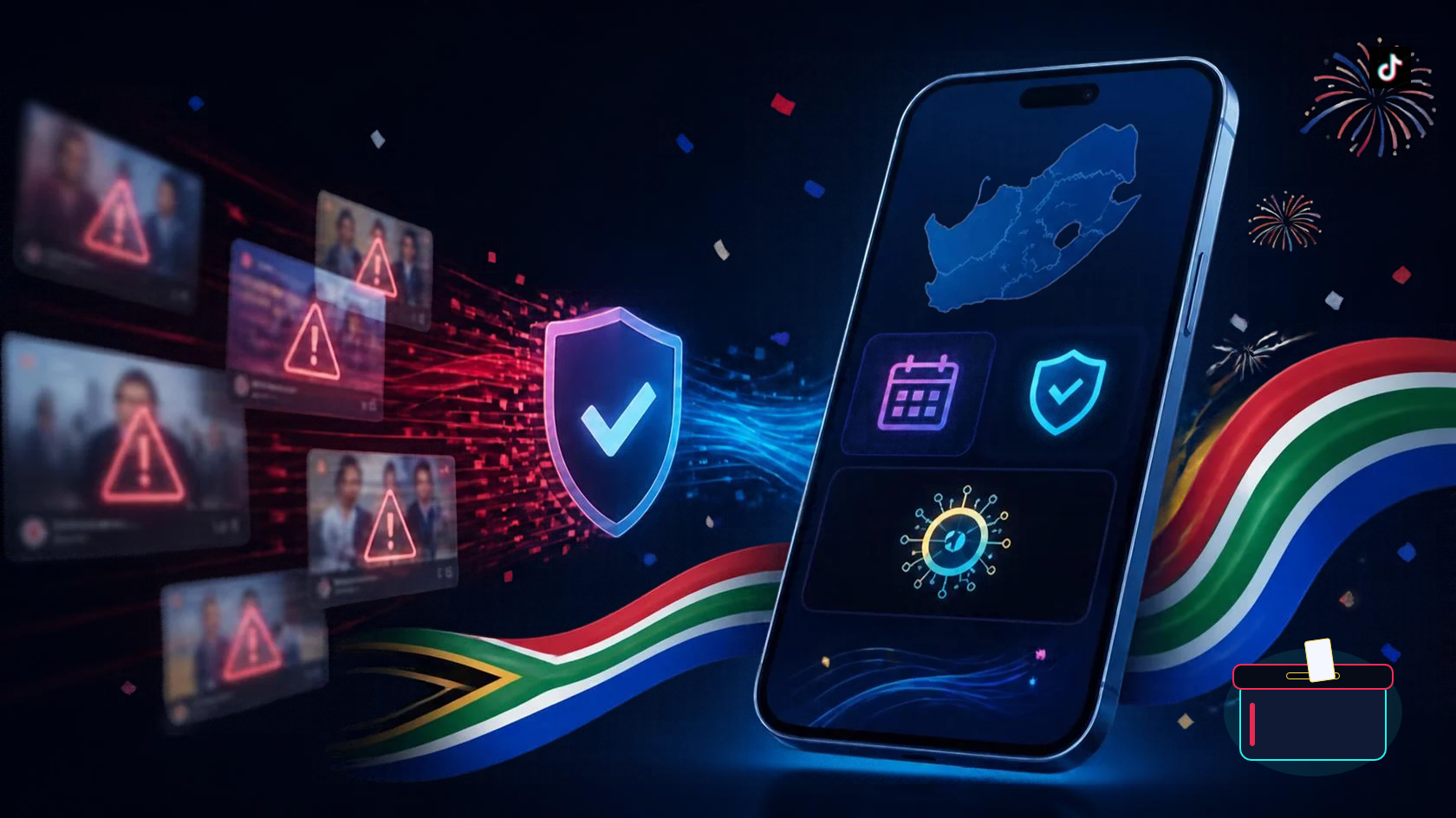
The main piece is an in-app Election Centre, built with the Electoral Commission of South Africa (IEC). Search “elections” on TikTok and it comes up, with voting information, key dates and tips on spotting misinformation. The release says it’s available in local languages including English. At the workshop, TikTok said five.
The Centre links to a new AI media literacy hub that explains how to recognise AI-generated content and use AI tools responsibly. You can also reach it by searching “AI”.
Election labels and search banners point people to the Centre. Tholoana Ncheke-Mahlaela, TikTok’s government relations and public policy lead for Southern Africa, described this as a single tap. It isn’t new. Coverage of the 2024 launch already described labels on election content.
For fact-checking, TikTok works with more than 20 organisations worldwide, and Code for Africa is the South African partner. At the workshop, TikTok said content found to be false gets limited reach on the For You feed. The release adds that unverified content may be labelled, made ineligible for recommendation, or come with a prompt asking users to reconsider before sharing.
Paid political advertising is banned outright. Politician and party accounts can’t advertise or earn money, and at the workshop TikTok said they can’t campaign or fundraise from them either. Only election management bodies can run ads, and only for voter information.
Realistic AI-generated video has to be labelled. TikTok added invisible watermarking in 2025 and says more than 3 billion videos have been labelled globally.
The percentages
TikTok’s headline figures come from its Community Guidelines enforcement report. In the first quarter of 2026 it removed about 1.1 million videos in South Africa. Of those, 99.6% came down before anyone reported them and 94.9% within 24 hours of posting. Roughly 90 000 were removed under civic and election integrity rules, with more than 99% caught before a report. At the workshop, TikTok added that 98.4% of the hate speech it removed in the country over that period was caught proactively.
They’re big, clean numbers. They’re also TikTok’s own, and the release doesn’t point to any independent audit.
Proactive removal means a video was taken down before a user flagged it. It says nothing about how many people watched it first. The 24-hour figure leaves roughly 5% of removals, or about 56 000 clips on a 1.1 million base, that stayed up for longer than a day. The release doesn’t say how many views the election videos collected before they were removed, or how the 90 000 compares with 2024. It does work out to about 8% of everything TikTok removed in South Africa that quarter, which tells you election content is a small slice of the enforcement work.
The release and the workshop also disagree in places:
- Total removals: The release says “over 1,100,000 million videos”, which can’t be right. The workshop figure was “over 1 million”, so we’ve gone with roughly 1.1 million.
- Scope of the 90 000: The release says they covered civic and election integrity, misinformation and misleading AI-generated content. At the workshop, they were described as civic and election policy violations only.
- Timing: The latest figures cover January to March. TikTok said the Q2 report is due this month, so the freshest data on offer describes a period six months before the vote.
Last time
TikTok’s 2024 election pitch sounded much the same. The IEC partnered with Google, Meta, TikTok and Media Monitoring Africa before that poll, and false claims still circulated, including stories about evaporating ink in voting pens and bribery accusations against the IEC.
At Africa Check’s post-election discussion, researcher Keegan Leech said a clear narrative had emerged that the IEC couldn’t be trusted. A report on that event said participants also pointed to TikTok’s algorithm and influencers as part of the problem.
Code for Africa’s session covered the same ground. Its analyst used claims that the IEC is biased as the textbook case of what the group calls information manipulation and interference, meaning coordinated efforts to shape what people believe. The aim, she said, is often to wear down trust in institutions rather than to land one specific lie. The group also showed how that spreads: a narrative starts on Facebook or X and gets repackaged as a TikTok video, and the repeat exposure makes it look more credible than it is.
What went unsaid
TikTok said it took down 14 covert influence operations worldwide in the first half of 2026. It gave no figure for South Africa.
It also said little about creators. The ad ban covers parties, candidates and their accounts. Code for Africa spent much of the evening on proxy accounts and opportunistic creators pushing narratives for views, and the release doesn’t address how those accounts are handled.
During questions, a News24 representative asked how political content avoids being flagged when everything in an election is political. TikTok didn’t answer that part and offered to continue by email. News24 also asked about featuring credible media in the Election Centre. TikTok said it currently carries IEC information only and that other options could be explored.
On AI literacy, TikTok put its fund at 4 million across more than 20 markets, with another 200 000 for sub-Saharan Africa. It didn’t give a currency. Split evenly, that’s about 10 000 per market at most.
What you can do
Creators can open TikTok Studio, then Account Health, to see whether any content has picked up strikes. Decisions can be appealed. If you earn through the platform, how TikTok One pays creators is worth knowing, because eligibility is tied to following the Community Guidelines.
Voters can use Code for Africa’s methods. Screenshot the video and run it through Google Lens. For suspected AI content, Hive Moderation is free, needs no sign-up and gives a probability score. PesaCheck runs a tip line for claims you can’t check yourself. Reports on TikTok are anonymous to the person you report.
TikTok also used the evening to mention that its STEM feed now runs in more than 20 sub-Saharan countries. We covered the launch of the STEM feed when it arrived in the region.
The Q2 enforcement report is the next thing to watch. If TikTok publishes post-election data that includes views before removal, that will say more than any of these percentages.
Quick answers
When are South Africa’s 2026 local government elections? Wednesday 4 November 2026.
Does TikTok allow political ads in South Africa? No. Paid political ads and ads from politician and party accounts are banned. Only election management bodies can run voter information ads.
How do I find election information on TikTok? Search “elections” to open the in-app Election Centre, built with the IEC.