
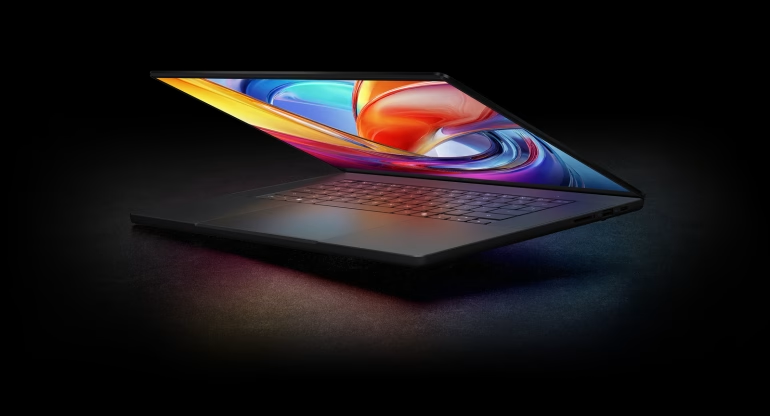
ASUS’s latest creator laptops aren’t just another spec bump. They’re built around NVIDIA’s new RTX Spark platform, which promises enough local AI horsepower to run large models without constantly leaning on the cloud. Pre-orders are open now in South Africa, with prices starting at R79 999.
If you’ve been watching the workstation space, you’ll know this isn’t happening in a vacuum. Dell’s also pushing hard into AI laptops with its Pro Max range, and the message from both companies is clear: the next battleground for creative pros isn’t just raw GPU power. It’s what you can run locally, privately and repeatedly without a usage bill breathing down your neck.
The hook: local AI that doesn’t live in the cloud
The headline feature here is NVIDIA’s RTX Spark Superchip, which pairs a Blackwell-based RTX GPU with a high-performance Grace CPU. On paper, that translates to up to 1 petaflop of AI performance and up to 128GB of unified memory, depending on configuration.
In practice, that means these machines are designed to handle workloads that would choke a lot of conventional laptops: local language and vision models, image and video generation, LoRA fine-tuning, agentic workflows and complex 3D scenes. The idea is to give creators and developers a PC that can act as a proper AI workstation, not just a terminal for cloud services.
ASUS is also pushing the economic angle. If you’re constantly generating images, testing prompts or iterating on models, per-token or per-generation charges add up. A machine with this kind of local capacity turns some of that variable cloud spend into fixed hardware cost. You still use the cloud for frontier models and burst workloads, but day-to-day experimentation can happen on-device.
There’s a privacy pitch too. Sensitive prompts, source files and project data can stay on the laptop instead of being uploaded to a third-party service. For agencies, studios and freelancers working under NDAs, that’s not just convenient. It’s often a requirement.
What you’re actually buying
The South African launch focuses on two models: the 14-inch ProArt P14 (H7407) and the 16-inch ProArt P16 (H7607). Both are built around the same RTX Spark foundation but differ in screen size, resolution and a few practical details.
Key specifications:
| Feature | ProArt P14 (H7407) | ProArt P16 (H7607) |
|---|---|---|
| Processor | NVIDIA RTX Spark (Grace CPU + Blackwell RTX GPU) | NVIDIA RTX Spark (Grace CPU + Blackwell RTX GPU) |
| AI performance | Up to 1 petaflop (FP4) | Up to 1 petaflop (FP4) |
| Unified memory | Up to 128GB LPDDR5X | Up to 128GB LPDDR5X |
| Display | 14″ 3K (2880×1800) ASUS Lumina Pro OLED, 120Hz | 16″ 4K (3840×2400) ASUS Lumina Pro OLED, 120Hz, G-SYNC |
| Peak brightness | Up to 1 600 nits | Up to 1 600 nits |
| Storage | Up to 1TB M.2 NVMe PCIe 4.0 SSD (single slot) | Up to 1TB M.2 NVMe PCIe 4.0 SSD (dual slots) |
| Battery | 90Wh | 99Wh |
| Weight | 1.48kg | 1.77kg |
| Thickness | 13.9mm | 12.9mm |
| Connectivity | Wi-Fi 7, Bluetooth 5.4 | Wi-Fi 7, Bluetooth 5.4 |
| Ports | 3× USB4 Type-C, 1× USB-A 3.2, HDMI 2.1, 3.5mm audio, SD 4.0 card reader | 3× USB4 Type-C, 1× USB-A 3.2, HDMI 2.1, 3.5mm audio, SD Express 7.0 card reader |
| Starting price (South Africa) | R79 999 | R84 999 |
Both laptops use ASUS’s Lumina Pro OLED panels, with 120Hz refresh rates and up to 1 600 nits peak brightness. The P16 tops out at 4K, while the P14 sits at 3K. Battery capacities are 90Wh and 99Wh respectively, and both support Wi‑Fi 7 and Bluetooth 5.4.
On the software side, ASUS is bundling its own AI tools into the mix. MuseTree brings local image generation (using models like FLUX and WAN) directly into the workflow, while StoryCube uses AI to help organise and tag media libraries. The idea is to make local AI feel less like a lab experiment and more like part of the everyday creative stack.
Eligible configurations can also include Adobe Creative Cloud bundles, and selected ASUS laptops come with an exclusive Google AI bundle. That hybrid approach is probably the right call for most pros: local AI for private, repeatable tasks and cloud services when you need the biggest models or extra capacity.
More details on the hardware and ASUS’s positioning are available on the ASUS South Africa ProArt page, and the company’s background on the platform is covered in its Computex announcement.
Pricing and availability in South Africa
If you’re shopping locally, here’s what you need to know.
The ProArt P14 starts at R79 999, while the larger ProArt P16 kicks off at R84 999. Both are available for pre-order now through ASUS, Incredible Connection and Evetech. As always, exact configurations, stock levels and any bundle deals will vary by retailer, so it’s worth checking each store’s site before you commit.
For full specs and local availability, the ASUS South Africa ProArt range page is your best starting point.
Who this is actually for
At R79 999 and R84 999, these aren’t machines you buy on a whim. They’re aimed at people whose work already leans heavily on AI: photographers and videographers experimenting with generative tools, designers and illustrators testing local image models, 3D artists working with large scenes, and developers building or fine-tuning AI applications.
They’ll also appeal to agencies and studios that need to keep certain workflows and data on-prem for privacy or compliance reasons. If your team is already running local models or building agentic workflows, a laptop that can handle that load without a constant internet connection is a genuine productivity tool, not just a nice-to-have.
For more general creative work, the value proposition is less clear. If you’re mostly editing photos in Lightroom, cutting video in Premiere or designing in Figma, you’ll still get excellent performance from these machines, but you might not fully utilise the AI capabilities that justify the price.
The bigger picture
ASUS isn’t the only company betting that serious local AI belongs in laptops. Dell’s Pro Max workstations are making a similar pitch on the Windows side, and Apple’s M-series Macs have already pushed a lot of creative pros towards powerful, unified-memory machines.
What’s interesting about the ProArt P14 and P16 is how explicitly they’re positioned around agentic AI workflows: multi-step processes where AI tools help organise assets, generate concepts, refine outputs and prepare final deliverables. That’s a more mature vision of AI in creative work than “type a prompt, get an image”. It assumes AI is part of the pipeline, not just a novelty.
Whether that vision lands in South Africa will depend on pricing, availability and how quickly local creative teams adopt these kinds of workflows. But if you’re already experimenting with local models and hitting the limits of your current hardware, the new ProArt laptops are worth a serious look.
Pre-orders are open now through ASUS, Incredible Connection and Evetech, with the ProArt P14 starting at R79 999 and the ProArt P16 at R84 999.