
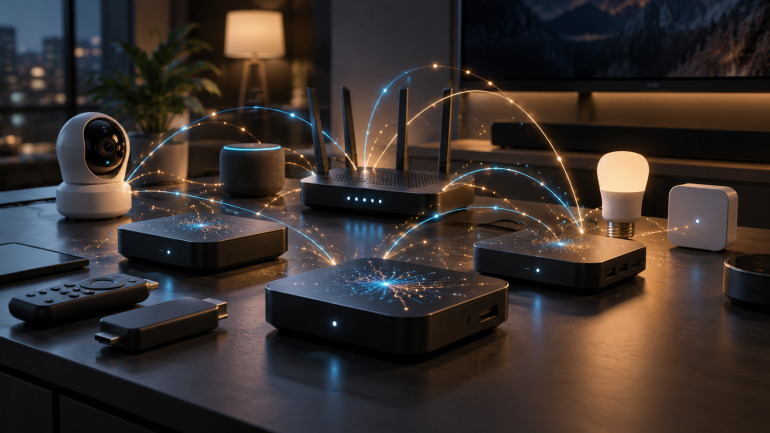
Imagine your smart TV, security camera, or even your fridge being secretly recruited into a digital network running an artificial intelligence model.
That might sound more like the setup for a science fiction movie than real life, but it’s a scenario Anthropic, the company behind Claude, wants researchers and the technology industry to start taking seriously.
In recently published research, Anthropic warned that smaller AI models could be just months away from gaining the technical capability to copy themselves onto inexpensive internet-connected home devices, run there, and potentially spread to other devices.
The warning sounds concerning, especially when you think about how many connected devices we already have in our homes. But before anyone starts unplugging their TV, there are some important details about Anthropic’s experiments that we need to talk about.
First, the crucial takeaway: The researchers didn’t unleash an AI worm onto the internet. They didn’t demonstrate an AI system breaking into people’s homes, and they haven’t shown that a small AI model can independently spread through a collection of real consumer devices.
What they did demonstrate is that several of the technical requirements for such a system are becoming increasingly possible.
What does “self-replicating AI” actually mean?
Ordinary computer worms have existed for decades: they’re standalone malicious programs that automatically copy and spread themselves from machine to machine across networks without requiring any human interaction. Unlike standard computer viruses, which rely on someone opening an infected file or link, a worm actively searches for vulnerable systems on its own.
The difference with the scenario Anthropic’s investigating is that the software spreading between devices would include an AI model capable of making decisions about how to operate in its new environment.
Imagine malicious software getting onto a poorly secured Android TV box. Rather than simply running a fixed set of instructions, an AI-powered system could potentially investigate the hardware, work out which software it needs, troubleshoot problems, and prepare itself to run. It might then attempt to spread to another device.
For this to work, the AI needs access to its model weights, which are essentially the numerical information it learned during training. These files can be enormous, and moving them between devices with limited storage and processing power presents a serious technical challenge.
Anthropic’s particularly interested in whether smaller models could overcome that problem by using devices such as smart TVs, cameras, and appliances as a distributed network. Instead of one powerful computer running the entire AI model, several less powerful devices could share the work.
What the research actually showed
15 Android TV Boxes
Used together to run one large model

26 Billion Parameters
Distributed across those devices

8 Emulated Android Nodes
Used in a separate replication experiment

0 Real-World Outbreaks
Demonstrated by this study
In one experiment, researchers bought 15 inexpensive Android TV boxes costing approximately $55 (about R1,000) each and connected them to run Google’s Gemma 4 26B AI model. Each box handled a small portion of the model. Together, they could process requests, although at a painfully slow 0.39 tokens per second. That’s considerably slower than the speed people are accustomed to when using ChatGPT or Claude.
The experiment demonstrated that a substantial AI model doesn’t necessarily need an expensive data centre to operate. A collection of relatively inexpensive devices can provide enough computing power, provided the work’s distributed between them.
Anthropic also tested whether AI models could configure inference software, which allows models to run and generate responses, on different types of hardware. One smaller model succeeded on eight of the nine hardware types tested.
The researchers then attempted something a little more ambitious: getting an AI system to move through a network, transfer the necessary files, establish a working inference server, and repeat the process on another machine. Of the open-weight models tested, GLM-5.2, developed by Chinese AI company Z.ai, was the only one capable of reliably completing the simplified replication exercise. It reached all eight nodes in four of five trials and seven nodes in the remaining trial.
The big catch: heavy shortcuts were taken
However, there was a catch. Actually, several.
- Simulated Environment: For the replication exercise, Anthropic used eight Google Cloud nodes running the same Android 15 emulator, rather than eight physically different smart devices.
- Unlocked Doors: The researchers deliberately simplified the process of getting access to each machine. The AI connected through an unauthenticated Android Debug Bridge (ADB) port, a developer interface that can provide powerful access to an Android device. In other words, the AI didn’t have to find a security vulnerability, bypass a password, or defeat a firewall. The experiment provided an open route onto the next machine.
- Outside Help: The more powerful AI model directing the experiment ran on a separate inference server because the test machines couldn’t accommodate it. Once a target machine was configured successfully, the researchers’ test system started another copy of the worm agent.
Consequently, the experiment didn’t establish that GLM-5.2 could independently transfer and operate its own model weights across a collection of inexpensive consumer devices. Nor did it demonstrate how such a system would remain installed after a device restarted, overcome software updates, or avoid being detected by security software and network monitoring.
Real households also contain equipment from different manufacturers, running different operating systems, using different processors, and subject to different security restrictions. An AI system that can move between eight similarly configured Android emulators may struggle considerably more with an ageing router, a security camera, and a television running completely different software.
Even moving the model files presents practical difficulties. Large transfers consume bandwidth and storage, which could easily attract attention from network operators or security systems.
Why is Anthropic warning about it now?
The company’s concern comes from the pace at which smaller AI models are improving.
As we explored in our recent look at the fragmented smart home ecosystem, hardware capabilities and local network software are rapidly evolving, making local automation and intelligence far more accessible. Anthropic believes models capable of handling the necessary reasoning and software configuration tasks may soon become small enough to operate on relatively inexpensive hardware.
Based on historical improvements, the researchers estimate that models with the necessary capabilities could emerge by the end of 2026, with smaller self-replicating systems potentially becoming feasible afterwards.
That’s a forecast, and AI capabilities don’t necessarily improve at predictable rates. Progress on benchmarks also doesn’t guarantee success against real devices with imperfect connections, limited memory, and security controls.
Nevertheless, Anthropic argues that a sufficiently capable AI system could make an existing cybersecurity problem considerably harder to contain. Traditional botnets already use compromised devices to generate malicious traffic, attack websites, and spread malware. AI could theoretically make these networks better at responding to unexpected problems, adjusting to unfamiliar systems, and continuing to operate when individual devices are disconnected.
It’s worth remembering, though, that a system capable of making decisions isn’t automatically capable of making good ones. Anthropic’s own experiments showed that smaller models frequently struggled when required to complete long sequences of dependent tasks.
Not everyone agrees that self-replicating AI is around the corner
Anthropic isn’t the first organisation to investigate whether AI systems could copy themselves or operate independently of their original infrastructure.
A 2025 study titled RepliBench examined whether leading AI models could acquire computing resources, extract model weights, deploy copies of themselves, and maintain those copies over time. The researchers found that models could complete several of these tasks, but struggled to combine them into a reliable, independent system. Their conclusion was that the models they tested didn’t pose a credible full self-replication threat at the time.
Other research has produced results that warrant attention. A 2026 paper on how AI Agents Enable Adaptive Computer Worms examined how AI agents could generate attack behaviour dynamically rather than following entirely predetermined instructions.
Meanwhile, OpenAI’s Preparedness Framework and Google DeepMind’s Frontier Safety Framework have incorporated autonomous replication into their approaches to advanced AI safety. Neither framework, however, establishes that the kind of AI worm Anthropic describes is already capable of spreading through people’s homes.
There’s also been criticism of how Anthropic presented its findings. Speaking to Reuters, Ciaran Martin, the former head of the UK’s National Cyber Security Centre, described the research as an interesting technical paper but suggested there was an element of vendor exaggeration.
What could this mean for your home?
If AI-powered worms eventually become practical, the most immediate consequences would probably resemble familiar cybersecurity problems.
A compromised smart TV or camera might become part of a botnet, contributing processing power or network bandwidth to attacks against websites and other online services. Devices with cameras or microphones could potentially be abused for surveillance if attackers gained the necessary access. Compromised routers could also create opportunities for attackers to interfere with other devices connected to the same network.
For those of us in South Africa, existing cybersecurity problems could be much more immediate. Poorly secured routers, devices that no longer receive security updates, exposed remote-access features, and inexpensive electronics with questionable software support all create opportunities for conventional malware.
How to protect your smart devices
Most of the precautions worth taking are the same ones many cybersecurity experts have recommended for years, including guidance published by the FTC:
- Update your devices: Enable automatic software and firmware updates where available. Check whether your router, television, cameras, and other connected products still receive security patches.
- Replace default passwords: Use strong, unique passwords for device administration and associated accounts. Enable two-factor authentication where supported.
- Secure your Wi-Fi router: Keep its software updated, use WPA2-AES or WPA3 encryption, and disable remote administration unless you specifically need it.
- Switch off unnecessary access: Features such as remote debugging, exposed management ports, and unused remote-access services can introduce security risks.
- Check what’s connected: Most routers provide a list of connected devices. Review it occasionally and investigate anything unfamiliar.
- Be careful with older or extremely cheap devices: Products that receive no security updates can remain vulnerable long after a problem has been discovered.
- Separate smart-home devices where practical: A guest or dedicated IoT network can help restrict access to personal computers and other sensitive devices, provided the router properly isolates those networks.
- Respond to suspected compromises: Disconnect the affected device, secure associated accounts, and follow the manufacturer’s recovery instructions before reconnecting it.
The bigger concern might be the devices we already own
Other than its AI prediction, there’s one specific warning from Anthropic that stands out.
Internet-connected devices have become increasingly powerful, but security standards and software support vary considerably between manufacturers. Some inexpensive products receive little maintenance after they’re sold, even though they can stay connected to your home network for years.
Criminals have been exploiting these weaknesses long before generative AI became popular. Anthropic’s research indicates that upcoming AI systems may increasingly capitalise on existing vulnerabilities in poorly secured devices, though the exact timeline and scope of this threat remains uncertain.