
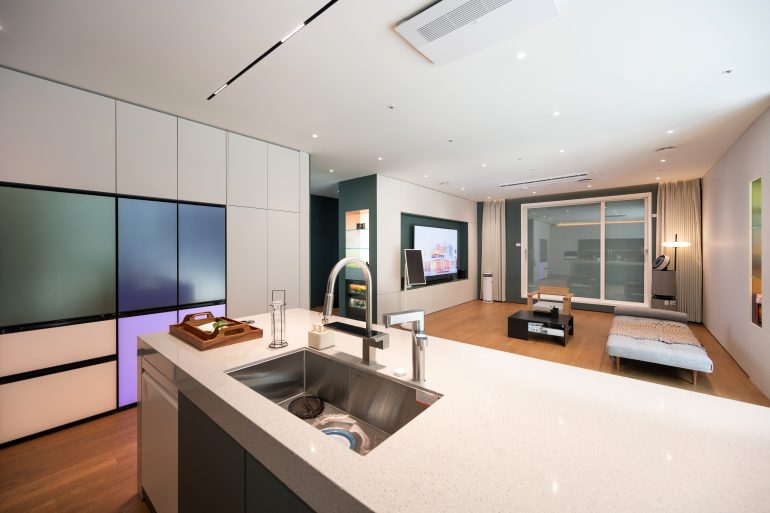
I’ve got mixed feelings about the idea of a home that does everything for me. I love cooking. I trained as a chef before becoming a technology journalist, and there’s still something special about working with produce and making something from scratch. It’s almost a type of therapy that I don’t necessarily want a machine taking away from me.
Washing up, though? I’m all for finding a better way to deal with that, by which I mean, someone or something else needs to do it, please. I also have a tendency to be very scatterbrained at times which makes remembering whether I’ve switched something a device off or set a smart appliance to do a job later, something that I forget about more often than I’d like to admit.
It’s interesting when you think about it;, there are things we do because we enjoy them, and plenty of other things we do because they need to be done. Technology has always promised to make our lives easier, but I don’t know if we’ve spent enough time thinking about what we’d actually like to do with the time it gives us back.
I remember a call from my time working at Amazon that changed how I thought about how much impact technology can have on everyday life. I was a supervisor, and a customer service agent escalated a call from a woman who was very upset because a video on Prime Video wouldn’t play.
She was a single mother with a young autistic child. The show was one of the few things her child would watch. It was familiar and comforting, and while it played, she had a little time to herself. She could make a cup of coffee, take a shower or just have a few minutes to do something else.
Once I understood that, I realised why she was so upset. To someone dealing with a technical support issue, it looked like just a video that wouldn’t play. For her, it was something that helped make her day a little easier, and suddenly it wasn’t there.
That conversation has stuck in my head for years. It made me think about how we can take things for granted and how much good, useful, intuitive technology can bring to someone else’s life. We talk about features, performance and what a product can do, but we don’t always think about what that actually makes possible for the person using it.
That was one of the things I kept coming back to during my recent visit to LG in South Korea.
What do we want technology to do for us?
LG has been talking about becoming a Smart Life Solution Company since 2023. It’s an ambitious shift in how the company sees itself, moving beyond the individual appliances and electronics it’s known for and shifting instead to connecting experiences across homes, commercial spaces and mobility.
The Home Appliance Solution Company is where that ambition gets particularly interesting. LG’s Zero Labour Home vision is built around the idea that appliances and connected devices should be able to take care of more household tasks, with less input from the people living there. It’s part of why their AI systems for these ecosystems are now referred to as Affectionate Intelligence, instead of “artificial”.
I saw a version of this at ThinQ Real, a demonstration apartment at LG Sciencepark in Seoul. Appliances, sensors and connected devices work together to respond to what’s happening in the home. Imagine unlocking your front door and the home itself is able to understand things like air quality, temperature (both inside the home and outside) and adjust the heating, switch on an air purifier if needed and prompt you to put your jacket or any other item of clothing in the LG Styler. The idea is that the environment can adjust to the people living there, rather than requiring them to keep telling every device what to do.
We’ve had smart appliances and smartphone apps for years. I can already switch things on remotely, check settings and set routines. But there’s a limit to how useful all of that is if I’m still the one who has to manage everything. That’s also why LG’s partnership with Apple on a new range of smart home products is such a gamechanger. Not only does Apple bring millions of new users into the smart home ecosystem, users also benefit from the seamless integration of LG’s smart home hardware and the company’s years of experience at building not only exceptional hardware products but also helping create standards that benefit the entire smart home community
I don’t want another app to check before I go to bed. I don’t want to spend my Sunday afternoon trying to get three different devices to communicate with each other. If technology is going to make life easier, it needs to get better at doing things without constantly asking for our attention.
That’s part of what LG is trying to address through its connected-home ecosystem. Its ThinQ ON hub is designed to bring devices together, while its acquisition of an 80% stake in Athom, the company behind Homey, gives it access to an even broader smart-home platform. Its aforementioned collaboration with Apple on seven smart-home accessories is another indication of how important interoperability is becoming.
There’s a bigger question here, though. A home that anticipates what you need sounds appealing, but how much control do you want to hand over? How much information should it collectWhat does it need to know about your routines? And what happens when something stops working?
These aren’t reasons to dismiss the idea. They’re questions any company promising a more intelligent home will eventually have to answer. The technology has to earn our trust, and it has to work reliably enough that we don’t end up spending more time fixing it than we save.
I still want to decide what happens in my home. I just don’t need to be involved in every little thing that makes it work. There’s a difference between giving up control and not having to think about something all the time.
The ambition beyond the home
The visit to LG Smart Park in Changwon gave me another perspective on the company’s interest in automation. This is where LG uses robotics, AI and digital-twin technology in manufacturing. I saw how different refrigerator models can be made on the same production line, with the system adapting as each product moves through the process.
LG also demonstrated how production data can help identify potential problems before they interrupt the line. It’s a long way from a washing machine quietly getting on with its cycle, but the underlying idea is familiar: technology doing more of the work in the background.
There were some rather impressive products along the way, too. I also spent time at LG’s Seoul showrooms, including Signature Kitchen Suite (SKS), its premium built-in kitchen brand, and D5, where the company showcases some of its more ambitious display technology. The 136-inch LG MAGNIT Micro LED display is quite something to see in person. There were a few things I’d happily find space for at home.
But, while the products were impressive, it was the bigger idea behind them, and whether LG can make that idea work beyond the carefully designed environments I saw in South Korea, that really stayed with me.
Of course, things look a little different when you bring this idea home to South Africa. Electricity costs, load-shedding,power outages, water use, connectivity and affordability all influence what we’re willing and able to bring into our homes. A connected appliance needs to do more than look impressive in a home. It has to be reliable, justify its price and be supported when something goes wrong.
There’s also the question of who gets to benefit. A home filled with connected appliances is one thing if you can afford it. Making technology genuinely useful to more people is a different challenge altogether.
I came away from South Korea thinking about how we measure technological progress. We’re so often impressed by what a device can do, how many features it has or how much intelligence has been built into it. Those things have their place, but they’re not the whole story.
Perhaps the better question to ask is what any of it gives us back. More time to cook, if that’s what we enjoy. A little less housework. A chance to sit down with a cup of coffee without having to think about the next thing that needs doing. It could also be more time with the family or more time to pursue a passion project.
I’m not sure I’d want a home that does absolutely everything for me. But I’d be quite happy with one that takes care of enough of the routine stuff that I have a little more time for the things I actually want to do. And I suspect most of us could find something we’d rather be doing than managing our appliances.