
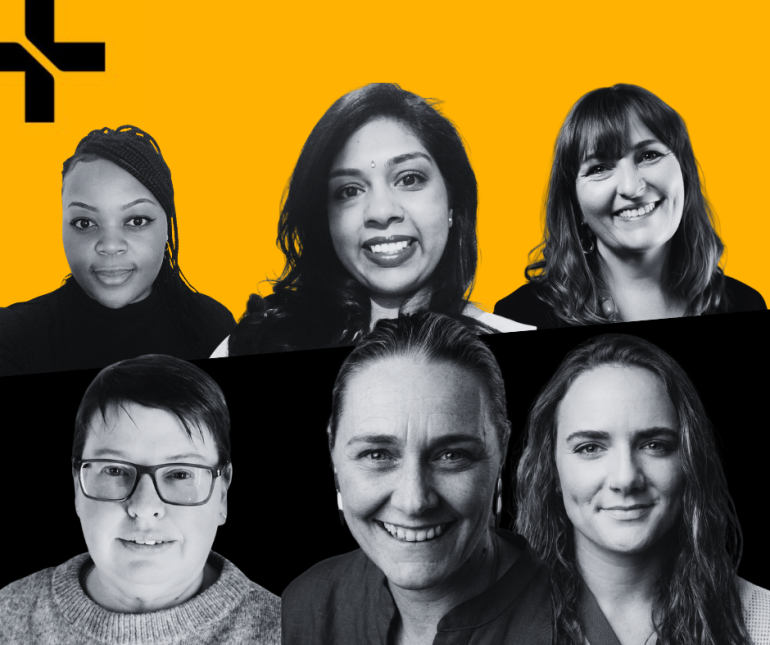
Generative AI is starting to change what an AI job looks like. At Brandtech+ in South Africa, the women helping to embed the technology across its creative business include a copywriter, motion graphics designer, HR lead, chief operating officer, creative optimisation head, business lead and automation and AI integration lead. Some have AI in their job titles and others don’t, but the technology is already part of their work.
The mix offers a glimpse of what happens once generative AI moves beyond experimentation and becomes part of ordinary business. Existing professions don’t necessarily disappear, but the skills expected inside them begin to shift. For South Africa, that could open AI-related work to people who didn’t come through computer science, while raising another question about whether greater participation eventually translates into greater influence inside the companies adopting it.
Brandtech+ is an interesting place to watch this happen because generative AI has already been pushed fairly deep into its creative operation. The company, formerly known as OLIVER+, works across film, CGI, automation, AI, motion design and digital and print production. Its parent, The Brandtech Group, owns Pencil, a generative AI marketing platform that the group says has produced more than one million ads across 5,000 brands.
Its South African operation is expanding too. Brandtech+ says it is recruiting hundreds of people across creative, technology, account management and project management, and its current vacancies show how AI is already bleeding into different kinds of work. Johannesburg openings include a GenAI Global Capability Lead and a Senior Integrated AI Producer, while other roles increasingly expect familiarity with AI-assisted workflows even when AI isn’t the job itself. That overlap may tell us more about AI employment than the brief period when “prompt engineer” looked likely to become the defining profession of the generative AI era.
AI is becoming another skill inside the job
Yolisa Mjamba’s title is Gen AI Senior Copywriter, and the order of those words is revealing. She remains a copywriter, but the tools available to do the job and the expectations attached to it are changing.
“AI can give you hundreds of lines in seconds, but that doesn’t mean any of them deserve to become the line,” Mjamba says. “The writer still needs to bring judgement, cultural understanding and a point of view.”
There’s some corporate self-interest in emphasising the continued importance of human creativity while introducing software capable of producing creative work at extraordinary speed. Still, the underlying problem is real. Generating dozens of possible lines doesn’t tell a brand which one is worth using. Someone still has to recognise when the language is generic, when the tone is wrong for the audience or when an apparently polished answer should never reach a client.
Tasmin le Roux encounters the visual version of that problem as a Gen AI Senior Motion Graphics Designer. Her role combines generative AI with motion design and visual storytelling, and she has completed specialist AI filmmaking training. She describes generation as an early part of the process, with much of the craft still sitting in directing and refining the work before deciding what is actually good enough to use.
Alison Stansfield-Franks, Brandtech+’s Global Head of Creative Optimisation, makes a related argument when she warns against treating faster production as evidence of better creativity. Taste and judgement remain important in her telling, even when the systems producing the material can work considerably faster than the people evaluating it.
The pattern becomes clearer outside the creative roles. Vicky Moodley, the company’s Gen AI Business Lead, has helped develop a Gen AI Centre of Excellence and train global teams on Pencil, while HR Lead Mumtaj Mohamed is dealing with the skills employees need as their roles change. Chief operating officer Candice Siege is concerned with getting AI to work consistently across different teams and markets while still meeting client requirements. Once that happens, AI adoption becomes an organisational problem as much as a technical one.
McKinsey’s 2025 State of AI research suggests many businesses are confronting a similar gap. Its survey found that 88% of respondents said their organisations used AI in at least one business function, but only 7% said it had been fully scaled across the organisation. Giving employees access to AI is relatively easy compared with redesigning real workflows around it.
For many workers, AI competence may simply become part of staying current in the career they already have. That puts more pressure on employers to provide meaningful training rather than expecting employees to figure out another significant workplace shift on their own.
More routes into AI won’t automatically fix who gets ahead
That question becomes particularly relevant when looking at women in African technology because the continent already loses a significant amount of female talent between education and senior employment. McKinsey found that women account for 47% of STEM graduates from African universities, yet their participation falls to between 23% and 30% in technology roles. Less than 12% of technology leadership positions are held by women.
The problem is already visible in the gap between Africa’s female STEM graduates and the women who make it into technology careers. Getting more girls and women into technical education remains useful, but the graduation numbers suggest that access to education is only part of what is going wrong. A substantial share of the loss happens after women have already acquired the qualifications.
Generative AI makes the boundary around that workforce harder to draw. Mjamba doesn’t need to retrain as a software engineer for AI to affect what employers expect from her as a copywriter, while le Roux can become highly specialised in AI-assisted production without abandoning motion design. Moodley’s work combines technology adoption with training and organisational change, and Mohamed’s involvement shows how quickly a new technical capability starts affecting hiring and career development.
That could create additional routes for women into work that companies consider important to their AI strategies. Someone with deep expertise in design or language may increasingly find that expertise combined with AI, while project managers and other people responsible for getting work out of the door are also being expected to understand where the technology fits.
Broader access to the work won’t necessarily produce broader access to power. Women can become proficient with AI systems while remaining underrepresented in the positions that decide budgets or control strategy. Companies can spend heavily on training without changing the promotion structures that produced the leadership gap in the first place.
Mohamed argues that businesses have a responsibility to give employees the training and confidence to develop new capabilities as their jobs change. That becomes more consequential once proficiency with generative AI moves from an optional advantage to something employers simply expect, because people who aren’t given access to the tools or time to learn them can fall behind even when they were already good at the underlying job.
South Africa therefore has to think about skills and progression together. Workers need realistic access to the capabilities changing their professions, but widening the entry point won’t achieve much if women continue disappearing from the pipeline before reaching senior positions.
South Africans may also be able to do more global creative work from here
Brandtech+ is making another argument through its South African expansion. Estelle van Heerden, its Global Automation and AI Integration Lead, believes generative AI can make proximity to traditional advertising centres less important, allowing more specialist creative work to be done from South Africa for international clients.
There is already a much larger South African industry built around the premise that work can travel. Business Process Enabling South Africa says the country’s global business services sector created 26,346 new jobs serving international markets in 2025, its highest annual total since 2018. Just under 23,800 went to young people, and the UK and US remain important source markets for work delivered from South Africa.
Creative production follows different economics from contact centres and other outsourced business services, so the comparison has limits. What the GBS sector demonstrates is that a South African worker can build a career around companies and customers elsewhere without physically moving to those markets.
Brandtech+ says it wants its South African expansion to create international careers locally, and generative AI could make that proposition easier in some creative disciplines. A designer in Johannesburg or Cape Town can work with many of the same models and production tools available to a team in London, while the work itself can already move between countries without much difficulty.
Where the work happens, however, is only part of what determines its value. If South African teams receive large volumes of AI-assisted adaptation and production while strategy and creative authority remain elsewhere, the country gains employment without gaining much influence over the work. A stronger outcome would see people based here increasingly involved in developing the processes, advising global clients and making the creative decisions that determine what eventually gets produced.
The women Brandtech+ has highlighted are interesting because their jobs already cross some of the boundaries that once separated creative and technical work. A copywriter can now have Gen AI in her title and a motion designer can specialise in AI filmmaking, while people elsewhere in the organisation have to understand the technology because their jobs depend on making it work.
That may be a more useful way to understand AI employment in South Africa than looking for an entirely new category of “AI professionals”. For a large number of people, AI will arrive inside the career they already have. Whether that widens opportunity for South African women will depend on whether they get access to the skills early enough to benefit from the change and remain in the pipeline as those jobs become more valuable and more senior.