
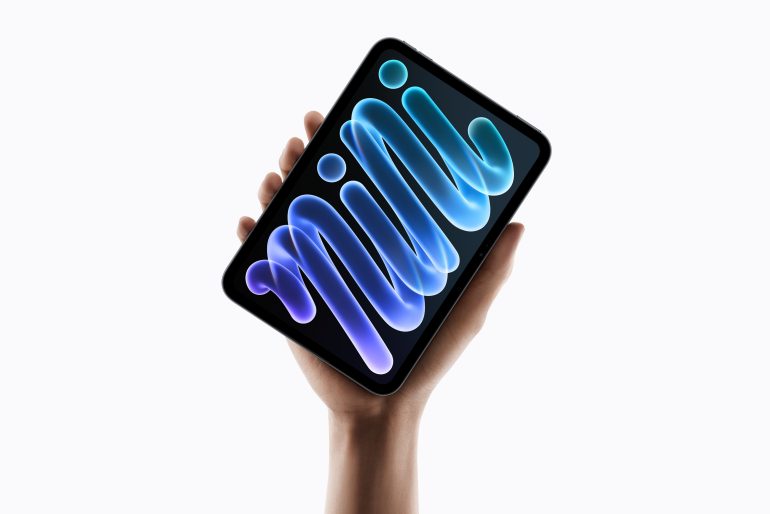
Apple has finally brought OLED to the iPad mini. The new model, announced on Monday, 26 October, has a larger 8.5-inch display, a thinner body, Apple’s A20 Pro processor and, for the first time on an iPad, an official water and dust resistance rating. It’s also considerably more expensive, starting at $699 in the US.
The price is likely to raise a few eyebrows, particularly among people who’ve always liked the iPad mini for its portability but haven’t necessarily needed the processing power of an iPad Pro. Apple has made some substantial changes this time, although one of the more obvious limitations remains: the display still has a 60Hz refresh rate.
It’s been two years since the previous iPad mini arrived with the A17 Pro chip and support for Apple Intelligence. That update left the design almost entirely untouched. The new model, which goes on sale on 6 November, is quite a different proposition.
A bigger OLED screen without a bigger iPad
The display has grown from 8.3 to 8.5 inches, but Apple hasn’t made the tablet itself any larger. Instead, it’s reduced the bezels by 24%, allowing the screen to occupy more of the available space.
Moving from LCD to OLED should make an immediately noticeable difference, especially when watching films, viewing photographs or reading in dark mode. Because OLED pixels produce their own light, black areas of the screen can be switched off completely. That’s something the backlight on the older LCD couldn’t do.
Brightness has improved as well. Apple claims a peak of 1,200 nits, more than twice that of the previous model, with 600 nits available across the whole display. It can also dim to just 1 nit, which will be particularly welcome for anyone who uses an iPad mini to read in bed.
There’s an optional nano-texture finish to reduce reflections, a feature previously associated with Apple’s more expensive displays. It could be useful outdoors, although Apple hasn’t detailed the availability and pricing of that option across the different configurations.
The disappointment is the refresh rate. As The Verge reports, the new iPad mini still doesn’t support ProMotion, Apple’s adaptive refresh rate technology that allows compatible displays to reach 120Hz.
A 60Hz screen isn’t inherently bad, but smoother scrolling and animation are noticeable improvements, particularly on a device that’s operated primarily through touch. Apple has made a point of improving almost every other aspect of the display, making the decision to retain 60Hz rather curious.
The tablet itself is now just 5.4mm thick, down from 6.3mm, and Apple says it’s lighter than before. The company has also introduced an IP67 rating, meaning the iPad mini has been tested to withstand immersion in fresh water at a depth of one metre for up to 30 minutes.
That’s useful protection against accidents, although it doesn’t mean the tablet should be taken swimming. Apple warns that water resistance can deteriorate with normal wear, and liquid damage isn’t covered by its standard warranty.
Apple’s A20 Pro is doing more than running apps faster
The new iPad mini uses Apple’s A20 Pro, manufactured using a 2-nanometre process. According to Apple’s testing, it delivers up to 60% faster multithreaded CPU performance and graphics performance that’s as much as 2.7 times faster than the previous model.
Those are sizeable improvements, although the older A17 Pro was already more than capable of handling the things most people do on a small tablet. Reading, streaming video, browsing the web and taking handwritten notes weren’t particularly demanding tasks for that processor.
The more interesting changes concern graphics and AI. The A20 Pro has a GPU with Neural Accelerators in each core, allowing it to handle certain AI tasks without sending information to a remote server. Apple claims AI performance is up to 4.5 times faster than before, although that figure comes from its own testing.
There are differences between the configurations, too. The 512GB model gets a Dual 16-core Neural Engine, effectively providing 32 cores that can be used together for more demanding AI workloads.
That might make a difference to people running local language models or using creative applications that rely heavily on AI processing. It’s unlikely to matter nearly as much to someone whose iPad mini spends most of its time running Safari, Kindle or Netflix.
Apple has also more than doubled unified memory bandwidth, which should help when applications need to move large amounts of data around.
A better camera position, new speakers and faster connectivity
Some of the smaller changes could turn out to be among the most useful.
Apple has moved the 12MP Center Stage front camera to the landscape edge of the tablet. It sounds minor, but anyone who’s joined a video call while holding an iPad horizontally will appreciate having the camera positioned above the screen rather than off to one side.
The 12MP rear camera remains capable of recording 4K video at up to 60fps, and now has an Adaptive True Tone flash. Apple says the improved lighting should also help when scanning documents, arguably one of the more practical uses for a tablet camera.
The speakers have been redesigned completely. Apple calls the system an Acoustic Display, using woofers paired through the display and smaller tweeters positioned between the glass and aluminium enclosure. The company promises stronger bass, more volume and clearer high frequencies, although we’ll need to hear it before drawing conclusions about the sound quality.
Connectivity has received attention, too. Apple’s N1 wireless chip brings Wi-Fi 7, Bluetooth 6 and Thread support, while cellular models use the newer C2 modem. Apple claims the modem can deliver mobile data speeds up to 50% faster than the previous iPad mini, depending on network conditions.
eSIM support remains, which is useful for travellers who want mobile connectivity without relying on public Wi-Fi or using their phone as a hotspot.
The tablet also continues to support the Apple Pencil Pro and Apple Pencil (USB-C). Apple has introduced a redesigned Smart Folio cover made from TechWoven fabric, available in navy blue and taupe.
Siri is getting smarter, although there are limitations
The new iPad mini ships with iPadOS 27 and supports Apple’s latest version of Apple Intelligence, including the more conversational Siri AI.
Apple says Siri can now draw on personal information stored in messages, emails and photographs to understand requests. It can also recognise what’s being displayed on the screen, allowing users to ask questions or request actions related to the content they’re looking at.
For example, someone could ask Siri to find information buried in an old message without having to remember which conversation it appeared in. That’s considerably more useful than being limited to straightforward questions, setting reminders or controlling connected devices, although the accuracy and reliability of these features still need to be tested.
There are also improvements to Apple’s photo-editing tools. Clean Up has been updated, while Spatial Reframing and Extend allow users to adjust the composition of existing images. Image Playground can now generate photorealistic pictures, and Safari has a Notify Me feature that monitors websites for changes, including price drops and stock availability.
There are a few catches, though. According to Apple’s announcement, Siri AI is arriving in beta with iPadOS 27.2 and won’t initially support every language or region. Apple is also placing daily limits on some of its cloud-based AI features, with plans to charge users who want additional access. It hasn’t said how much that will cost or how much people will be able to use these features for free.
Another useful software addition is extended display support, arriving with iPadOS 27.2. This will allow the iPad mini to run apps across its own screen and an external monitor, rather than simply showing the same image on both. It could make the tablet considerably more practical for occasional desktop-style work.
The new iPad mini starts at $699
Apple is offering the iPad mini in midnight and starlight, with 128GB, 256GB and 512GB storage configurations.
The Wi-Fi model starts at $699 in the US, while the Wi-Fi + Cellular version starts at $849. The new Smart Folio costs $79, with the Apple Pencil (USB-C) also priced at $79 and the Pencil Pro at $129.
Pre-orders open on Wednesday, 28 October, with availability beginning on Friday, 6 November in the initial launch markets.
South African pricing and availability haven’t been confirmed. Apple’s US prices exclude applicable sales taxes, so a direct currency conversion wouldn’t provide a particularly useful indication of what buyers will eventually pay locally.
The higher starting price also changes the conversation around the iPad mini. The 2024 model launched at $499 in the US, although Apple subsequently increased its price to $599 earlier in 2026. That means the new model costs $100 more than its immediate predecessor did before the announcement, and $200 more than the 2024 launch price.
There’s no question that OLED, water resistance and a thinner design make this a more interesting device than its predecessor. The iPad mini also occupies a fairly unusual position in the tablet market. There aren’t many compact tablets with comparable processing power, stylus support and access to the iPad app ecosystem.
Still, $699 is a substantial amount to spend on an 8.5-inch tablet, especially when the screen remains limited to 60Hz. And while the A20 Pro’s additional performance is impressive on paper, someone who primarily wants a small tablet for reading, watching videos and browsing probably doesn’t need most of it.