
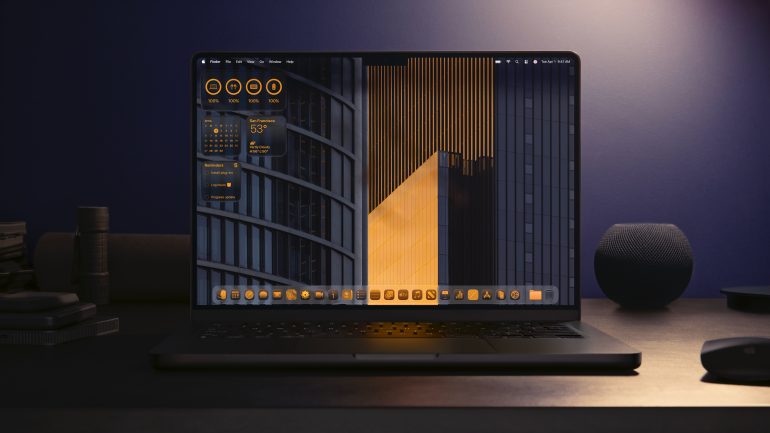
Apple WWDC 2025 didn’t just showcase new features — it revealed the mindset of a company choosing polish over provocation in the age of generative chaos.
At this year’s Worldwide Developers Conference, Apple performed an elegant act of deflection. While rivals like Google and OpenAI race to unleash increasingly powerful AI models with world-altering potential (and consequences), Apple chose the familiar path: restraint, design coherence, and user experience so refined it borders on sterile. There were AI features — of course. But they were housed within beautiful glass edges, delivered with soothing continuity, and tempered by Apple’s one true obsession: control.
In unveiling a new visual aesthetic called Liquid Glass, a renamed OS lineup that aligns with calendar years, and modest but tightly-integrated AI tools under the Apple Intelligence banner, Apple communicated less about innovation than about containment. Containment of complexity, of risk, of disruption. And perhaps most tellingly, containment of expectation.
This is Apple in 2025: polished, defensive, and still allergic to the unpredictable spirit that now animates its competitors.
“Apple did what Apple does best — simplifying user interfaces for daily use and enhancing seamless integration,” said Anisha Bhatia, Senior Technology Analyst at GlobalData. Her comment may sound like praise, but it also underscores Apple’s current challenge: doing what it does best at a time when the best may no longer be enough.
From Vision to Retreat
Consider the subdued rollout of Apple Intelligence. Features like Live Translate, Visual Intelligence, and Spotlight’s new contextual search were scattered across the keynote with the casual air of a company unwilling to hype what it hasn’t perfected. These are solid capabilities — built on-device, running at the edge, respecting user privacy. But they aren’t paradigm-shifting. And Apple didn’t pretend they were.
Compare that to Google’s Gemini-first strategy or Meta’s open-source Llama bet. Those companies are releasing AI that is raw, untested, arguably dangerous — but undeniably ambitious. Apple’s refusal to move fast and break things has become part of its brand. But in 2025, with AI fundamentally remapping the way humans interact with machines, Apple’s caution looks less like integrity and more like a refusal to imagine otherwise.
Even developers, once Apple’s loyal vanguard, are showing signs of discontent. The company’s restrictive App Store policies, opaque review processes, and now delayed implementation of promised AI tools have made WWDC feel more like a PR ritual than a true rallying point. The promise that third-party developers will now be able to build applications using Apple’s edge AI models is welcome — but late.
Edge Intelligence, but No Edge
Apple’s strategy of localised, privacy-first AI should be a strong counterpoint to the data-hungry cloud models of its rivals. Yet, paradoxically, it now feels like a retreat. Generative AI is messy, sometimes wrong, and often surprising. It’s also collaborative — requiring feedback, iteration, improvisation. These are not Apple’s instincts.
The aesthetic of Liquid Glass — all smooth transitions and ethereal transparencies — is more than a design motif. It’s a metaphor for how Apple wishes to interact with intelligence: beautifully, seamlessly, invisibly. But real intelligence, especially of the artificial kind, isn’t always elegant. Sometimes it’s awkward. Sometimes it argues back.
Therein lies Apple’s current dilemma. Its power comes from making the future feel like the present — clean, unified, curated. But the future of AI isn’t going to be neat. And if Apple doesn’t adapt to the mess, it may find itself designing ever more beautiful interfaces for a world that no longer needs them.
Tariffs, Tensions, and the Fight for the Future
This year’s WWDC took place against a backdrop of trade tensions, increased developer backlash, and criticism of Apple’s slow rollout of AI features announced last year. The company is facing renewed pressure from Chinese tariffs, EU regulatory scrutiny, and the US government’s ongoing interest in antitrust enforcement. Its fortress approach — keeping everything in-house, on-device, behind walled gardens — is being tested from all sides.
And yet, Apple remains Apple. A company that builds not just devices, but realities. The question raised by WWDC 2025 is whether the reality Apple is building — controlled, elegant, intentionally closed — still matches the one the rest of the world is rushing toward.
If Apple continues to treat AI as a tool to be tidily embedded within its ecosystem, it may find itself left behind not by inferior competitors, but by a culture that no longer wants to be curated.