
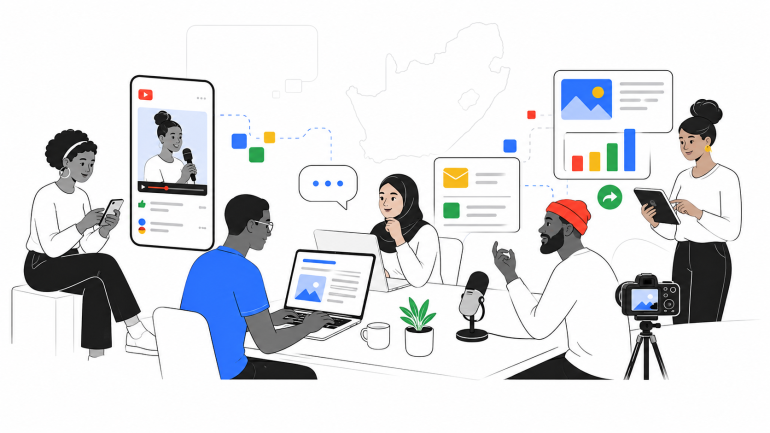
South Africa’s next newsrooms may not look much like the institutions that came before them. They’re being built around creators, social platforms, video and direct relationships with audiences, occupying territory that once belonged almost exclusively to conventional publishers.
The Google News Initiative has selected eight South African independent news operations for its Emerging News Voices Growth Lab, a three-month virtual programme involving 18 organisations across Sub-Saharan Africa. The South African participants include Mapepeza News Media, SMWX, Good Things Guy, Explain, Amahle-Imvelo Jaxa, Our City News, Scrolla Africa and The Bigger Picture.
Read the announcement as a list of participants and it’s a fairly conventional industry story. Look at what Google plans to teach them, though, and something more interesting appears. The programme combines newsroom uses of Gemini, NotebookLM, Google Trends and SynthID with YouTube strategy, Shorts, newsletters, direct audience relationships and ways of making money.
That’s a curious description of a newsroom if your mental image is still a publication with a homepage, sections and an audience expected to come looking for it. It makes considerably more sense if the publication itself is becoming something distributed across platforms, held together by a recognisable voice and an audience that may have little interest in visiting a traditional news website.
News audiences have moved, but they didn’t move alone
Google isn’t inventing this version of journalism, but neither did audiences simply choose it. The way people now encounter news has been shaped by a technological environment that made publishing almost frictionless, information abundant and often free, and feeds increasingly good at bringing the next piece of content to us before we’ve decided to look for it.
That environment matters because audience behaviour doesn’t develop in isolation. TikTok, YouTube, Instagram and other platforms have normalised a version of the internet in which information arrives continuously rather than waiting to be sought out. Recommendation systems determine much of what appears next, short-form video has become an ordinary way of consuming information, and the boundary between journalism, commentary, expertise, entertainment and assertion can be remarkably thin when all of it arrives in the same feed.
The Reuters Institute’s 2026 Digital News Report found that social media and video networks have overtaken news websites and apps as a source of news globally. Add AI chatbots and 56% of respondents used these third-party channels for news in the previous week. Among 18-to-24-year-olds, 52% now say social media, video networks and AI chatbots are their main way of getting news.
That tells us something important about behaviour, but it doesn’t necessarily tell us what audiences would have chosen in a different technological environment. A young person who gets most of their news through TikTok may genuinely prefer a 90-second explanation to a long article, but that preference has also developed inside systems designed around feeds, recommendations, notifications and an endless supply of content competing for attention.
The shift towards personalities is just as significant. Reuters Institute research published earlier this year found that among 18-to-24-year-old social media news users, 51% said they paid more attention to individual news creators or personalities, compared with 39% who paid more attention to traditional news organisations or journalists. Its wider 2026 research found that more than a quarter of people surveyed across 48 markets get information from news creators each week. Those creators are frequently regarded as more accessible and engaging than traditional news media, although audiences also tend to consider them less trustworthy and less impartial.
The technology has changed who can participate too. Someone witnessing an event can post about it before a reporter gets there. A genuine expert can explain a complicated subject without first convincing an editor to give them a column. Someone with no expertise at all can do exactly the same thing, and often with equal visual authority. A phone, a platform account and enough confidence can place reporting, expertise, misinformation and speculation next to one another in a feed with surprisingly few clues about which is which.
South Africa isn’t watching that change from the sidelines. The country section of the same Digital News Report describes digital news creators as increasingly influential, with audiences moving towards smaller, personality-driven platforms while established newsrooms continue to shrink. It also identifies the difficult part: building sustainable businesses around these new forms of journalism while maintaining journalistic standards. The South African survey sample primarily represents younger English-speaking internet users, so it shouldn’t be treated as a perfect picture of the whole country, but the direction it identifies is difficult to ignore.
There’s also an economic history behind those habits. News publishers spent much of the early internet era making journalism available without asking readers to pay for each piece of it, while search engines and social platforms made information increasingly easy to discover elsewhere. Subscription models have since become more important, but they arrived after the expectation of freely available online information had already become deeply embedded. Creator-led news didn’t invent that expectation. It inherited it.
There’s a parallel shift happening in the broader creator market. South African creators are increasingly being treated as businesses rather than people who happen to have large social followings, something visible in the growing commercial infrastructure around the industry. We’ve previously looked at South Africa’s influencer economy is growing on the wrong metrics and how rapidly the South African creator economy is becoming more professionalised, even as its measurement and monetisation systems struggle to keep pace. Journalism is starting to run into some of the same questions.
A newsroom that doesn’t look much like one
The Growth Lab’s curriculum is revealing because it treats distribution, editorial work and business sustainability as parts of the same problem.
For a small independent publisher, that’s probably realistic. A creator-led news operation can’t necessarily afford separate editorial, audience development, video, product and commercial teams. The person researching a story may also be recording the video, publishing it to YouTube, sending the newsletter and thinking about how any of this eventually pays the bills.
Google has been experimenting with this territory for a while. Its Journalistic Creators Lab explicitly supports creators producing fact-based news and information through formats ranging from short-form video to longer investigative work. The company also announced a Global News Gaps Project in 2025 aimed at hundreds of emerging news providers, combining product training with strategic support for growth.
The Emerging News Voices programme pushes the idea further in Africa because the participants don’t neatly fit one definition. Good Things Guy has spent years building a recognisable digital publishing brand. Scrolla Africa operates as a digital news publication. Other participants are smaller or more personality-led. Google has put them in the same room because, from the audience side of the screen, the boundaries between those models are becoming much less useful.
That doesn’t mean every person with a TikTok account and an opinion is suddenly a journalist. The growth of news creators introduces its own problems around sourcing, verification, accountability and the uncomfortable blur between reporting, commentary, activism and influence. Reuters Institute researchers make that ambiguity explicit when describing the creator news ecosystem.
It does suggest that institutional shape is becoming a poor shortcut for deciding what counts as serious news work. A five-person digital operation publishing reporting through YouTube, WhatsApp and a newsletter may behave more like a newsroom than a recognisable media brand recycling wire copy onto a website. The address bar tells us considerably less than it used to.
Google gets something out of this too
There’s another side to Google helping news businesses adapt to platform-led journalism: Google is one of the technology companies that helped build the environment to which those businesses now have to adapt.
That makes its role more complicated than simply responding to changing audience behaviour. Google supplies discovery, advertising infrastructure and analytics to publishers, while Gemini is becoming another interface through which people can obtain information without necessarily visiting the publication that produced it. The 2026 Digital News Report found weekly use of AI chatbots for news had risen from 7% to 10% globally in a year. Google, meanwhile, has publicly said it is working with publishers and emerging creators as it develops new web and AI experiences.
There’s genuine value in Google helping smaller publishers understand AI, video distribution and revenue, but there’s also an obvious strategic interest in keeping those publishers healthy enough to continue producing the information on which the wider web, search products and increasingly AI systems depend.
The relationship is therefore less straightforward than “audiences moved, so Google followed”. Technology companies changed distribution, publishers changed their business models in response, creators exploited new forms of access, audiences developed new habits and those habits then gave platforms further incentive to build around them. None of those forces operates independently.
South Africa makes that relationship particularly interesting. Google’s Growth Lab isn’t its only local media intervention. The company is also working with the MDDA and Daily Maverick on a five-province programme providing digital skills, business sustainability and AI training to vernacular-language publishers in isiXhosa, Afrikaans, isiZulu, English and Sepedi.
Taken together, these initiatives suggest Google is looking beyond the large publisher when it imagines where the next viable news businesses might emerge. Some may begin as community publications. Others may begin with a person and a camera. A few will probably grow into organisations that eventually look surprisingly conventional. The more consequential change is that they no longer need to.
For most of the internet era, digital journalism still inherited the organisational assumptions of newspapers and broadcasters. The homepage became a front page, sections became navigation menus and social platforms largely served as routes back to something recognisably called a publication. That architecture is being dismantled from several directions at once, by platforms, by publishers, by creators and by audiences responding to the environment all of them have collectively produced.
The challenge for South African news creators now isn’t proving that people will get news from them. They already do. It’s whether they can turn that attention into durable, credible journalism without becoming entirely dependent on the same platforms that shaped the conditions under which they emerged.