

Spotify’s latest experiment in how much we will pay to listen a little better is called Spotify Premium Platinum, and South Africa is one of five test markets, alongside India, Indonesia, the UAE and Saudi Arabia.
For a company that usually tests new features in the United States or Western Europe, that is a notable shift. Spotify is saying, in effect, that the “next billion listeners” are not just a growth cliché anymore. They are now the laboratory.
A hierarchy of listening
The pilot introduces a new three-tier structure: Premium Lite, Premium Standard (including Student), and the new Premium Platinum plan.
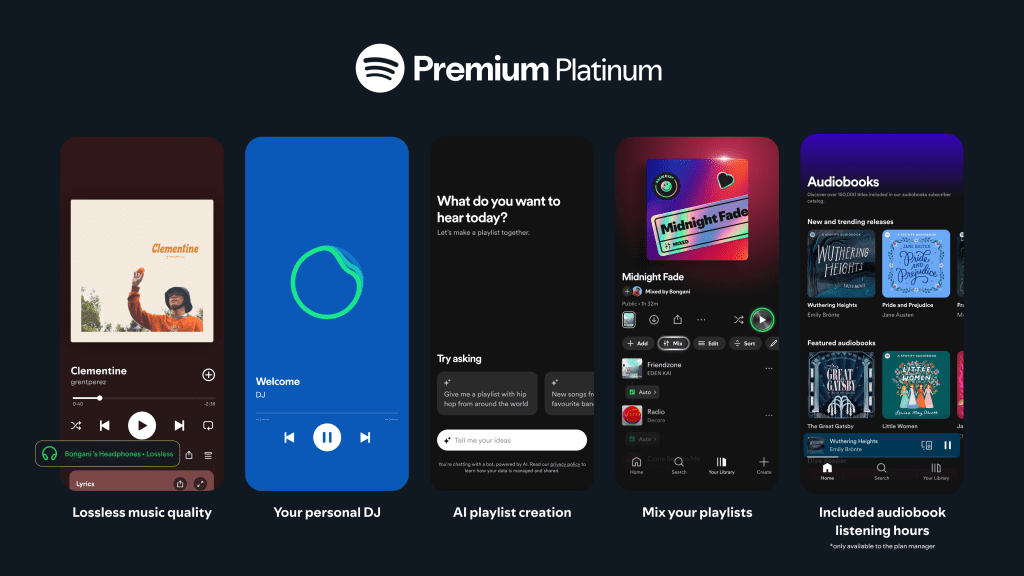
Platinum is presented as “the ultimate Spotify experience”, a phrase that sounds like it was written by a marketing team, but it actually comes with substance. Subscribers get lossless audio, which Spotify has promised for years, as well as third-party DJ integration and mixing tools. Features such as Jam and daylist also remain part of the experience. In short, you do not just listen; you can play with what you listen to.
Audiobooks are another inclusion. Platinum subscribers get 12 hours of audiobook listening per month, with optional 10-hour top-ups, from a catalogue of over 150,000 English-language titles. It is a subtle addition, but one that matters in markets where standalone audiobook platforms have never quite taken hold.
You can browse Spotify’s plans here.
Why South Africa, and not somewhere like Spain?
Spotify describes this pilot as a response to “engagement insights across our platform”. In other words, these are markets where people use Spotify heavily, but not necessarily in the same way as Western users.
South Africa’s inclusion makes sense because our listening habits are so mixed. Some users download playlists over mobile data, students on shared family plans, DJs who link Spotify into live sets, and casual listeners who switch between free and premium as needed. All of that data is gold for Spotify’s monetisation experiments.
The five countries chosen — India, Indonesia, the UAE, Saudi Arabia and South Africa — all sit at an interesting intersection. They have emerging middle-class spending power, complex connectivity realities and thriving local music scenes. They are also markets where people want premium experiences, but only if the pricing feels fair.
Lossless sound meets market noise
Lossless audio is the headline feature. It has been missing from Spotify for years, even as Apple Music and Tidal normalised high-resolution streaming. The reason for the delay was not technical. It was economic. Lossless costs more to deliver and demands more bandwidth, which makes it a tricky sell in markets with unreliable internet access or high data costs.
That is what makes this pilot so interesting. Spotify is introducing its most data-heavy feature in countries that are still navigating inconsistent infrastructure. The company is betting that even if people do not have top-end headphones or perfect fibre connections, they will still pay for the idea of better sound.
Audiobooks: Spotify’s quiet land grab
Audiobooks are the stealth move here. They are Spotify’s way of becoming an all-in-one audio platform rather than just a music streamer. Bundling audiobook hours into a premium plan introduces users to a new format without asking them to download another app.
For South Africa, where podcast culture is growing but still uneven, it also makes Spotify feel more like a local media platform than a global service that just happens to operate here. It is the same logic that underpinned the company’s African playlist work, like the rebrand of Spotify’s African Heat and the RADAR Africa programme. Each move adds a layer of local relevance without having to create an entirely new product.
A global test of value
The bigger story behind Premium Platinum is not sound quality or audiobooks. It is value. Spotify knows that users in South Africa, India and similar markets will pay for quality, but only to a point. The question is how much.
Platinum is not just a new tier. It is a pricing experiment. If users upgrade in meaningful numbers, Spotify learns that its ceiling for premium pricing in emerging markets is higher than expected. If they stay put, the company learns that incremental upgrades are not enough to justify another rand or rupee.
It is not charity. It is calibration.
Spotify does not pilot features like this out of goodwill. It is calibrating. These five countries represent a cross-section of the future global streaming economy: youthful, mobile-first, cost-sensitive and musically diverse. If Spotify can figure out how to balance affordability with profitability here, it can apply that model anywhere.
It is a similar kind of experimentation to what we covered in our piece on Acer’s AITV rollout in South Africa, where we argued that global brands now use South Africa not only as a market, but as a proving ground.
Verdict: cautious optimism, good sound
Spotify Premium Platinum may not redefine listening, but it could redefine how Spotify listens to its own users. For South Africa, it is a small sign that global tech companies are finally testing with us, not just on us.
Whether this becomes a permanent tier or fades after the pilot will depend on what Spotify learns, and whether it is willing to act on that insight.