

At AfricaCom 2025, Huawei highlighted how its Fibre to the Room (FTTR) solutions are reshaping broadband for homes and small businesses across Africa. The company positioned FTTR not just as an upgrade to in-building connectivity, but as a way for operators to turn broadband into a broader digital platform.
FTTR takes fibre beyond the front door and into every room, supporting consistent high-speed Wi-Fi, smart-home features, and value-added services that operators can bundle into simple, managed offerings. The approach aligns with what households and SMEs increasingly expect: strong, reliable Wi-Fi throughout their space and digital tools that make day-to-day life easier.
Room-by-room fibre for reliable coverage
Huawei’s FTTR architecture uses transparent fibre routed along walls and into individual rooms, ending in slim access points that deliver stable Wi-Fi where people work, stream, and play. Because the fibre is nearly invisible once installed, operators can extend dense, room-by-room connectivity without affecting the look and feel of homes or business premises.
This layout enables operators to offer true whole-home fibre Wi-Fi packages. With in-room access points, performance stays consistent across bedrooms, studies, and shared living areas. The network easily supports many devices at once — from remote work setups to gaming and streaming — and creates a ready foundation for future smart-home services such as sensing and automation.
A home network customers can manage easily
A key part of Huawei’s FTTR offering is an app that gives households a live view of their home network. Instead of navigating complex router interfaces, users can enable guest Wi-Fi with one tap, view and manage connected devices, and update Wi-Fi names and passwords quickly.
If the connection feels slow, users can run an instant health check before contacting support. Wi-Fi sensing capabilities also allow the system to detect movement patterns by analysing small changes in wireless signals, laying the groundwork for new security and smart-home applications.


Helping operators manage dense fibre networks
FTTR relies on dense fibre deployments in buildings and neighbourhoods — infrastructure that can be difficult to track and maintain. To support operators, Huawei demonstrated a GIS-enabled fibre management platform that provides clearer visibility and control.
Technicians can scan QR codes on passive boxes to capture GPS locations, photos, and port information. This data feeds into a centralised map showing which fibre cores are in use and which remain available. AI-assisted tools can also estimate where along a route a fibre cut has occurred, guiding technicians directly to the problem area and reducing fault-finding time and unnecessary truck rolls.
“Travel-free” diagnostics for quicker support
To cut down on on-site visits, Huawei has built a self-diagnostic “travel-free” feature into its FTTR solution. When a home network underperforms, the customer scans a QR code on the device to launch a guided diagnostic that checks the Wi-Fi environment and access status.
Simple issues are resolved automatically in the background. For more complex cases, the diagnostic creates a detailed report that can be shared with the operator’s support team, giving call-centre agents a clearer starting point and speeding up resolution.
Turning FTTR into an SME service platform
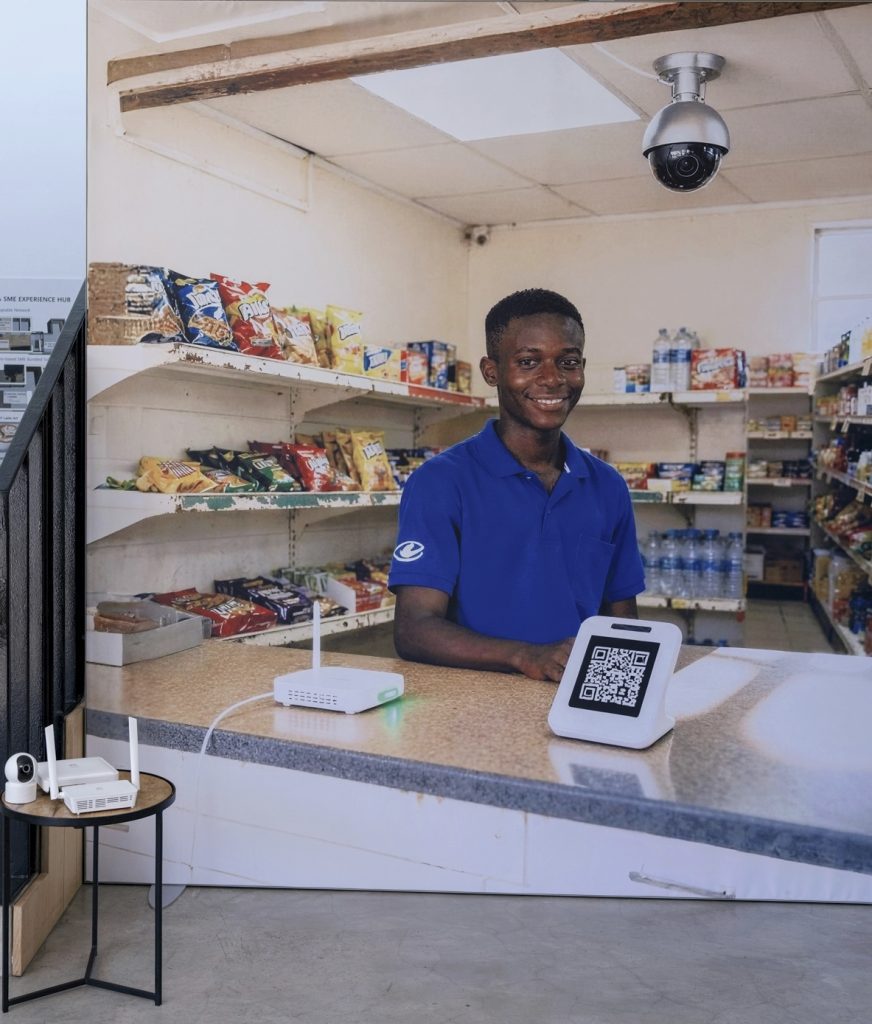
For small businesses, Huawei showcased an all-in-one FTTR-based device that blends connectivity with local digital services. Operators can offer high-speed fibre broadband and in-store Wi-Fi, along with on-premise photo and video storage that stays within the business rather than the public cloud.
The solution supports user permissions and separation of personal and shared content, making collaboration easier while protecting private material. Basic attendance and workforce-tracking tools can be added, with a roadmap for integrating point-of-sale and other business applications through partner ecosystems.
For cafés, salons, and small retailers, this creates a single monthly service covering connectivity and essential digital tools — without the complexity of managing multiple vendors.
FTTR as the foundation for the next wave of broadband value
Huawei’s showcase positions FTTR as both an infrastructure upgrade and a product-design opportunity. By enabling whole-home Wi-Fi, smarter network operations, and new SME service bundles on one platform, FTTR opens the door to the next phase of broadband value for operators across Africa.