
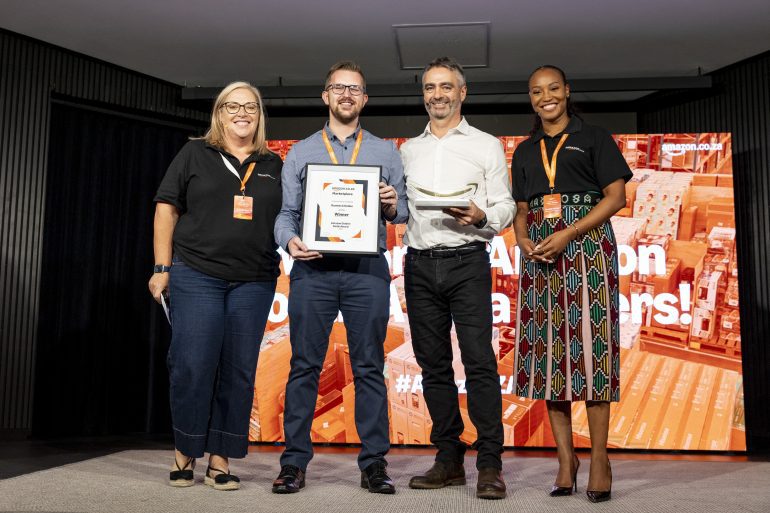
The seller summit held by Amazon South Africa isn’t really about training any more, and that tells you everything about where the platform is in its local journey.
For its second annual summit, Amazon SA brought over 300 entrepreneurs to Cape Town, ran masterclasses on advertising, AI tools, brand building, and fulfilment, and then added something Year 1 didn’t have: the inaugural Amazon South Africa Seller Awards. That addition is the most revealing thing about where Amazon finds itself right now. Two years into its local operation, the platform isn’t still explaining why sellers should join. It’s trying to show them what winning looks like.
That’s a meaningful shift in emphasis. When I covered the first summit in April 2025, the event was framed as a launchpad moment. Robert Koen, Amazon’s Managing Director for Sub-Saharan Africa, described it as an “important milestone.” The language at this year’s event is more confident: Koen is now talking about “ongoing success” and a “global stage.” The programme has moved from introduction to immersion, and the awards give Amazon something no amount of masterclass content can manufacture: real local success stories it can point to by name.
The three winners are well chosen for the narrative Amazon is building. SKIN Functional, taking the Shop Mzansi award, is exactly the kind of brand Amazon needs visible on its platform. It’s locally made, premium, and has built an audience that values South African identity alongside product quality. A & F Home, the Rising Star winner, represents the entrepreneurial upside story. Romtech Online, the top-performing seller picking up the Golden Smile award, supplies the revenue credibility. Together they sketch a picture of a local marketplace that can compete at multiple levels, not just on imported product range.
That framing matters because it pushes back against Amazon South Africa’s most persistent perception problem. As of 2025, Takealot holds around 20% of South Africa’s online market compared to Amazon’s roughly 6%. Code Cash More importantly, Takealot has remained a far more popular search for South African consumers than Amazon, according to Google Trends data, even as Amazon has steadily built momentum through 2025 and into 2026. The gap isn’t primarily about product range any more. It’s about familiarity, trust, and the kind of deep local integration that Takealot has had more than a decade to build. Amazon can’t close that gap with logistics alone.
What it can do is win the seller layer first. The strategic logic here is straightforward: if Amazon can attract and retain the best local sellers, it improves its product selection, which improves the consumer experience, which grows the customer base. The Seller Success Centre it opened in Observatory in early 2025 was the physical proof of that approach; the annual summit is the community proof. Amazon’s entry was positioned as addressing the technical capacity gap among South African small businesses, a sector that employs approximately 50% of the country’s workforce but struggles with digital adoption due to limited access to technology and skills. That’s a real problem the summit format can genuinely help solve, and it’s one Takealot’s more transactional seller relationship doesn’t address as directly.
It’s worth noting what the press release doesn’t say. There are no seller count figures, no data on average seller revenue, no breakdown of how many of the 300 summit attendees are full-time sellers versus dipping a toe in. Globally, third-party sellers now account for 62% of all units sold on Amazon, maintaining their all-time high market share. Locally, that seller base is still early-stage, and the summit format is partly designed to keep momentum going before the critical mass needed for genuine marketplace vitality is reached.
The AI angle deserves some scepticism too. Masterclasses on “harnessing AI” are standard fare at every major platform event globally right now, from Shopify Unite to Google’s local business summits. Every platform is promising that AI will simplify the seller journey. The practical reality for a small South African business managing inventory, logistics, and digital advertising simultaneously is considerably messier than a Cape Town conference stage suggests. The tools are real, but the learning curve and resource requirements to use them well are rarely discussed alongside the pitch.
None of this undermines what Amazon SA is doing, but it does put it in context. This is a platform genuinely investing in local seller infrastructure, and the awards format is a smart community-building move. The keynote by Mushambi Mutuma on adaptability and digital transformation is the kind of content that resonates beyond a product demo. Amazon is working to be culturally relevant to local entrepreneurs, not just commercially available to them.
The real test isn’t the summit, though. Roughly 45% of regular online consumers in South Africa still use Takealot as their primary shopping destination. For sellers, the question isn’t whether Amazon’s tools are impressive in a masterclass setting. It’s whether selling on Amazon South Africa actually moves the needle on their revenue relative to Takealot, or whether it’s a productive second channel rather than a primary one. That answer will be written by the Romtechs and SKIN Functionals of the next few years, not by the summit programme.
Amazon South Africa’s second year looks like a company that’s stopped introducing itself and started competing. The awards are the clearest signal of that maturity. Whether the seller community grows deep enough to shift the broader market dynamic is the story that’s still being written, and it’ll take more than two Seller Summits to answer it.
For more information about selling on Amazon South Africa, visit sellercentral.amazon.co.za.