
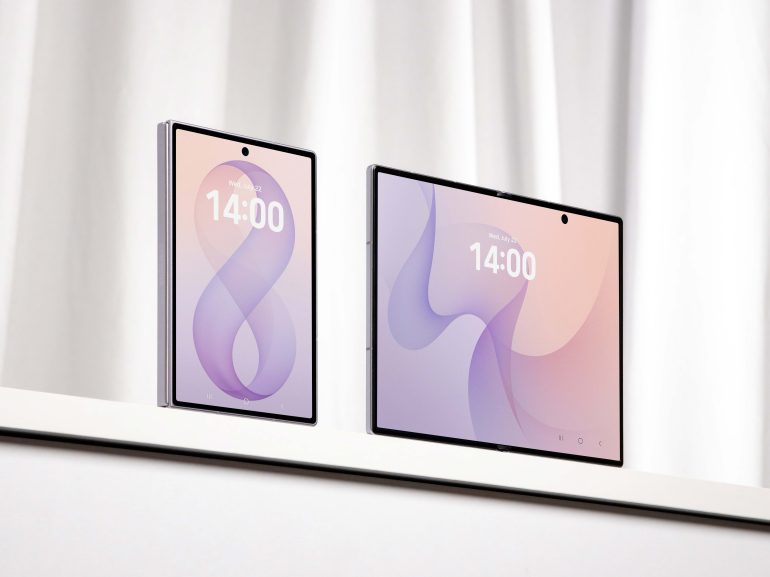
Samsung spent seven generations telling us a foldable had to be tall to be serious. The Galaxy Z Fold8 quietly drops that argument. It’s shorter, wider, closes down to something the size of a passport, and Samsung has spent the last week trying to convince everyone that this shape exists so you can watch Netflix and scroll TikTok in comfort. I’ve been carrying it for the past few days and I don’t think Samsung understands what it actually built.
Let’s get the obvious out of the way first. This isn’t the Galaxy Z Fold8 Ultra, the tall, book-style device that used to just be called the Fold. That one starts at R50,999 for 512GB and climbs to R60,999 for 1TB. The Fold8 I’m talking about, the wide one, starts at R40,999 for 256GB and R45,999 for 512GB. Two different phones, two different philosophies, and Samsung has muddied that further by giving the newer, cheaper, wider phone the name everyone associates with the flagship fold. Expect confusion at retail counters for months.
What you get for that money is a phone that closes to 72.8mm by 158.4mm, opens into a 7.6-inch 4:3 canvas, and weighs 201 grams, lighter than a Galaxy S26 Ultra, lighter than a Pixel 10 Pro, lighter than a OnePlus 15. That’s the part nobody saw coming. A foldable that’s genuinely lighter than the non-folding flagships sitting next to it on the shelf. Fold it shut and you’ve got a 5.5-inch cover screen in a 16:10 ratio, proper phone proportions, not the tall sliver Samsung’s been shipping since the original Fold. You can use this thing one-handed. I haven’t been able to say that about a book-style Samsung foldable since before I can remember.
Samsung didn’t invent this shape. Oppo tried it first with the Find N back in 2021. Google tried it with the original Pixel Fold in 2023. Huawei’s been running with it more recently through the Pura X and the Pura X Max. Even Microsoft’s Surface Duo, clumsy as it was with its two separate panes of glass instead of one flexible display, was chasing the same instinct years before any of them: that a foldable closed should feel like something you’d actually put in a jacket pocket, not a paperback novel. All of those attempts arrived either too early, on chips that couldn’t keep up, or in software that hadn’t figured out what to do with a squarish screen. What’s changed isn’t the idea. It’s that the hinge engineering, the weight, and the chip inside are finally good enough that the format doesn’t feel like a compromise anymore. Same Snapdragon 8 Elite Gen 5 as the Ultra, same silicon carbon battery chemistry across the range, Flex Titanium doing real work on crease reduction. The shape stopped being the trade-off.
But hardware catching up is only half of why I think this is where foldables go next, and it’s the smaller half. The phone in your pocket is quietly turning into an AI computer rather than a phone in the traditional sense, one where the task, not the app, is becoming the actual interface. That shift changes what a screen is for. An app-organised phone rewards a tall strip you scroll one thing on at a time. A device organised around agents doing the coordinating rewards a screen wide enough to hold a plan, a document and a conversation side by side while something else stitches them together in the background, and a cover screen big enough to be a workspace on its own rather than a glorified notification strip. Samsung’s 5.5-inch outer display on the Fold8 is nearly as capable as an entire flagship cover screen was a couple of generations ago. That’s not an accident of industrial design. It’s Samsung building the outer screen for a kind of interaction that didn’t really exist the last time this shape was tried, which is a big part of why Oppo and the original Pixel Fold couldn’t make it stick and Samsung might.
Whether this becomes the shape everyone expects a foldable to be might not even come down to Samsung. Apple’s long-rumoured foldable iPhone is widely expected to launch in September, alongside the iPhone 18 line, and virtually every recent leak points to the same passport proportions Samsung and Huawei have already shipped, a wide cover screen, a roughly 4:3 inner display, no telephoto lens to keep the stack thin. None of that is confirmed until Apple actually stands on a stage and says it, and I’ll treat it as rumour until then. But it’s fair to say that when Apple commits to a shape, the rest of the industry tends to stop treating that shape as an experiment and starts treating it as the default. Samsung and Huawei have already done the hard, unglamorous work of proving the wide fold can be built well. If Apple’s version lands anywhere close to what’s being reported, it won’t be the company that invented the passport foldable, but it may well be the one that makes it the shape everyone expects a foldable to be. What Samsung can still control, in the meantime, is how convincingly it argues for the shape it already has in market.
Samsung’s own case for the Fold8 doesn’t hold up its end of that argument. The whole pitch is immersion. Content. The 4:3 main screen for gaming and films, the cover screen for quick scrolls, the rotate-into-portrait trick for reading. Fine, all true, all pleasant in practice. But living with it, I keep bumping into how well suited this thing is to actual work. Samsung’s own software leans into split view and multitasking on that main display, the portrait keyboard has clearly had real attention paid to it for typing, and the size and weight mean I’ll actually take it out of my bag rather than leaving it there because a taller Fold felt like effort. A phone this pocketable that still opens into a proper multitasking canvas is a productivity story if I’ve ever seen one, and Samsung buried it under content consumption and lifestyle copy.
The colour choices make that framing worse, not better. Lavender and Pistachio are fun, breezy, and about as far from “serious tool” as Samsung’s palette gets, the kind of shades the brand normally reserves for its lighter, more lifestyle-driven devices. Meanwhile the Fold8 Ultra, the one actually pitched at creators and professionals, gets Graphite and Violet Shadow. If you didn’t know the specs, you’d assume the pastel one was the toy and the darker one was the workhorse. In this case it might be the opposite, or at least a lot closer to even than the colourways suggest.
Then there’s the S Pen question, which nags at me every time I close this phone. Shut, the cover screen sits at a size not far off a small Moleskine, and there’s a version of this device where that surface becomes genuinely brilliant for quick notes with the S Pen from the S26 Ultra. Samsung didn’t build a digitiser into either the Fold8 or the Fold8 Ultra, so none of that is happening. It’s a strange gap to leave open on the one device in the range shaped exactly like a notebook.
FlexMode is the other one I can’t quite explain. The Ultra has it. The Fold8 doesn’t, apparently because its hinge is tuned to be springier and doesn’t hold at arbitrary angles the way the Ultra’s does. I don’t buy that as a reason so much as a description of the decision. There’s no obvious technical wall stopping Samsung from giving the shorter Fold a hinge that holds an angle, and leaving it out feels like a line drawn to protect the Ultra’s positioning rather than a genuine hardware limit.
Dust resistance is the one that actually bothers me most, and it’s worth being precise about what IP48 means, because “water resistance” isn’t really the gap here. That rating is two separate numbers. The 8 covers water, and it’s a strong number, rated for continuous submersion beyond a metre. The 4 covers solids, and it’s a weak one, protection against objects larger than 1mm, which leaves fine dust and sand as a genuine risk around a hinge with more moving parts than almost anything else in your pocket. All three new foldables, Fold8, Fold8 Ultra, and Flip8, ship with that same IP48 rating, and it’s the dust half of it that other foldable makers have already pushed past. There’s no compelling engineering story here, just a rating that hasn’t kept pace with where the rest of the category has moved.
None of that has cooled how I feel about actually using this phone, and that surprises me a bit. I didn’t expect a shorter, wider Fold to be the one that finally sold me on the format, not in a tablet-replacement sense, because it isn’t that and was never going to be, but in the sense that it adjusts to how I already hold and use a phone instead of asking me to hold my life differently to suit it. It’s more practical day to day than the Fold8 Ultra’s taller frame, and it does more with productivity than the Flip8 ever will, fun as that little phone is in its own right. I’ve used most of Samsung’s folds since the very first one. This is the first one I’m truly obsessed with.
Samsung will keep selling this as the fun, content-first Fold, and Ultra will keep getting the productivity pitch by default. I think that’s backwards, or at least a lot less clear-cut than the marketing wants it to be. The shape that Oppo, Google, and Huawei couldn’t quite make stick has arrived at the moment the hardware finally supports it, wearing pastel colours and a content-consumption label that undersells exactly what it’s capable of.