
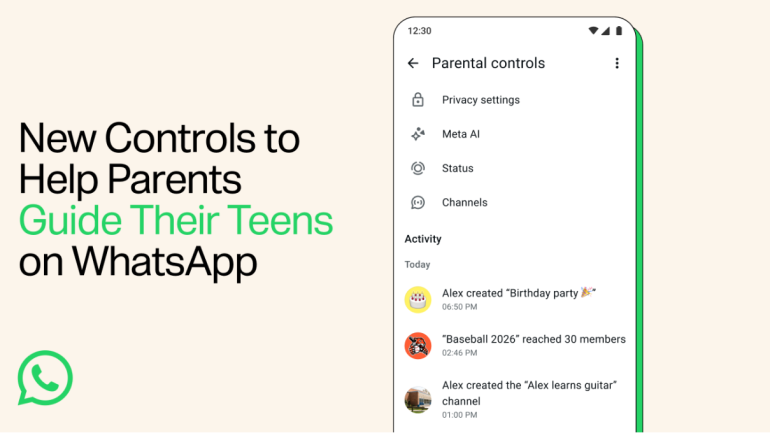
Knowing who added your child to a WhatsApp group is useful. Knowing whether the people in that group are making their life miserable is considerably harder. WhatsApp’s new parental controls give parents more say over their teen’s account, but some of the most troubling research concerns what happens between children who already know each other.
Announced on 30 September, the optional controls let parents choose who can see their teen’s profile photo or add them to groups. Relaxing those settings requires approval through a parent-set PIN. Parents also get notifications when their teen joins or leaves a group, or when its membership grows significantly, and can manage Channels, Status and the content setting for Meta AI. Personal messages and calls remain private and protected by end-to-end encryption.
There’s practical value in that. A parent can help establish privacy settings and know they won’t simply be changed later. A group notification could prompt a conversation that might otherwise never happen. But Meta’s announcement provides no results showing that these controls reduce bullying or unwanted contact. For now, their benefits are plausible rather than demonstrated.
WhatsApp has also been here before. Its group privacy settings arrived in 2019, letting users restrict who could add them directly to groups. In 2023, Silence Unknown Callers and Privacy Checkup made it easier to manage unwanted calls and work through privacy options. Those tools depended largely on the person using the account choosing and maintaining the settings.
More recently, WhatsApp introduced parent-managed accounts for pre-teens in March 2026. Those accounts limit the experience to messaging and calling, with parents deciding who can contact the child and which groups they can join. Parents can review requests from unknown contacts, while privacy settings are protected by a PIN. Parental supervision itself isn’t new; the September announcement extends it to teens with controls suited to a broader WhatsApp experience.
That history makes the new controls easier to assess. They’re an additional level of supervision, with useful options inside the app. They don’t amount to a system that can tell a parent whether their child is safe in every conversation.
Research on classmates’ WhatsApp groups explains why that matters. A study by Dana Aizenkot and Gabriela Kashy-Rosenbaum, published online in 2019 and in the Journal of Interpersonal Violence in 2021, surveyed 4,477 Israeli school pupils. Approximately 30% reported personal victimisation through cyberbullying in their classmates’ groups. Reported victimisation was higher among elementary-school pupils than those in middle and high school.
That percentage isn’t a measure of what’s happening in South African schools. It’s a self-reported survey from another country. It does, however, document a problem that restrictions on unfamiliar contacts can’t resolve: children can be targeted by the very people they’re expected to communicate with.
Exclusion deserves attention too. Research by Shanyan Lin and colleagues, published online in October 2024 and in a 2025 issue of the Journal of Social and Personal Relationships, examined 858 students with an average age of about 14. Being kicked out of WhatsApp groups was associated with lower grade-point averages, with fear of missing out and problematic social-media use among the factors examined in that relationship.
The study doesn’t prove that exclusion caused poorer grades. Its cross-sectional design can’t establish which events or difficulties came first. Still, it gives parents a reason to take group exclusion seriously. A child’s removal from a chat can be part of a wider problem at school, even if the account’s privacy settings are exactly where the parent wants them.
We also have evidence much closer to home. UNICEF Innocenti, ECPAT and INTERPOL’s Disrupting Harm in South Africa report, published in 2022, analysed household interviews with 1,639 internet-using children aged nine to 17, conducted in 2020.
Among children who reported unwanted sexual requests through social media, instant messaging or media-sharing apps, 27% identified WhatsApp when asked about their most recent experience. That figure applies to the affected subgroup, not all children surveyed. Among the broader subgroup who had received these unwanted requests, 55% hadn’t told anyone about the most recent incident.
Those findings don’t tell us whether the new controls work. They establish that WhatsApp has been a channel through which children here were targeted, and that parents can’t assume they’ll be told when something happens. An activity alert could create an opening, but it won’t necessarily reveal what a child is afraid or embarrassed to discuss.
Apple and Google tackle some of these risks through the phone itself. Apple’s iOS 27 child-safety updates, available from 14 September, add approval requests for new websites in Safari, age-tailored Time Allowances and a redesigned Screen Time interface. Communication Safety now covers gore and violence alongside nudity in supported images and videos.
On Android, Google Family Link lets parents limit individual apps, set daily limits and schedule School Time or Downtime. It also provides controls for services such as Chrome and Google Play, including website restrictions and approval for new apps. Manufacturer-specific options and device support can vary.
The comparison becomes clearer when we look at what each system can actually control.
| Protection | WhatsApp’s new teen controls | Apple’s iOS 27 controls | Google Family Link |
|---|---|---|---|
| Privacy and activity inside WhatsApp | PIN-protected settings, group alerts, Channels, Status and Meta AI controls | Doesn’t provide these internal WhatsApp controls | Doesn’t provide these internal WhatsApp controls |
| When apps can be used | No time limits described in the announcement | App-category allowances and access schedules | App limits, daily limits, School Time and Downtime |
| Communication with new contacts | No blanket approval requirement described for teen chats | Approval controls for Messages, FaceTime and Phone | Contact restrictions in supported calling and messaging apps |
| Websites and downloads | Doesn’t manage the wider phone | Safari website approval and App Store controls | Controls for Chrome, Play and other Google services |
Apple documents contact approval for its own communication apps and schedules for app access. Google’s controls manage supported services and device use. Neither should be mistaken for parental oversight of every WhatsApp conversation.
Google is explicit about this limitation: children who have access to WhatsApp can still call and message numbers outside their parent-approved contacts. Apple’s Communication Safety also has a defined scope. It analyses sensitive media on the device in specified services and some occasions when children select media to share through third-party apps. That isn’t a guarantee that every incoming WhatsApp image or video is screened.
For families, using the phone’s controls alongside WhatsApp’s makes sense. Limits on smartphone use address when an app is available; WhatsApp’s settings address parts of the experience within it. Neither can judge whether an otherwise ordinary message is humiliating because of something that happened in the classroom earlier that day.
There is evidence that addressing behaviour can help. A 2018 study in New Media & Society evaluated a school intervention on cyberbullying and behaviour in classmates’ WhatsApp groups. Researchers collected responses from 1,402 pupils before the programme and 1,268 a month afterwards, reporting reduced WhatsApp cyberbullying and improved classroom climate. The short follow-up leaves questions about lasting effects, but it gives schools a reason to address group behaviour directly.
WhatsApp’s new controls are worth taking seriously, without treating their arrival as proof that the app has become safe for teens. Meta still needs to explain what triggers its group-growth alerts and publish evidence of whether supervision reduces harm. Parents may find the notifications useful, especially if they help a child talk about something they’ve kept to themselves. The response to that conversation will matter far more than the fact that a notification arrived.