
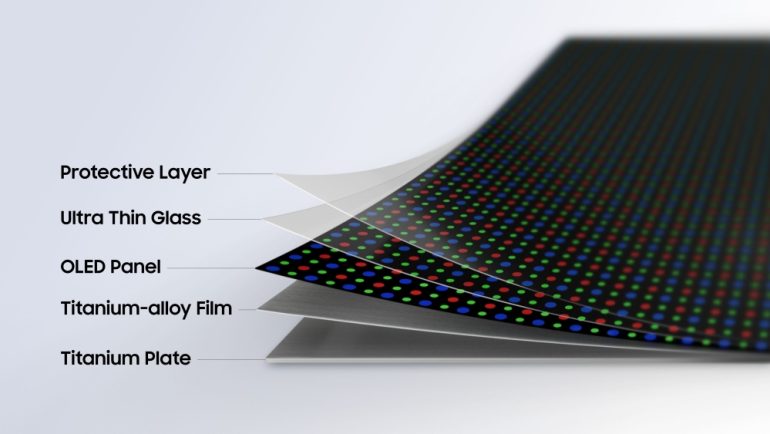
Samsung has unveiled Flex Titanium, a new display structure for its next generation of Galaxy foldables that combines a titanium-alloy film and a titanium plate to cut crease visibility and improve durability. It’s the most significant change to how Samsung builds a foldable screen since the original Galaxy Fold launched in 2019, and it targets the one flaw that’s survived every generation since: the visible line down the middle of the display.
The titanium-alloy film sits below the OLED panel and supports the display from within. It offers 20 times the mechanical stiffness of the polymer film it replaces, and a precision rolling process makes it thin enough to measure roughly a third the width of a human hair. Beneath that sits a titanium plate, using micro-patterned holes at the folding section to bond more tightly to the display module without trapping air gaps underneath. Together they let Samsung support the display more firmly when it’s unfolded while keeping the flexibility a foldable needs when it isn’t.
Titanium wasn’t an obvious choice. It’s already used in satellite antennas and Mars rover wheels because of its strength, but that same stiffness has made it difficult to fold. Getting titanium thin and flexible enough to sit inside a foldable display, without losing the durability that makes it worth using in the first place, is what’s taken Samsung this long to introduce it.
The Galaxy Z Fold 7 already showed how far Samsung has closed the gap between a foldable and an ordinary phone. What’s left is the crease, the single detail that still gives away what kind of device you’re holding. Flex Titanium is aimed squarely at that.
It also lands in a market that’s stopped being uncontested. Huawei’s Mate X7, HONOR’s Magic V5 and Samsung’s own Fold 7 are closing in on each other on thickness and weight, down to a few grams and fractions of a millimetre. None of Samsung’s rivals have solved crease visibility either, which makes it one of the few areas where Samsung can still separate itself on more than a spec sheet.
In South Africa, most foldables are financed through MTN or Vodacom contracts running 24 to 36 months rather than bought outright. A more durable display structure matters more here than in markets where phones get replaced every year, since buyers are committing to live with the same screen, and the same crease, for the length of the contract.
Kyung-Jin Yoo, who heads mobile display product development at Samsung Display, said the micro-patterned holes in the titanium plate were what let the company secure flexibility without giving up durability. It’s the same tradeoff that’s defined every foldable display since 2019, solved this time with a structural change rather than a workaround.
Flex Titanium debuts with Samsung’s next generation of Galaxy foldables. Full device details follow at the next Galaxy Unpacked, which Samsung has set for 22 July in London.