

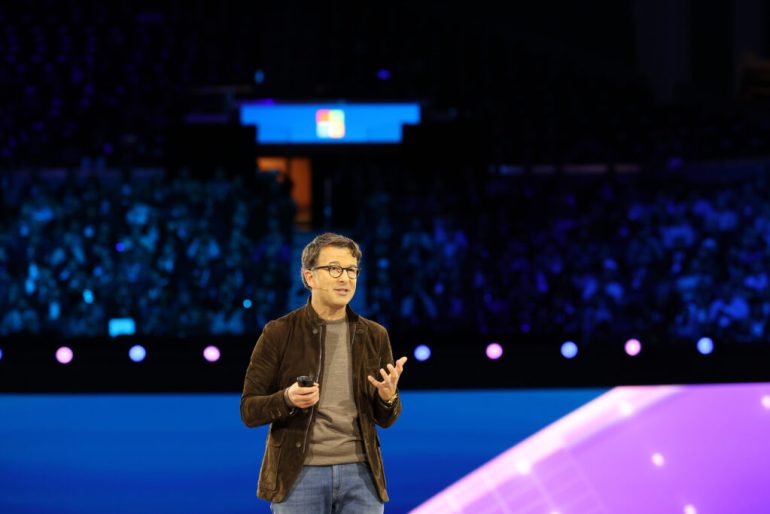
There was plenty of noise about breakthroughs at Microsoft Ignite 2025, but the interesting part was everything Microsoft didn’t frame as headline material. This wasn’t a product parade. It was a consolidation exercise, a tightening of Microsoft’s grip on the architecture that increasingly governs how work happens. Ignite didn’t feel like a tech conference. It felt like a strategic repositioning of the enterprise itself.
Microsoft introduced a tidy vocabulary for this shift. Work IQ, Fabric IQ, Foundry IQ, Agent Factory, Agent 365. On their own, they look like routine updates. Together, they form a vertical stack for enterprise intelligence, data and agents. And crucially, Microsoft wants that stack anchored at the centre of organisational workflow and decision-making. That’s the quiet through-line of Ignite.
The official framing is neat. Work IQ connects your emails, meetings and files to suggest next actions. Fabric IQ merges operational, analytical and time-series data into one shared model. Foundry IQ grounds agents across Work IQ, Fabric IQ, your internal systems and the web. Agent Factory helps build and deploy these agents. Agent 365 becomes the control plane. All of this is packaged neatly across Microsoft’s own pages, from Work IQ to Fabric IQ, Foundry IQ and the Book of News.
Remove the polish and Microsoft’s intention becomes clearer. Once an organisation adopts this model, Microsoft isn’t just supplying tools. It becomes the backbone. Your data bends to its structures. Your workflows adapt to its logic. Your agents operate inside Microsoft’s behavioural boundaries. It isn’t sinister. It’s strategic.
Agents are the hook. The dependency is the business model
Ignite made something very plain. Agents aren’t the main product. They’re the doorway. The real product is the stack underneath them. Agents sell the vision of contextual work. But their usefulness depends entirely on Microsoft’s data model, knowledge layer and governance plane. Once a company embeds a handful of agents into daily operations, unplugging them becomes disruptive and expensive. Dependency becomes structural, not symbolic.
This is why Microsoft leaned so heavily on the Agent Factory and its “single metred plan”. If the Microsoft ecosystem becomes the simplest place to build, deploy and supervise agents, organisations will default to it. Convenience is powerful. It’s also rarely neutral.
South Africa sees the promise, but it also sees the context
South African enterprises will recognise the appeal. Integrated intelligence. Real-time insight. Workflow automation that reacts rather than waits. But the promise meets the local reality quickly.
Infrastructure is patchy. Load shedding interrupts continuity. Legacy systems remain entrenched. Governance varies widely across teams. Identity layers still reflect years of reconstruction rather than unified design. The architecture Microsoft wants enterprises to adopt assumes a level of maturity many South African organisations don’t yet have.
That doesn’t make the stack unworkable. It just stretches the timeline to value. And the power dynamics aren’t hypothetical. I’ve written this before in my piece on how Africa’s AI future is already political, where capability and control sit in constant negotiation. Ignite leaned confidently into capability. It stayed quiet on control.
The question Ignite avoided
Which brings us to the thing Ignite didn’t discuss. What does an organisation lose when its work patterns, data flows and agent behaviour are shaped by the worldview of a single external platform?
Ignite projected absolute confidence. The pitch was straightforward: let Microsoft organise your knowledge, align your systems and orchestrate your agents. All you need to do is step inside. It’s a compelling offer, but convenience draws you into someone else’s architecture. It always has a centre. And that centre is Microsoft.
The real takeaway
Microsoft Ignite 2025 wasn’t about tools. It was about intent. Microsoft isn’t selling apps anymore. It’s selling alignment. The announcements weren’t crafted to impress. They were crafted to redraw the structure of the enterprise around Microsoft’s logic.
For South African organisations, the question isn’t whether Microsoft’s stack works. It does. The question is whether you want your organisation’s future to be shaped inside a system you don’t control.