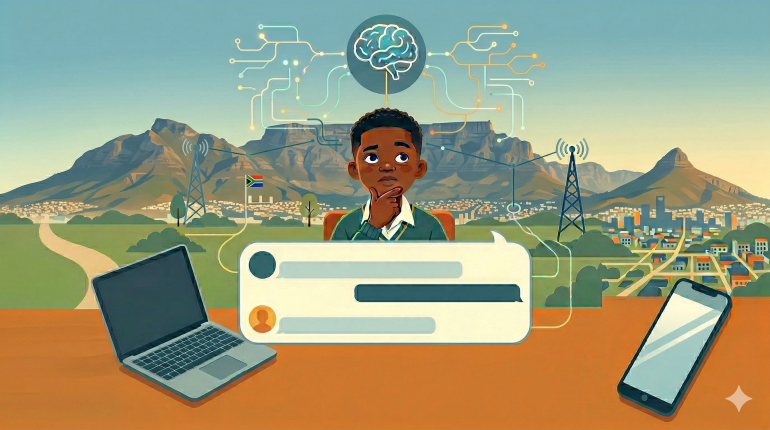
South Africa’s AI tutoring problem isn’t really about ChatGPT doing homework. It’s about who has reliable enough connectivity, a capable enough device, and R200 a month to spare to use any of these platforms at all. HelloAida, a newly launched AI tutoring platform, has entered the local edtech space with a clear and earnest pedagogical position: rather than hand students answers, it walks them through the thinking process step by step. The philosophy is sound. The reach is the part that needs scrutiny.
The platform’s founder, Leora Hessen, frames the offering around a genuine tension in education right now. When students can paste any question into an AI and get an instant answer, what happens to the learning process? HelloAida’s response is to guide rather than resolve — presenting questions, explanations, and prompts that push students toward independent reasoning. It supports all grades, all subjects, and both the CAPS and IEB curricula, and claims availability in all South African languages. For parents who want AI in their child’s life but not at the cost of actual comprehension, this is an appealing pitch.
The thing is, this pedagogical position isn’t new, even if its local application is. Khan Academy’s Khanmigo, launched internationally a few years before HelloAida, operates on precisely the same Socratic principle. Rather than providing the answer when a student asks for help with a maths problem, Khanmigo responds with guiding questions that push the student to work through the solution themselves. The approach has earned real praise from educators and parents in the US, while also attracting a familiar criticism: students who are used to instant answers often find the guided approach frustrating at first. HelloAida will almost certainly encounter the same friction. That’s not a flaw in the design, it’s the point of the design, but it does mean the platform needs committed users, not casual ones.
Locally, the competitive landscape is more crowded than the “South Africa’s first” framing suggests. Siyavula has been doing AI-personalised learning for maths and science for years, is zero-rated on major mobile networks, and carries the trust of established institutional backing. In August 2025, BSG Technologies launched IRIS, billed as South Africa’s first AI-powered robot tutor, capable of teaching from Grade R to tertiary level in all 11 official South African languages. Luma Learn operates through WhatsApp — no app installation required, low bandwidth, functional on a basic smartphone. The multilingual and curriculum-aligned angles that HelloAida highlights are real differentiators from a platform like Khanmigo, but they’re shared territory with several local and pan-African competitors already in the field.
None of this undermines what HelloAida is trying to do. A platform that approaches every subject through guided Socratic reasoning, across both major SA curricula, in multiple languages, is a genuinely useful addition to the local edtech ecosystem. The concern isn’t whether the product works — it’s whether the market framing matches the reality of deployment.
The press release invokes a striking figure: 81% of South African Grade 4 learners cannot read for meaning in any language, referencing the 2021 PIRLS data. It’s used to establish urgency. But a subscription-based conversational AI platform that requires consistent internet access and a compatible device isn’t, in its current form, a solution for that 81%. It’s a solution for the portion of South African families who already have digital access and are looking for a more educationally defensible alternative to leaving their children with ChatGPT. That’s a real market, and it’s not nothing, but it isn’t the crisis framing the press release leans on.
The pricing deserves an honest look. At R200 per month for an individual subscription, HelloAida is dramatically cheaper than private tutoring, where rates generally sit between R180 and R200 per hour. For a family already paying for a data plan and a device, the cost argument makes sense. The school pricing of R25 per learner per month on a 24-month agreement is designed for institutions, but it locks schools into a long contractual commitment for a platform without a published efficacy track record. Schools making that call will be doing so on the strength of the pitch, not the data.
What HelloAida also doesn’t address, and what every online-first edtech product in South Africa must address, is the infrastructure layer beneath the product itself. Connectivity remains a challenge in South Africa due to costs, reach, reliability, and the lingering effects of load shedding. Siyavula’s zero-rating arrangement with mobile networks is a concrete response to that reality. HelloAida’s press materials don’t mention data costs, offline capability, or device requirements. That gap matters most for the learners the literacy statistics are actually describing.
As has been explored before on Reframed, the promise of AI in South African education is genuine, but the delivery is always filtered through the country’s structural constraints. A product that teaches students to think rather than just answer is exactly what the education sector needs more of. HelloAida’s philosophy is right. Whether it can build the infrastructure relationships, pricing flexibility, and offline resilience to reach beyond connected, middle-class learners is the question that will determine whether this is a meaningful edtech entrant or a well-designed product for a narrow slice of the country it says it’s built for.