
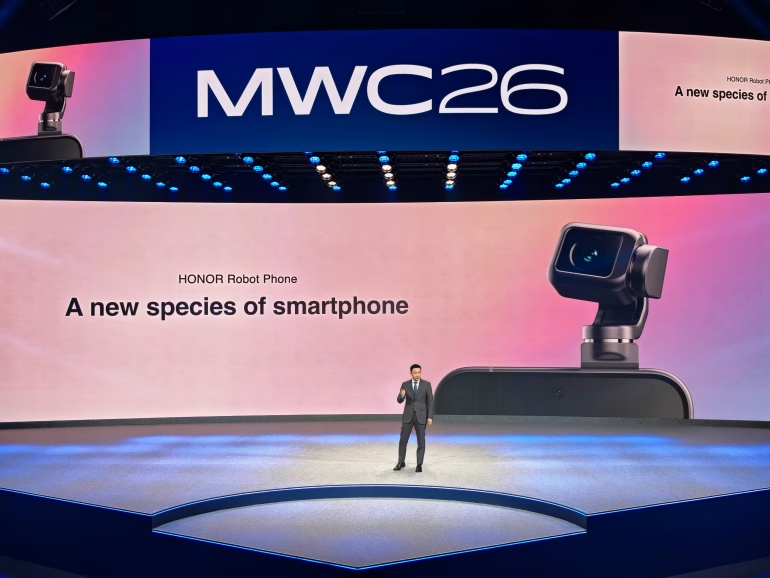
At Mobile World Congress earlier this year, HONOR introduced what it calls a “robot phone”. The concept imagines smartphones evolving into AI-driven companions that can assist beyond the screen and into the physical world.
It’s an arresting idea. It’s also not where HONOR’s strategy begins.
What the company is doing now, particularly in South Africa, is more incremental and easier to overlook. It’s also where most of the impact will be felt.
AI, distributed rather than differentiated
When HONOR South Africa CEO Fred Zhou talks about artificial intelligence, the emphasis isn’t on pushing boundaries at the top end. It’s on spreading capability across the entire product range.
That includes the flagship Magic series, with devices like the HONOR Magic V6 and HONOR Magic 8 Pro, but it doesn’t stop there. The same AI features are being extended into the Number series and further down into the entry-level X series.
It’s a pragmatic decision. In South Africa, most consumers aren’t buying flagship smartphones. If AI stays concentrated at the top, it stays peripheral. If it’s distributed across price points, it has a chance to become part of everyday use.
The ambition here isn’t to make AI feel exceptional. It’s to make it feel standard.
The mid-range is where this will be tested
That approach will be tested with the arrival of the 600 series, which HONOR says will launch in South Africa in Q2.
This is also where HONOR’s broader strategy becomes easier to understand. As I’ve said previously in my coverage of the 600 series, this part of the market is where momentum is actually built and where competitors are most exposed.
The mid-range segment is where competition is most intense. It’s where consumers are weighing price against performance, and where brand loyalty is often weakest. It’s also where volumes sit.
In South Africa, this tier is shaped heavily by contract pricing and upgrade cycles. Devices aren’t just compared on specs. They’re compared on what they cost per month, what’s bundled in, and how they sit against competing offers in-store.
That makes it one of the few segments where momentum can shift quickly.
Products in this category rarely define a brand’s identity. They do, however, define its position. If HONOR’s broader strategy is working, it should show up here first.
A changing market position
Zhou also confirmed that HONOR is now the second-largest smartphone brand in South Africa, behind Samsung.
That position reflects a period of steady expansion. HONOR has increased its presence across retail and operator channels, broadened its portfolio, and aligned its launches more closely with local market conditions.
In South Africa, distribution tends to matter as much as the product itself. Visibility in stores, relationships with operators, and consistency across price points often determine what actually sells.
From that perspective, HONOR’s rise is less surprising than it might appear. It’s the result of sustained execution in the parts of the market where decisions are made.
The market itself remains layered. Apple continues to hold influence at the premium end, even where volumes are lower. But volume share is shaped elsewhere, and that’s where HONOR has been competing.
Building an ecosystem with local relevance
Beyond smartphones, HONOR is expanding its ecosystem in South Africa to include tablets, laptops, audio products, and wearables.
Some of this expansion is beginning to intersect with local services. Zhou referenced discussions involving Discovery Health, particularly around wearables and health tracking.
That matters more than it might seem. In South Africa, wearables don’t really scale on features alone. They scale through incentives.
Programmes tied to Discovery have effectively set the standard for how fitness devices gain traction, linking activity to rewards, discounts, and measurable outcomes. For most consumers, that’s the clearest reason to buy and consistently use a wearable.
Seen in that context, a partnership isn’t just a value-add. It’s close to a requirement.
If HONOR wants its wearables to move beyond the margins, integration into that ecosystem would likely be one of the most effective ways to do it.
Moving closer to the customer
HONOR also confirmed that it’s in discussions to bring an official retail store to South Africa.
That would mark a shift from reliance on third-party retail and operators toward a more direct presence.
In practice, this isn’t just about sales. It’s about context.
In a market where many purchasing decisions happen in-store, the way a product is explained, demonstrated, and compared can shape the outcome as much as the product itself. A dedicated retail space allows HONOR to control that experience, especially as its ecosystem expands.
It’s a model that’s been central to the strategies of Apple and Samsung, where retail acts as both a storefront and a way of telling the product story.
Where the robot fits
Seen alongside these developments, the robot phone becomes easier to interpret.
It isn’t a near-term product. It’s a way of expressing a direction.
Much of today’s AI operates in the background. It improves images, automates small tasks, and optimises performance. Its effects are real, but often subtle.
A physical, interactive device makes that same intelligence more visible. It gives form to something that’s otherwise difficult to describe.
A gradual shift
HONOR’s trajectory in South Africa isn’t defined by a single breakthrough.
It’s shaped by a series of quieter decisions. Extending AI across price tiers. Competing where volume sits. Building an ecosystem that connects to local services. Exploring more direct ways of reaching customers.
The robot may represent where the company hopes to go.
What matters for now is how effectively it’s navigating where it already is.