

No post-founder CEO in the history of technology has been more commercially successful and less culturally credited than Tim Cook. He ran Apple for fifteen years, grew it from a $350 billion company to a $4 trillion one, and will probably be remembered as the man who kept the seat warm after Steve Jobs died.
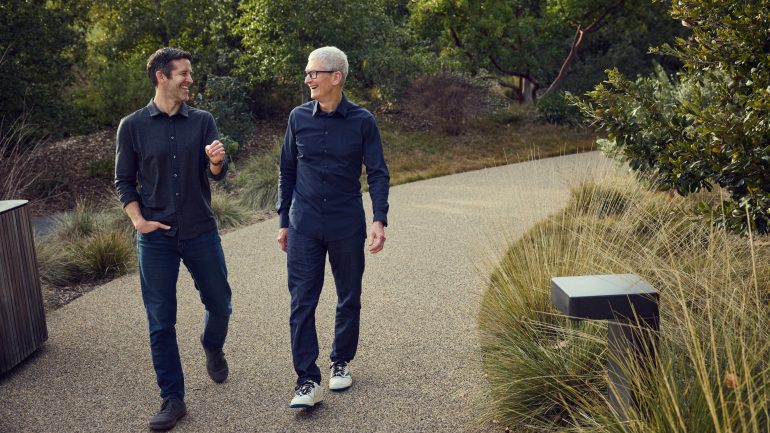
Apple announced that Cook will step down as CEO on 1 September 2026, moving to executive chairman, with hardware engineering chief John Ternus taking over. It’s the first CEO transition at Apple since Cook succeeded Jobs in 2011, shortly before Jobs died, and it arrives at a moment when the company’s commercial position has never been stronger and its technological narrative has rarely been more contested.
Cook did something far harder than founding a great company. He kept one alive after its founder died, scaled it to a $4 trillion business, and oversaw the introduction of new product categories including Apple Watch, AirPods and Apple Vision Pro, alongside services that grew into a business equivalent to a Fortune 40 company on their own. He did this while navigating a geopolitical environment that would have broken most CEOs: US-China trade friction, Trump-era tariff pressure, a global pandemic, and a supply chain crisis that exposed every other hardware company’s vulnerabilities. None of that appears in the mythology.
The Jobs-versus-Cook debate has always been a category error. Jobs was a product dictator. He needed someone to make the planes run on time, and Cook was already doing that before Jobs died. Cook replaced Jobs’ micromanagement with a collaborative culture, doubled revenue and profit between 2011 and 2020, and grew the company’s market value from $348 billion to nearly $2 trillion in that period, before it kept going. The criticism that he lacked vision was never really about vision. It was about whether he was sufficiently theatrical. He wasn’t. He’s a supply chain engineer who turned inventory discipline into a trillion-dollar competitive advantage.
The comparison that should follow Cook around isn’t Steve Jobs. It’s Satya Nadella. Nadella succeeded Steve Ballmer at Microsoft in 2014 when the company was widely dismissed as a legacy giant that had missed mobile. He reoriented it around cloud, kept the culture functional, and watched the market cap grow tenfold. No one calls Nadella unvisionary. Cook did something structurally similar, taking a hardware company and building a services layer on top of it that now generates over $100 billion annually, but he’ll always live in Jobs’ shadow in a way Nadella never had to live in Bill Gates’. The difference is narrative, not achievement.
Apple’s market cap increased by more than 20-fold on Cook’s watch, which makes him arguably the most commercially successful post-founder CEO in the history of technology. That fact will get mentioned in business school curricula. It probably won’t get mentioned at dinner tables. The public remembers the iPhone launch. It doesn’t remember the Apple Silicon transition that Cook oversaw, arguably the most technically decisive strategic bet Apple made this century, ditching Intel and building chips that now outperform the competition by margins that have reshaped the entire laptop category.
Ternus is a legitimate successor, but he’s walking into a different problem than the one Cook inherited. He joined Apple in 2001, spent two decades working through the product design and engineering ranks, and has been senior vice president of Hardware Engineering since 2021. He’s the person most directly responsible for the hardware quality recovery that Apple quietly needed after years of prioritising thinness over performance. His fingerprints are on the iPad line, AirPods, the Apple Silicon transition, the iPhone 17 lineup, and the durability and materials work that has made recent Apple hardware meaningfully more resilient. He’s an engineer first, an executive second, and almost entirely unknown to the people who buy the products he’s spent his career building. Whereas Jobs was a product innovator and Cook a supply chain architect, Ternus is the person who ensures the gadgets actually get developed. The most critical aspect of his new job, though, will be pushing Apple deeper into artificial intelligence, where it’s lagged many of its megacap peers. Apple’s Siri stumble wasn’t just a product miss. It was a credibility problem. The company that defined the smartphone era arrived late to the AI moment, and Cook never fully corrected it.
That gap matters differently in markets like South Africa, where Apple’s services proposition is perpetually incomplete. Apple Intelligence remains largely US-centric. An entry-level iPhone starts at around R12,325 locally, with a flagship Pro Max pushing past R20,000, and much of what justifies that premium is software and services that either don’t work here or don’t work well. Cook built a global device footprint but never fully globalised the services layer. For South African consumers, Apple remains a hardware proposition. That’s not a critique of Cook specifically, it’s part of a wider pattern in how Silicon Valley prices and deploys its AI features across emerging markets, but it’s the constraint Ternus inherits too.
Cook’s statement today reads as genuinely emotional by his standards, and the warmth seems real. What the press release doesn’t mention is that he’s leaving with Apple’s AI narrative unresolved, Jony Ive gone to OpenAI, and a succession that bets heavily on hardware discipline at a moment when the industry is rewarding software imagination. Ternus may be exactly what Apple needs. He may also be exactly what Apple would have chosen five years ago, when the problems were different.
Tim Cook will be remembered as the man who ran Apple after Jobs died. That’s a thin summary for someone who turned a $350 billion company into a $4 trillion one, built a wearables category from nothing, executed the most significant silicon transition in personal computing in decades, and navigated every geopolitical storm of the last fifteen years without capsizing. History tends to flatten these things. The myth endures; the management does not.