
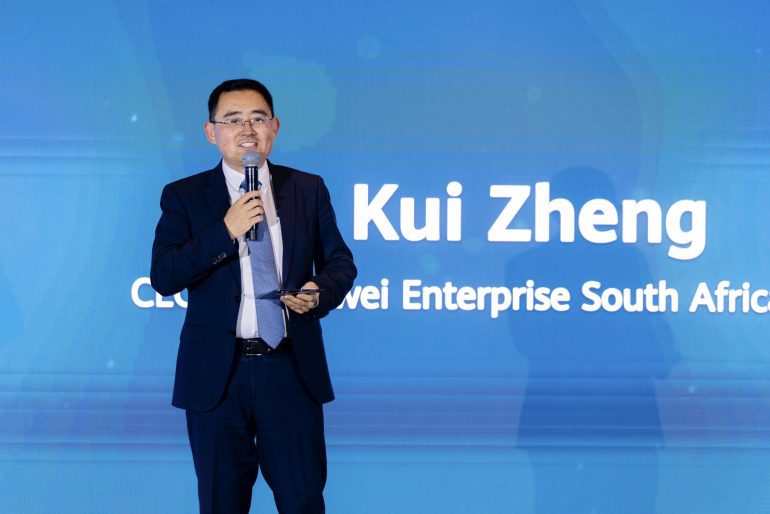
Huawei‘s annual IT Day in Johannesburg this week was built around a question its CEO Kui Zheng put directly to the room: how do organisations future-proof data storage and unlock the real value of data in the AI era? It’s a smart question. It’s also the exact question Dell, HPE, NetApp, Nutanix, and Pure Storage have all been answering in parallel, at GTC, at .NEXT, and in a steady stream of press releases since January. The phrase “AI-ready data infrastructure” has become the enterprise tech industry’s version of a loyalty oath in 2026, and Huawei is now formally signing it.
That’s not a dismissal. It’s context.
The event drew more than 400 customers and partners and showcased Huawei’s OceanStor Dorado all-flash storage, its DCS data centre virtualisation platform, Atlas AI computing, and the IdeaHub smart collaboration system. On paper, that’s a credible full-stack answer. In practice, it lands in a market where every major infrastructure vendor is making structurally identical claims. For years, enterprise AI budgets allocated roughly 80 percent of spend to compute, with storage funded by whatever was left over. Now the conversation has shifted: AI’s limiting factor is not model capability but data readiness, and that realisation is pulling storage back into the centre of the conversation. Every vendor in the space knows this, and every vendor is talking about it in the same breath.
What Huawei’s presentation does well is ground the narrative in local terms. The partnership with Altron Digital Business, now 14 years old, backed by 91 Huawei-certified engineers and having delivered more than R5 billion in project value, is the most substantive thing in the entire programme. That’s not a number Altron’s Aadhir Maharaj dropped casually; it’s a direct argument for depth of local execution at a time when South African enterprises face real pressure to convert AI ambition into operational outcomes. The OceanStor Dorado has a local reference point too: Sanlam is cited as a customer. In an announcement cycle where global vendors frequently treat SA as a footnote, Huawei’s IT Day is a deliberate reminder that the footprint is real.
The infrastructure claims themselves are technically sound. Enterprise Strategy Group’s technical validation of New-Gen OceanStor Dorado, released at MWC Barcelona in March, found that a five-year TCO analysis shows it can reduce total cost of ownership by up to 64% compared with traditional hybrid storage. That’s a meaningful number for budget-constrained enterprise IT in South Africa. Independent user reviews consistently highlight the price-to-performance ratio as OceanStor Dorado’s defining advantage, though the same reviews flag cloud integration as a consistent weakness and note that the licensing model, with over 12 separate licences, creates procurement complexity. Neither point came up at IT Day.
The Atlas AI computing portfolio is where the press release quietly buries what might be the most interesting conversation. Huawei’s Atlas 850E and 950 SuperPoD architecture scales to 8,192 of its own Ascend NPUs and supports trillion-parameter model training, without a single Nvidia GPU. The broader global dynamic is that storage vendors are converging on a common goal: making the storage layer an active, intelligent participant in AI pipelines. What isn’t said as often is that the compute layer has a similar convergence happening, mostly around Nvidia. Huawei, by necessity and design, is building outside that gravitational pull. For SA enterprises trying to navigate AI infrastructure procurement without getting locked into a single geopolitical supply chain, that independence is worth naming directly, and Huawei didn’t name it.
The DCS virtualisation pitch follows a familiar pattern. Clinton George described it as more than a hypervisor, pointing to unified management, AI integration, ransomware protection, and a migration tool that’s handled over 1,200 customers over two years. That’s a strong claim, but it sits in a market where Nutanix just announced a full agentic AI infrastructure platform, where the next phase of AI is expected to centre on scaling inference and running agentic AI applications in production, and where VMware’s ongoing post-Broadcom disruption continues to send customers looking for alternatives. DCS has a real opening. The presentation doesn’t make the competitive case explicit enough to take advantage of it.
HPE’s South African leadership warned last week that AI adoption locally remains constrained by networking infrastructure, with organisations at risk of stalling at the pilot stage without the right foundation. HyperFRAME Research found that only 14% of organisations report having a fully AI-ready data architecture, which means the infrastructure narrative everyone is selling is running well ahead of actual enterprise readiness. Huawei’s IT Day didn’t engage with that gap either. The audience left with a sharp product overview and no particular reason to question the distance between infrastructure investment and AI outcomes.
None of that makes Huawei’s pitch wrong. It makes it incomplete in ways that are indistinguishable from most of its competitors’ pitches. The real question for South African enterprises evaluating AI-ready data infrastructure isn’t which vendor can align their portfolio to the AI narrative most convincingly, because they all can. It’s which vendor’s local execution depth, TCO position, and ecosystem openness actually holds up when the pilot is over and the production workload begins. On the first two, Huawei has a genuine argument. On the third, the conversation is still worth having.