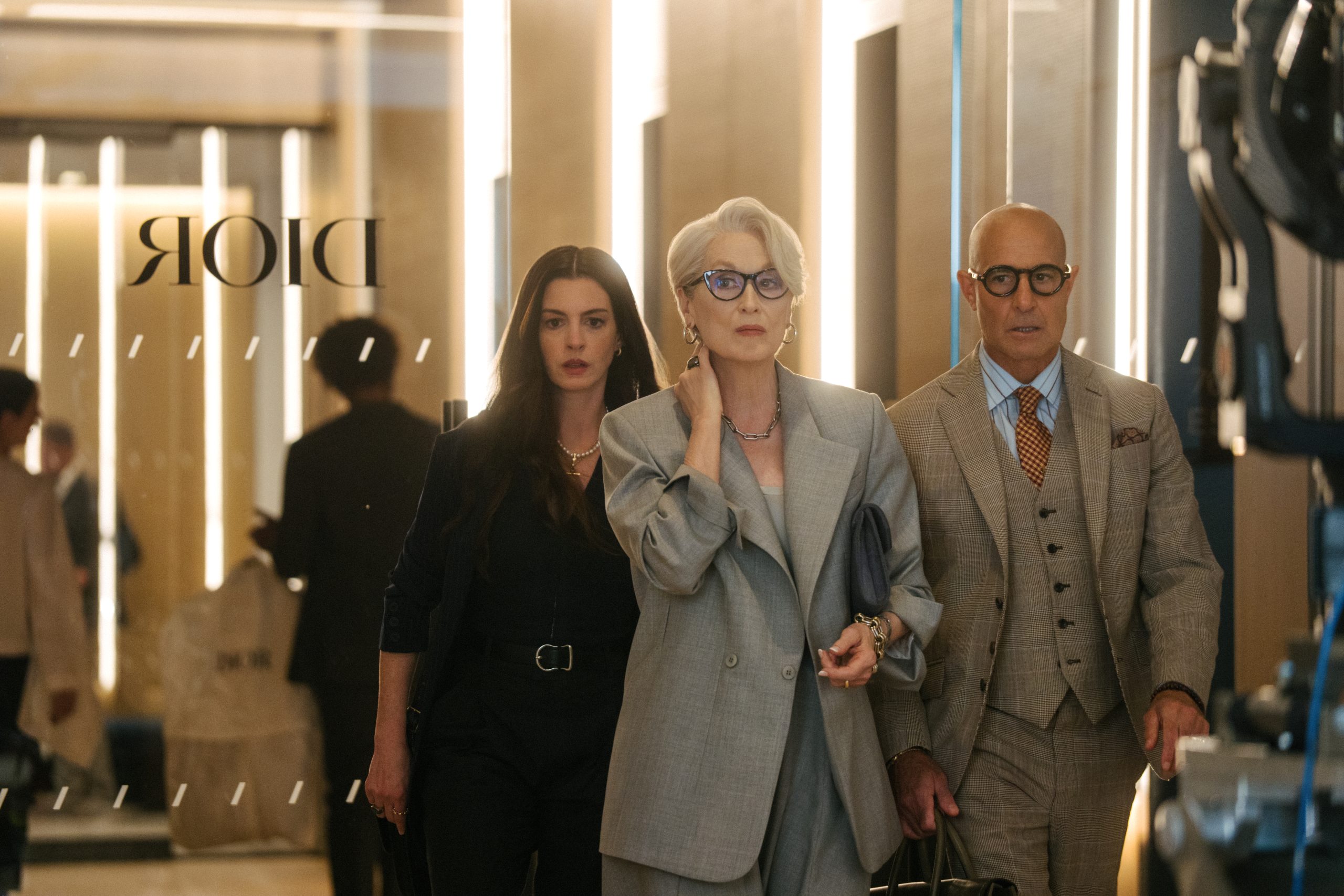
There’s a particular kind of dread that sets in when a trailer makes you uneasy but you can’t quite articulate why. As someone who considers the original Devil Wears Prada one of the most rewatchable and most iconic films of the 2000s, I felt it immediately watching the first footage from the sequel, The Devil Wears Prada 2. Something was off. Twenty years ago, Meryl Streep conjured one of cinema’s most compelling screen presences without raising her voice once. Miranda Priestly wasn’t a villain so much as a force: ruthless, exacting, and completely honest about what she was and what she expected. You knew where you stood with her, even if where you stood was nowhere good. In this sequel, the whisper is still there. The menace, largely, is not.
Let’s be fair to what the film is trying to do. The story follows Miranda as she navigates a rapidly shifting media landscape, with Andy Sachs returning to Runway, and the two reconnecting with Emily, now a powerful figure at a luxury brand whose financial backing could determine the magazine’s survival. It’s a reasonable enough premise, and there’s genuine affection visible in the way the cast slips back into these roles. You can feel it in the small moments, a glance, a pause, a line reading that lands just right. The fashion, it should be said, is still magnificent: considered, witty, and occasionally so good it stops the film dead in the best possible way. The film loves these characters and it loves this world. The trouble is that loving them and knowing what to do with them twenty years later are different things.
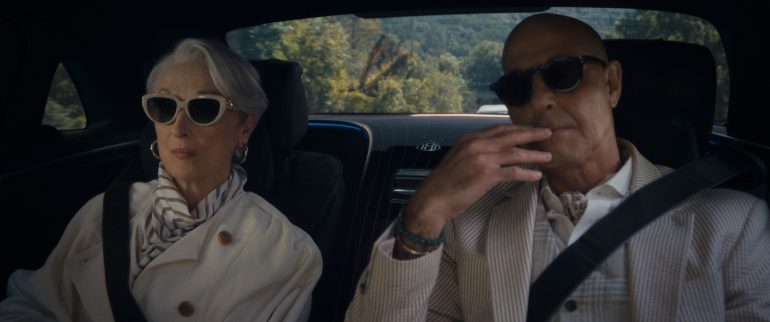
The execution is where it starts to unravel. Streep’s minimalist delivery remains a pleasure, and the script’s jabs at the current dire state of media make a play for relevance, but it’s hard to see this gaining the enduring comfort-watch status of its predecessor. The film wants to soften Miranda for contemporary audiences, and in doing so it creates a character who contradicts herself at almost every turn. People around her insist she’s just as ruthless as she’s always been. The film doesn’t show us that. This Miranda says please and thank you. She acquiesces to other people’s demands without pushback. That’s not the woman whose opinion was the only one that mattered in any room she walked into. Giving Miranda more depth may soften her just a tad, but it also forces you to recalibrate your entire relationship with the character. The closest we get to the original Miranda is a car ride with Anne Hathaway’s Andy, and for a few brief minutes the film remembers what it used to be. It’s the best scene in the movie, and it’s over too quickly.
Andy’s character development is also baffling in ways the script doesn’t seem to notice. There’s a version of Andy at forty-something that would’ve been fascinating to spend time with, a woman who chose ambition, paid for it, and figured out what she actually wanted on the other side of that. Instead we get verbal tics and attitudinal adjustments that feel less like the accumulation of twenty years of living and more like a writer’s shorthand for signalling that time has passed. She calls people “babe” now. It’s the kind of detail that’s meant to do a great deal of work and ends up doing very little.
Emily Blunt’s Emily Charlton presents a more complex problem, and if I’m honest, a more interesting one. Once a long-suffering underling held together by willpower and the right shoes, her character has evolved into a figure draped in designer labels, partnered with a billionaire tech mogul in what amounts to a fairly pointed parody of a certain real-world couple. The satirical intent is clear enough, and Blunt brings genuine commitment to it. But the arc requires a leap of faith the script hasn’t earned. The Emily of the original was defined by her hunger, her brittle professionalism, her barely concealed terror of failure. To get from there to here requires a journey the film gestures at rather than shows. There’s a genuinely compelling character evolution buried somewhere in this storyline. This film doesn’t quite find it.
Stanley Tucci’s Nigel is the exception, and watching him you’re reminded of what this franchise does best when it’s firing. He’s warm, wry, and still somehow the moral centre of everything, the person in every scene who seems to understand exactly what’s happening and has quietly made his peace with it. He’s been given less to do than he deserves, which feels like the film’s most avoidable mistake. When the film does allow itself to be genuinely funny, it earns it. There are scenes here that land with real wit and timing, moments where the cast’s comic instincts take over and the film briefly stops worrying about its own cultural significance long enough to just be enjoyable. Those moments are a reminder of how good this could’ve been with a slightly looser hand on the wheel.
The celebrity and influencer cameos are harder to defend. They’re present, they’re plentiful, and they add almost nothing beyond the momentary recognition hit that will play well on social media and vanish just as quickly. There’s also the matter of the marketing campaign, which sent its stars around the world in a promotional exercise so extensive and relentless that it began to feel less like the promotion of a film and more like a live demonstration of the influencer logic the film claims to be critiquing. The sense that this is a product as much as a film was already present before a single frame had been publicly screened, and that sense doesn’t dissipate once you’re sitting in the dark watching it. It’s symptomatic of a film that’s trying very hard to manufacture the kind of cultural hype and relevance that the original generated effortlessly, without quite seeming to understand that you can’t engineer a zeitgeist. The first Devil Wears Prada didn’t set out to become iconic. It just did. This sequel is, in some ways, a victim of that stature, forever measured against something it had no hand in creating and can’t hope to replicate simply by trying harder.
There’s a moment early in the film, before Andy has even returned to Runway, when she delivers a speech about what’s happened to the media industry she once entered with such anxious idealism. The corporate repackaging, the algorithmic flattening, the slow replacement of craft with content. It’s a good speech, delivered well, and it lands with the particular sting of something true. Then it cuts to a lavish Runway red carpet event, and the contrast is entirely intentional. Andy has just spoken about hardworking people losing their jobs to corporate greed, and here is Runway, still flaunting its excess, still performing its own importance. But the shine has dulled slightly. Miranda’s once flawless editorial judgement, the very thing that made Runway untouchable, has taken a hit after the magazine published a piece containing factual errors about a fast fashion brand with genuinely abhorrent working conditions. It’s a neat and pointed piece of storytelling, and it quietly sets up everything that follows.
The central theme, that traditional media is being displaced by influencer culture, by shrinking budgets, by AI eating through entire industries, is genuinely timely. There’s also a quieter undercurrent running beneath it about the death of craftsmanship, about what it costs to spend years learning something and becoming genuinely excellent at it, only to find that the culture has moved on to valuing speed over mastery and volume over craft. Anyone who’s watched a newsroom shrink, or seen a skilled colleague made redundant by an algorithm, will feel that particular ache. It’s a theme that South Africa’s own newsrooms are navigating in real time. The film deserved to sit with these ideas longer than it does.
The pacing is uneven, and several key character moments are underbaked to the point of frustration. The references to the original are also where the film is at its most self-conscious. Rather than trusting the audience to carry their own memories into the cinema, it keeps nudging them, callbacks and visual echoes and lines that exist purely to trigger recognition rather than to earn a moment of their own. It’s the cinematic equivalent of someone telling you a joke and then explaining why it’s funny. The original didn’t need to remind you it was iconic. It just was. What the film doesn’t seem to notice is that it’s asking the same questions about itself that it’s asking about Runway. How much do you change to stay relevant? What do you owe the thing you used to be? It doesn’t have especially convincing answers to either.
And yet. For good long stretches, it genuinely feels like old times. The cast’s easy chemistry carries scenes that the script doesn’t quite deserve, and there are moments, particularly between Streep and Hathaway, that remind you why these characters burrowed so deeply into the culture in the first place. That warmth is real, and it counts for something.
Worth watching? Yes, without question. Worth the cinema? Only if being part of the opening weekend conversation matters to you. The overstuffed global marketing tour that preceded this release inflated expectations the film can’t quite meet, which is a shame because on its own quieter terms it has more going for it than the discourse around it suggests. Watch it at home, with the volume up for Streep’s line readings, and let yourself enjoy it for what it is rather than mourn what it could’ve been. The original Miranda would’ve noticed all of this, of course. She wouldn’t have mentioned it. She’d have just looked at you, and you’d have known.